Birds
-
Final fledge, and other neighborhood hawks
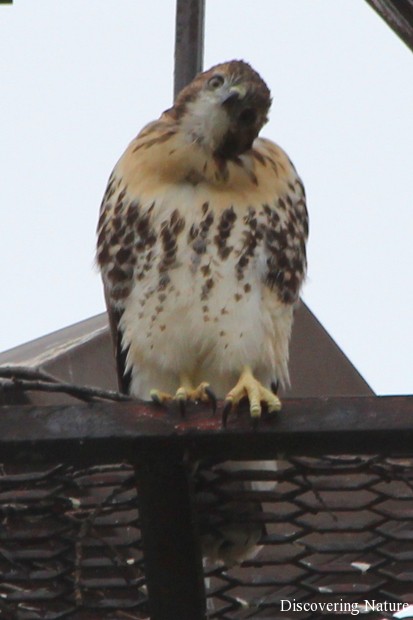
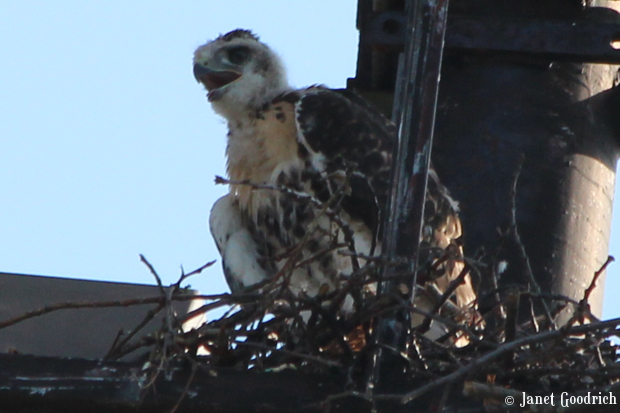
Chick #3 a few hours before fledging The girls and I went to Cornell yesterday morning with the awareness that it would probably be fledge day for the final eyass. As it turned out, the chick did fledge, but not till later in the day. It was chilly and overcast during the two hours we waited at the nest site, and though we did see all three chicks, there wasn’t a lot going on.
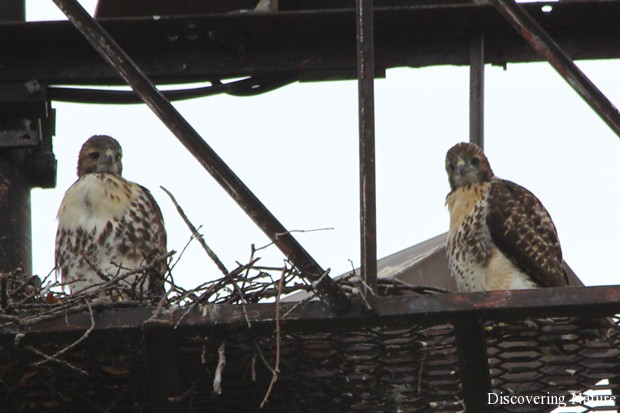
“Look, Sis — it’s the two-leggeds again.” 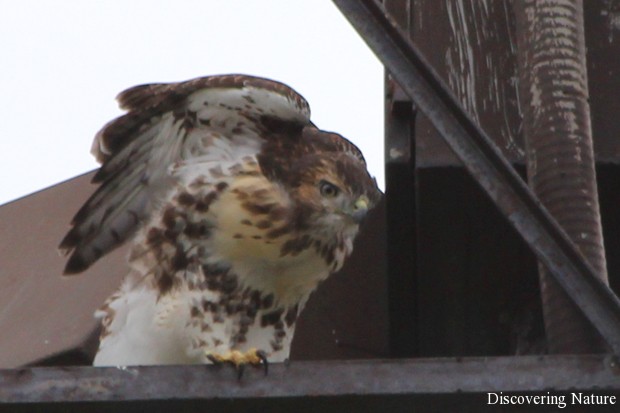
Imagining flight… 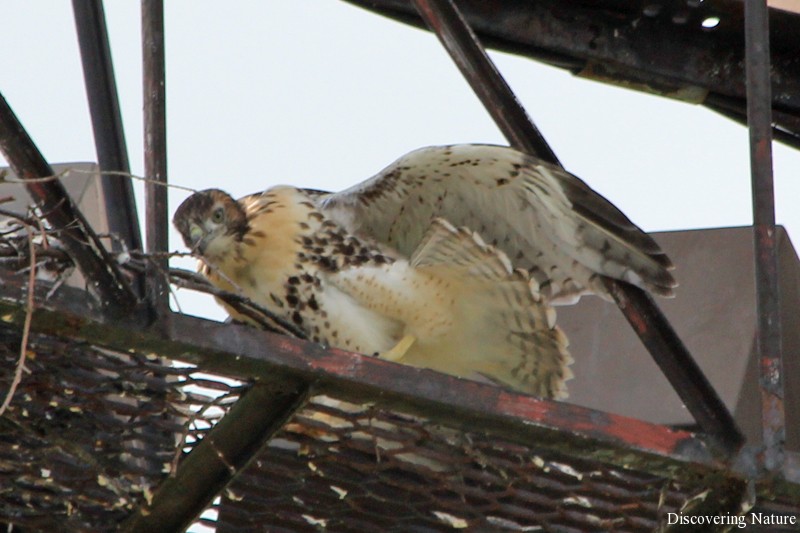
Big stretch For a tenth of what my parking ticket cost last week, I purchased a two-hour visitor permit, and during that time the girls and I enjoyed meeting a few other folks from the hawk chat. Almost everyone who drove, biked, or walked past did so while craning their necks, looking up at the tower. Everyone seemed aware of C3; one young woman who passed by said that she walked by every day on her way to work. “I think about how amazing it would be if the third one jumped off and flew while I was on my way past!” she said.
The chick’s first flight was marvelous, and probably the first intentional fledge of the three. The first two appeared to fledge by accident, blown from their perches by a breeze, but this one took off like a pro. I wasn’t watching at the time, so I was glad for this video capture.
Best of luck to you, C3!
My parking permit ran out around 1:00, just as the sun was starting to break through. So we ate our bag lunches and then drove around for awhile, visiting some sites of interest to us raptor geeks.
One was a large pheasant farm to the Northeast of the nest. Someone told me that it produces pretty much all of the pheasants in the state, and when it was proposed recently that funding be cut because of the state’s economic woes, there was quite a protest.

One of the three or four fields of pheasants However, it’s not only humans who appreciate the pheasant farm. There were flocks of pigeons, crows, and blackbirds there, pilfering the feed (or so we guessed). One turkey vulture visited, for some mysterious reason. I’ve heard that they frequent natural gas lines because of the smell of decay. I doubt that there were any dead pheasants around; it’s to all appearances a very well-maintained farm. But maybe there was some other explanation.
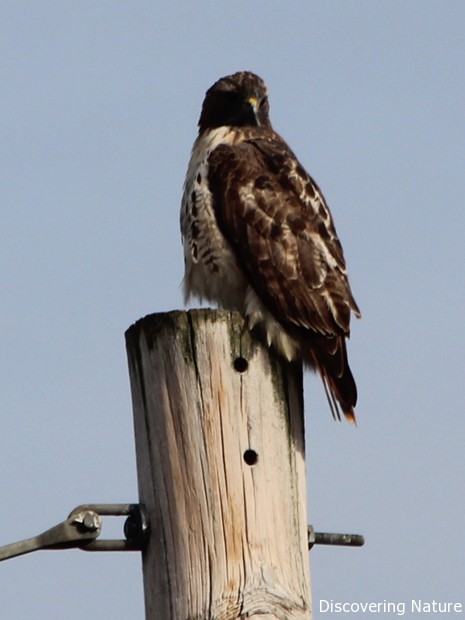
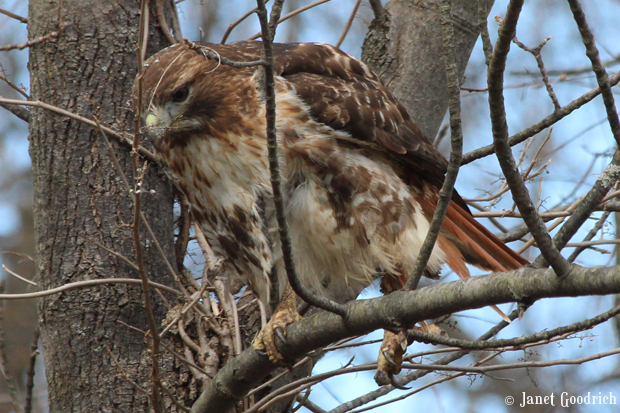
A pheasant would be too heavy for a hawk to carry away in most cases. But the pigeons and, likely, small rodents attracted by the feed must in turn attract hawks, because there was a pair of redtails there.
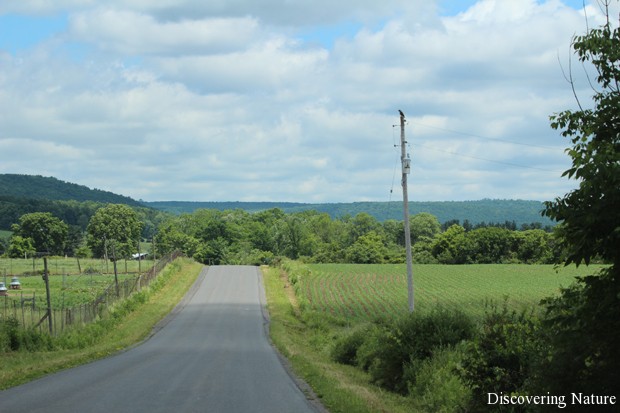
A hawk perches on the right-hand pole, studying the pheasant farm across the road. 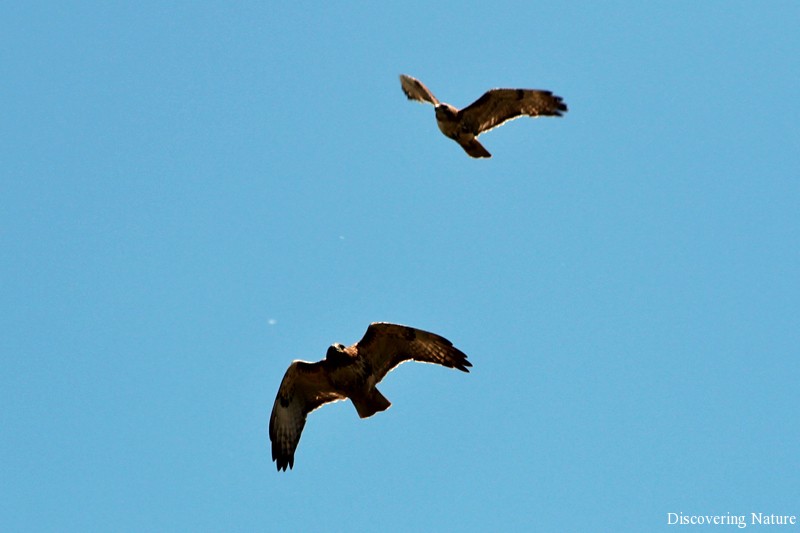
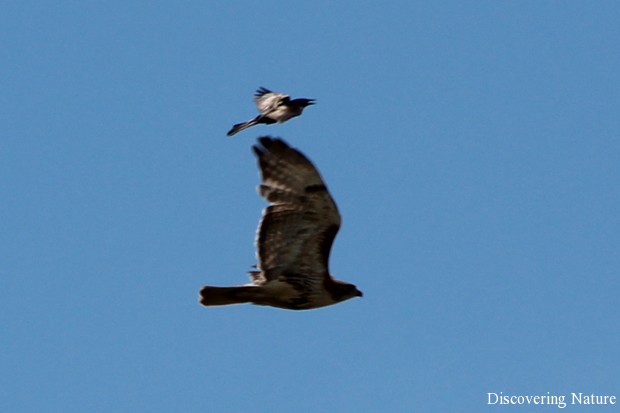
A harrassed hawk Just to the southeast is a long field of utility poles. The southern end of the field is visible sometimes when the cam pans the landscape near the cemetery where Ezra is thought to hunt. Back in April, we observed a pair of redtails actually mating atop one of the poles. They were there again yesterday.
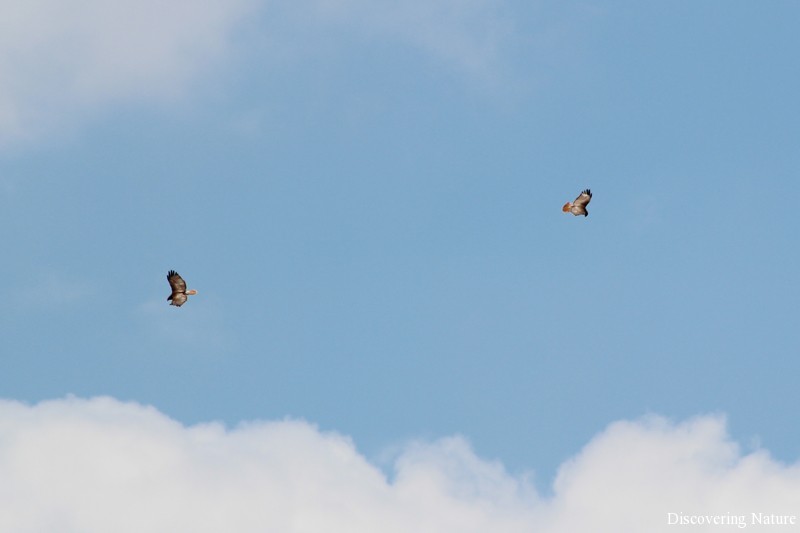
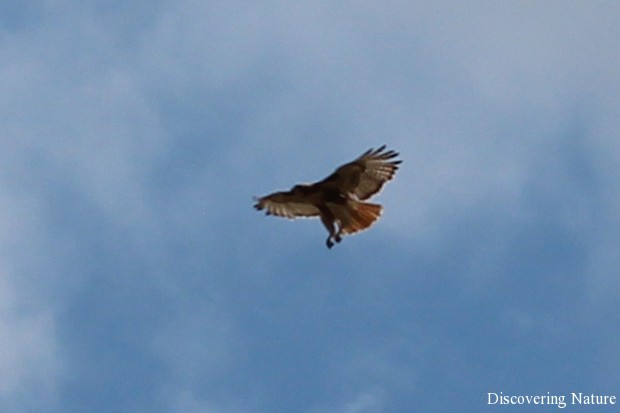
Hawk flying with legs down — a new sight for me 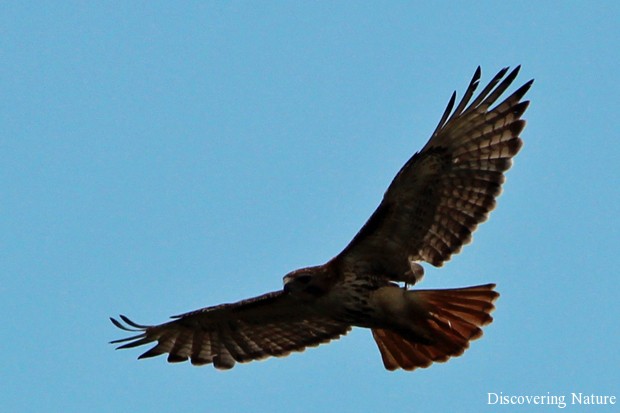
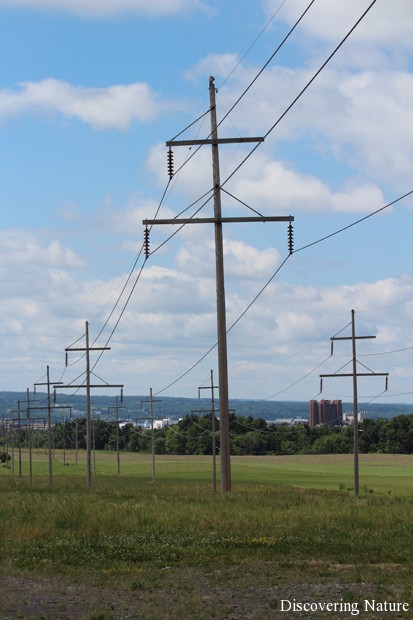
A hawk is perched on the near pole. Bradfield Hall, a tall brick building near the cam hawk nest, is visible in the distance. Was this one pair of hawks, or two? Was the pair monitoring the pheasant farm Red and Ezra? We could only be at one place at a time, but we can say for sure that there is at least one other pair of redtails in Big Red and Ezra’s near neighborhood, and perhaps two. The utility field hawks look enough like Red and Ezra to be twins, but they’re definitely different hawks based on what we observed back in April.
It was interesting to get a slightly expanded sense of the hawk neighborhood. Watching the cams, it’s easy to develop tunnel vision, but the hawks live in a place full of raptor-friendly habitat. I’m sure they all have their invisible but well-defended “property lines” and the place will be full of young hawks learning to fly and hunt this summer.
Probably not everyone is excited about this!

Timmy Tiptoes, posing for me across the street from Red and Ezra’s nest -
Serenity Wood
I took a walk today in a favorite place called the Serenity Wood. It was very hot, and I saw many things as I explored woods and meadows: yellow-throats, house wrens, an eastern towhee, a Baltimore oriole. There were deer tracks, coyote tracks, and raccoon tracks in the mud. Robins and sparrows and yellow warblers and chestnut-sided warblers hopped among the leaves. And there were catbirds — always catbirds.

I heard a brown thrasher at one point, and later on I thought this bird, startled up out of the grass beside the trail, was a thrasher. But it was quiet, and it had a shorter tail. I think it was a wood thrush, nesting in the grass. I was delighted to make her acquaintance!
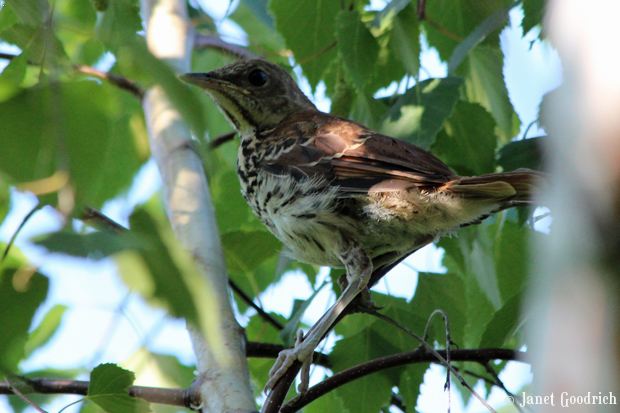
*Edited to add: I’m thinking it may be more likely that this is a hermit thrush, because of the striping on the throat. Very pleased to meet this beautiful songster!
This tiny pearl crescent butterfly was a welcome sight too. Exquisite.

Not everyone is so picturesque, of course. And though the woods were full of noise — squeaking chipmunks, an ovenbird, red-eyed vireos, rustling leaves — some were in a more quiet, meditative mood.

He owes me a smile for not stepping on him as he lay there in the middle of the trail. No gratitude. (It must be confessed: I like toads. As a child I would spend whole afternoons collecting them in coffee cans, then let them all go at the end of the day. I was certain they recognized me as their benefactress.)
I saw the fawn I had the close encounter with last week, too. It might have been a different one, but I prefer to think it’s the same one, developing on schedule. Unbeknownst to me, I was standing right next to it in the trail; it was in the long grass beside me. I didn’t realize it till I gave up on trying to take a picture of the towhee, and took a step. The little fawn thrashed to its feet and disappeared into the brush with a flick of its tail. I was glad… I want it to know enough to run from strange critters like humans.
It was a nice, leisurely walk — perfect outing for a Sunday afternoon.
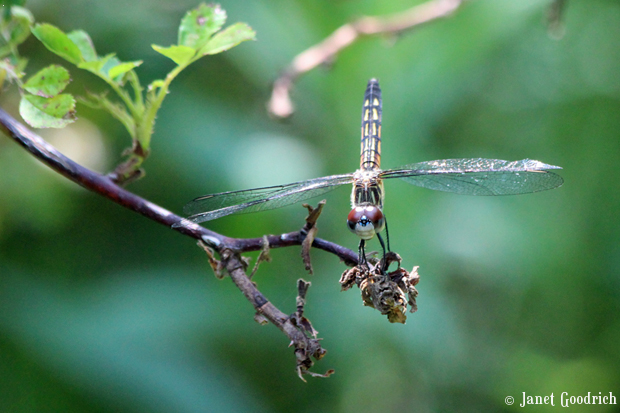
Yellow-striped hunter -
Mighty Mouse
On Tuesday we went to visit the site of a suspected red-bellied woodpecker nest cavity on one of our haunts. I wondered if we might see some nestling activity.
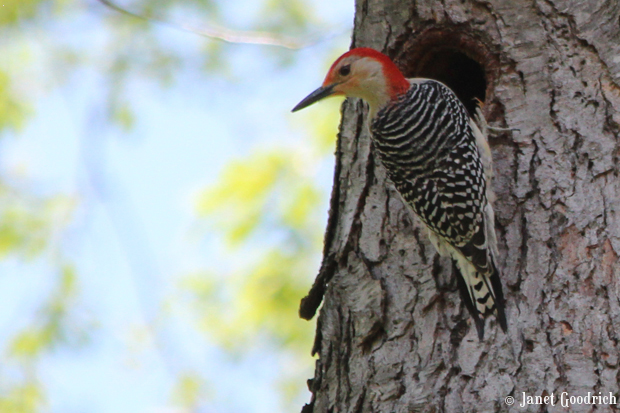
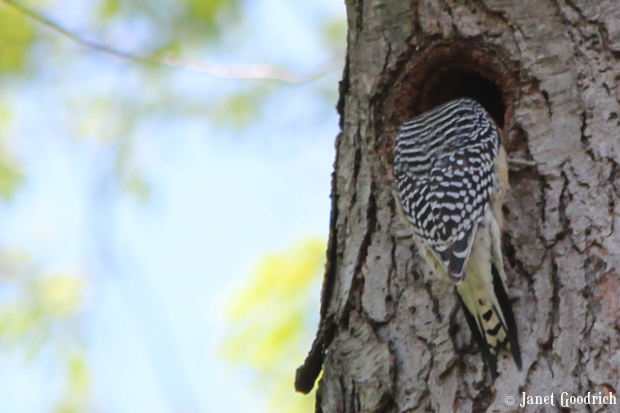
I took these pictures on May 11, and the bird appeared to be feeding young. We hadn’t been able to observe the site again, and I knew that by this time, there was a good chance that any possible woodpecker nestlings had fledged.
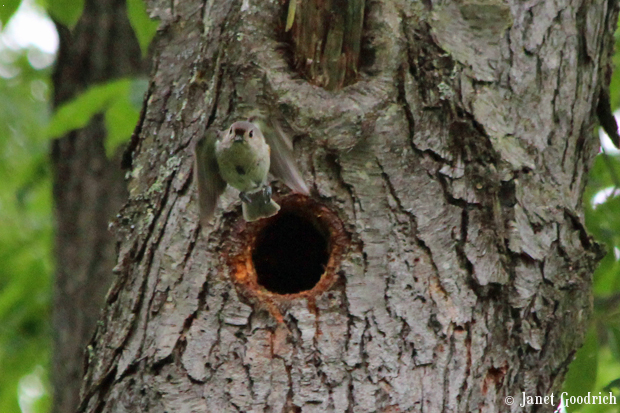
Turned out I was right. We saw nary a woodpecker… but this tufted titmouse came flying briskly out of the woodpecker hole!

I’m not sure if the titmouse is nesting in the woodpecker’s former home, or if it was just foraging for insects in there. We’ll have to check in again soon to see what we can find out.
It’s a brave looking little bird, isn’t it? — Looks like it feels ready for anything.
-
Red’s ledge

I wanted to share a few last photos of our Cornell trip yesterday.
Twice now, when we’ve visited the hawks, Red has spent some time perched on a ledge of the building across the street from the nest. She enjoyed the sun there yesterday before Chick 1 left the nest. Maybe it’s a sauna-type experience for her, surrounded by warm brick.
It’s not necessarily easy to see her there, though — till you step back a bit.
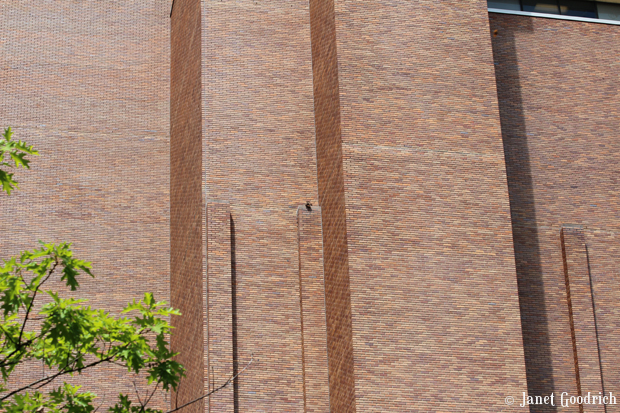
Find that hawk She is such an athlete. I love to see the power when she launches, unfurling all that energy and strength.
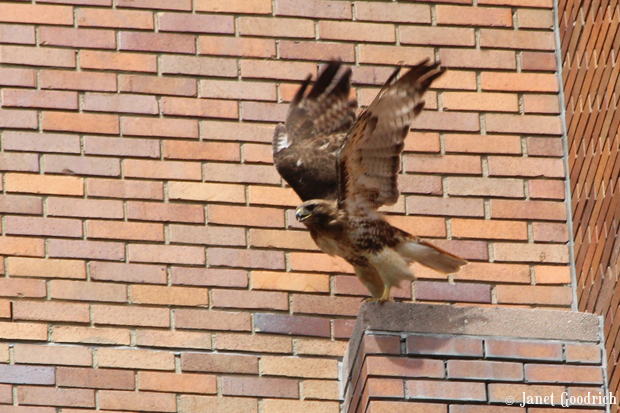
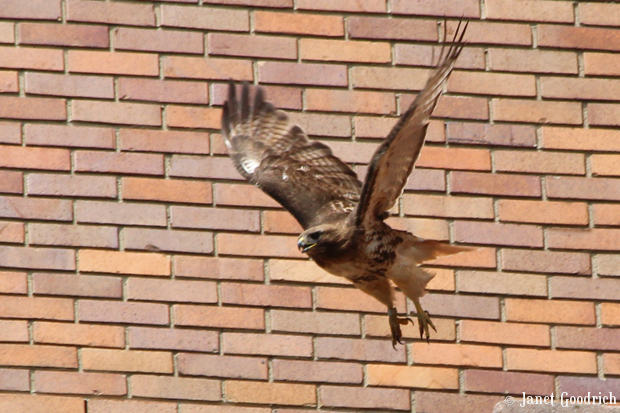
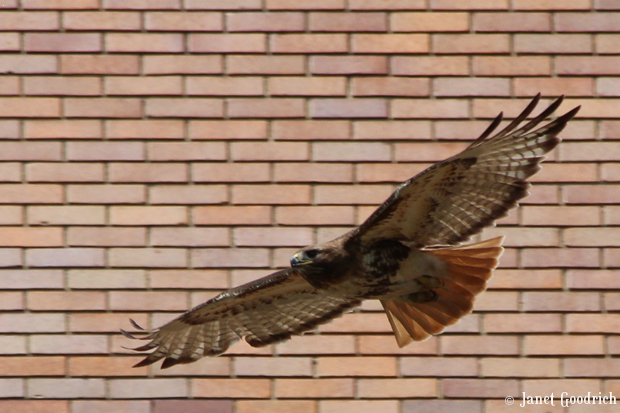
She sets a great example for young birds with much to learn about mastering the air. The hawk chicks watched as they practiced their own feats of daring.

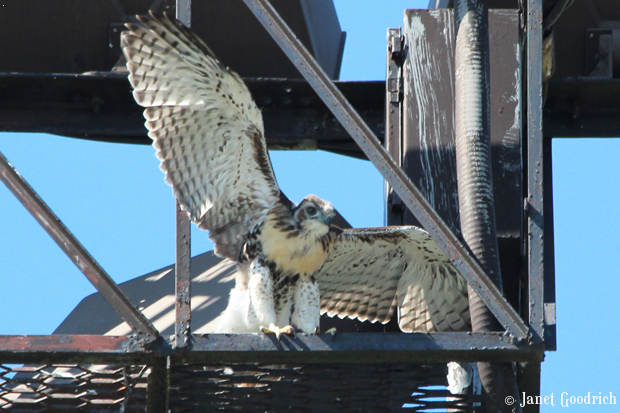
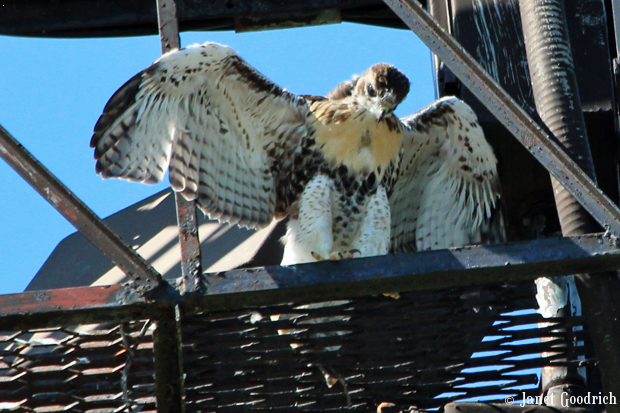
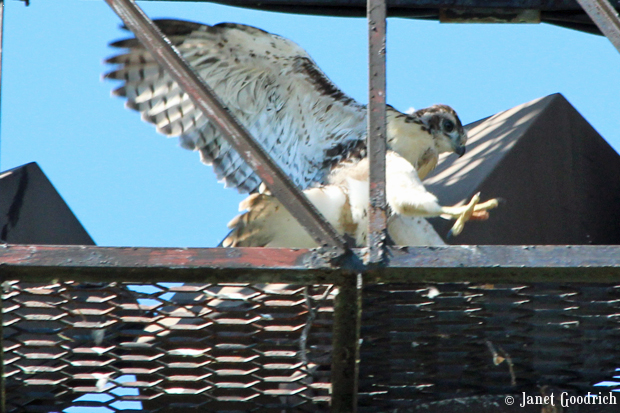
"Let the wild rumpus begin!" While two of the hawklets flapped and considered, the third power-lounged.
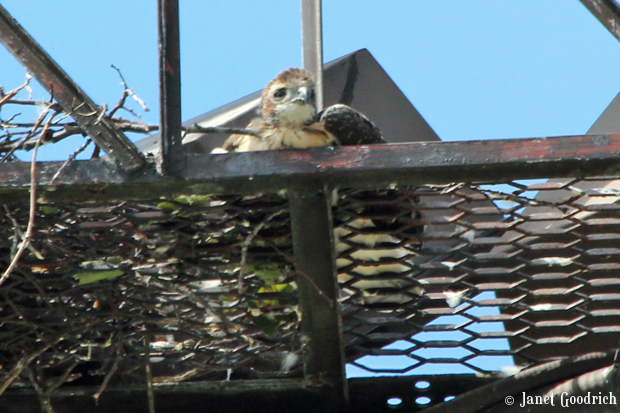

Yesterday as we drove home, I had the bittersweet awareness that we won’t be able to follow these young hawks much longer. I think it was a classic empty-nest feeling. Part of me is relieved that I won’t know all the scrapes they get into. But I’ll always wonder how they fared.
I hope that they find the wits and resourcefulness to rise to every challenge.
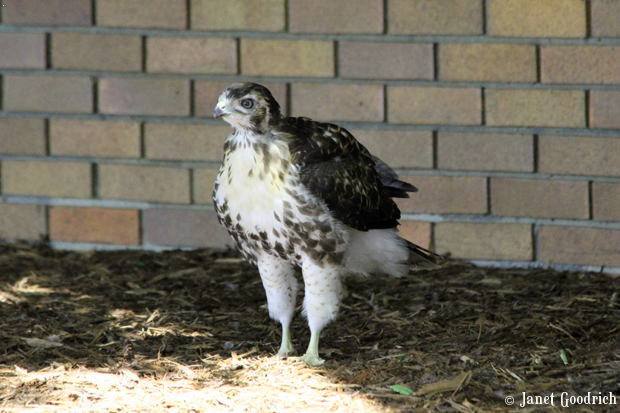
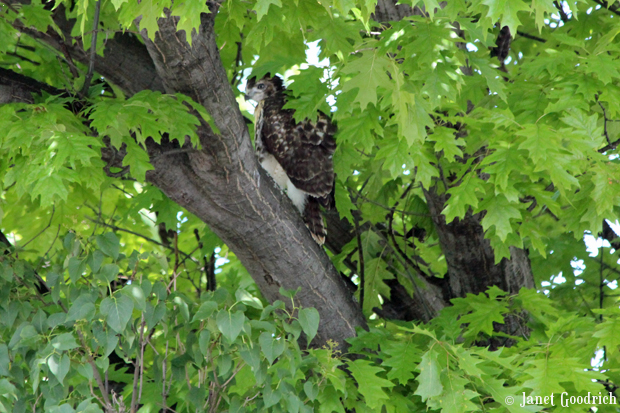
These hawks have parents who show them how it’s done with grace.
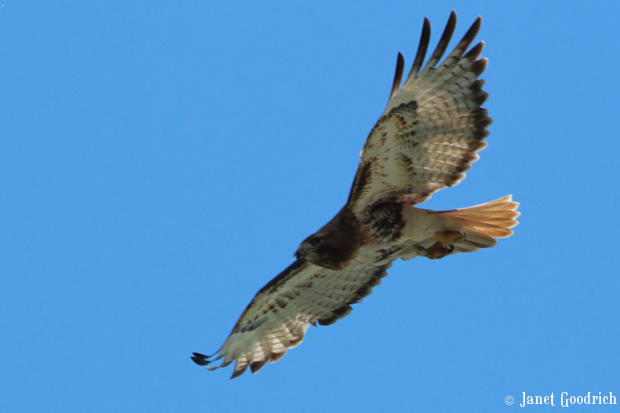
Big Red 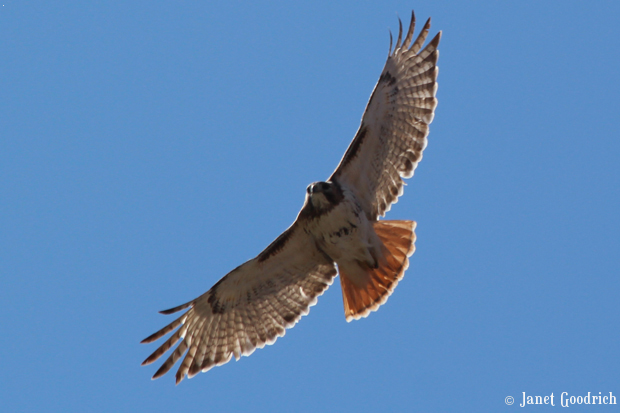
Ezra (photo from April 7) -
Fledge!
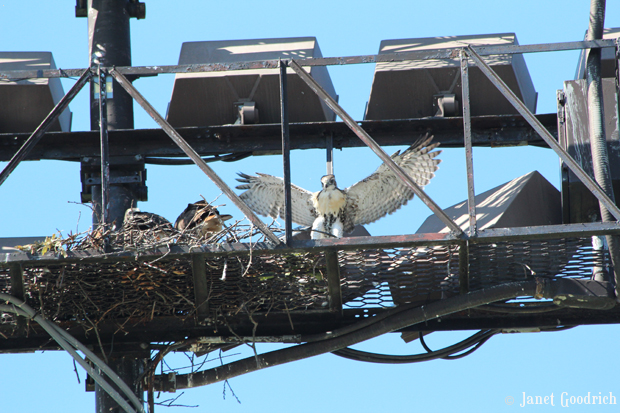
My daughters and I had a feeling today would be the day that one of the Cornell hawks would fledge. So capitalizing on the flexibility of schedule homeschooling gives us, we made the hour’s drive to Ithaca on this glorious sunny morning.
We were watching the cam when the first hawkling made its appearance after a spring snow. We’ve been watching the cam through numerous feeding and flapping sessions. But it was a thrill indeed to be there at the moment of the first fledge!
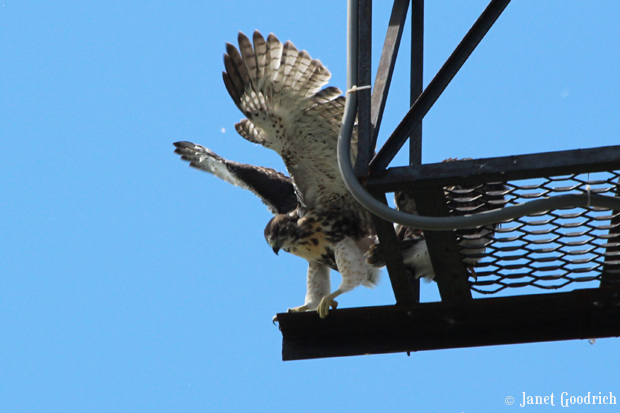
Hawkling on the landing, pumping its wings 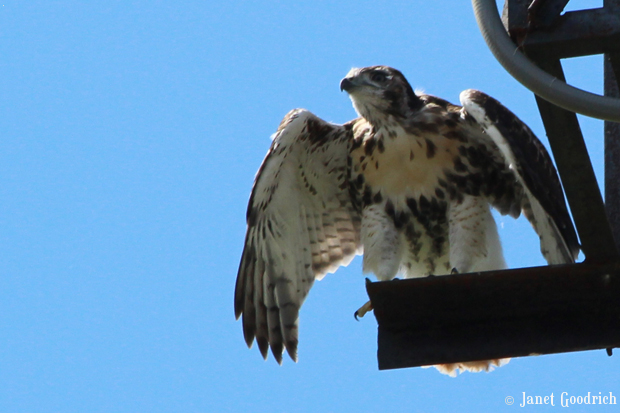
Getting ready to... 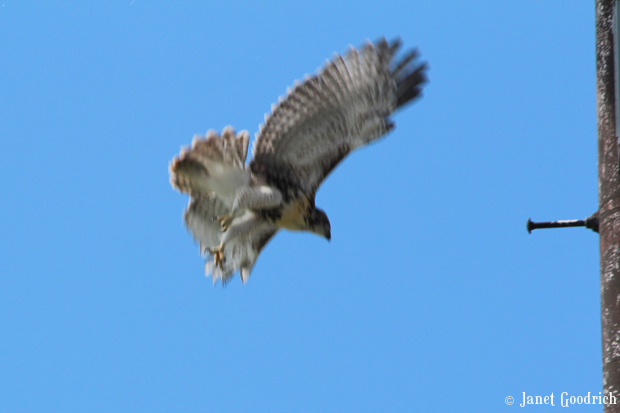
FLY! 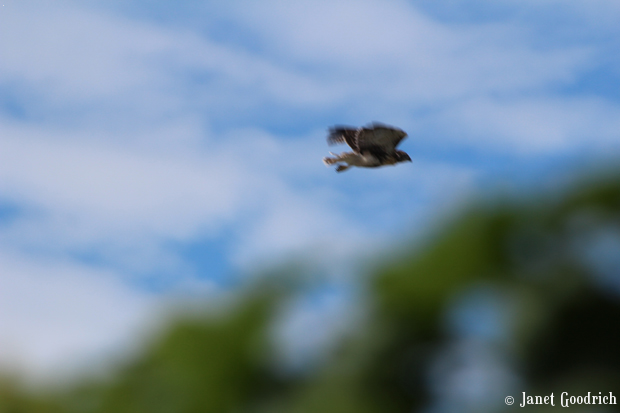
Into the wild blue yonder Where did it go? After an anxious search of nearby trees, a fellow hawk-watcher located the fledgling on the ground at a busy corner of the building across the street.
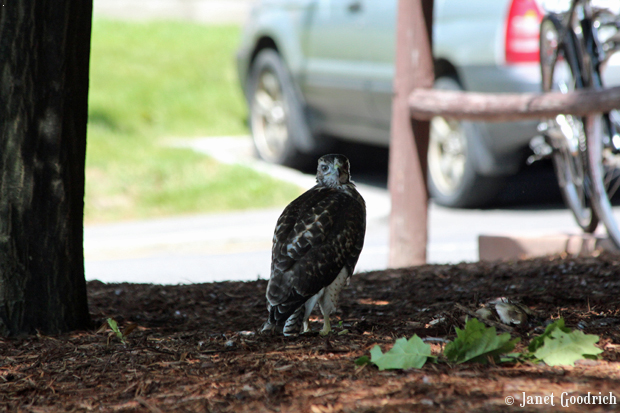
Feeling the ground for the first time 

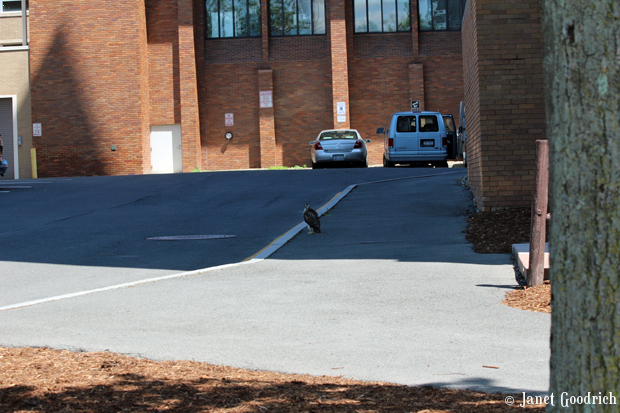
A crowd was congregating, and I was getting nervous. It’s an awfully busy spot for a young hawk. But the crowd served the purpose by alerting drivers to something unusual going on, and any cars that drew near slowed way down.
After perhaps ten minutes on the ground, the young hawk gathered its nerve and flew, screeching, across the street and into a small oak — where it landed upside-down and dangled for a minute. It was a tense moment, but eventually the fledgling righted itself.
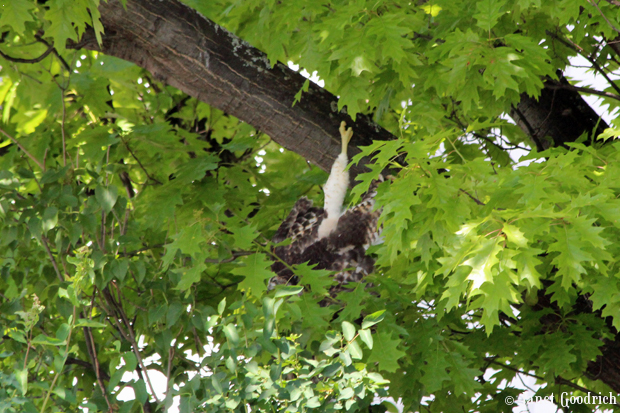
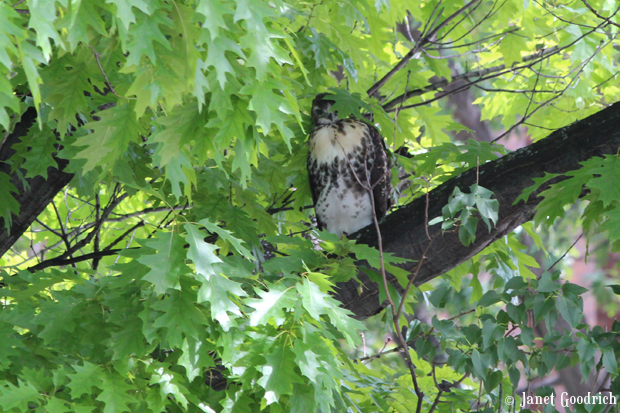
Red had flown over a few times, way up high. She was on a light pole across the fields when the youngster took flight. We left, hoping to give the bird some space to calm down and get reconnected to its parents. Ezra was on a roof nearby, preening, and I’m sure Red wasn’t far away. I got some great flight pics of her; I’ll post them tomorrow, as well as a few more of the chicks in the nest.
We’re grateful to Cornell for this experience! We’re wishing the young hawks well as they move into this next steep learning curve on their way to adulthood.
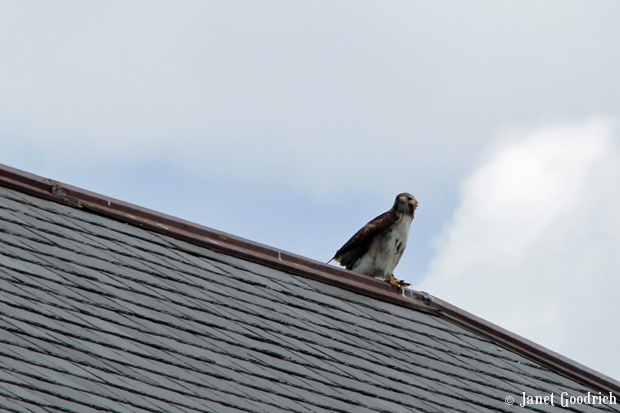
Ezra -
Flyaway
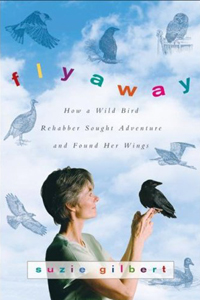 It’s not often that I laugh out loud while reading — laugh till tears trickle down my cheeks and my daughters get out of bed to find out what’s so funny.
It’s only slightly more common that a book moves me deeply enough to call out tears of the other kind. Reading is such an inward act, and the processing happens at such a slow pace, that my emotions seem to absorb and adjust without working their way out to the surface like this. As a Reading Action Figure, I’m normally a silent shape on the couch, eyes on the page, emitting a rustle every now and then when I shift position or turn a page.
A book that makes me both laugh and cry? Rare indeed. But Flyaway: How a Wild Bird Rehabber Sought Adventure and Found Her Wings does. Suzie Gilbert’s writing is lively, honest, and funny enough to prompt me to read sections aloud to my family. “Any new stories?” they would ask when they caught me reading. I could always comply. Her take on the animals she cares for, her insight into their personalities, and her frankness about her own struggles and adventures and passions along the way all make for a fascinating and often comical story.
But there is grief too: birds who don’t survive, exhaustion and difficulty balancing the demands of rehabbing and the rest of life, the perpetual tension of loving creatures enough to nurse them back to health only to release them and perhaps never see them again. Underlying it all is the awareness of the challenges and tragedies birds face, many of them a result of human activity. At times, Gilbert only resolves these tensions in her dreams, beautiful poetic visions of injured creatures flying strong and free. But the majority of the book traces her quest toward workable limits within which to engage in her passion to help wildlife without burning out or shortchanging her family.
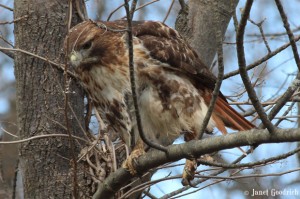 I’ve been interested in the world of bird rehabilitation since seeing this injured hawk at a popular local walking trail back in April. A mature redtail, he could still fly, though he was propping himself up in his perch with a mesh of twigs and when he took off we could see that one leg was dangling. I called a rehabber and was told that until the bird was grounded, he couldn’t pick it up. “But keep looking for it,” he advised. “Keep your eyes open.”
We did. And we saw the hawk twice more, but that was it. What became of it? Did it have a nest somewhere with eggs, or nestlings? It has continued to bother me when I think of the hawk, suffering but unreachable.
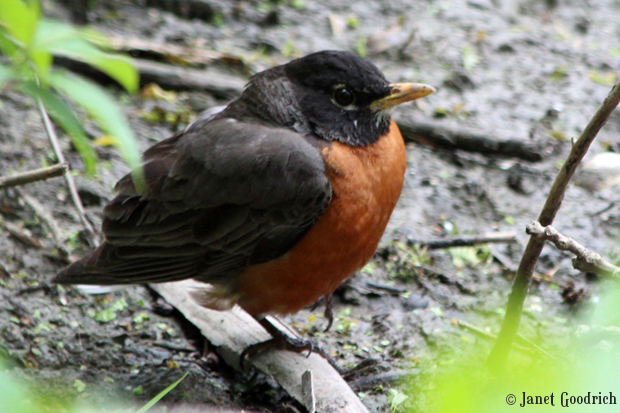
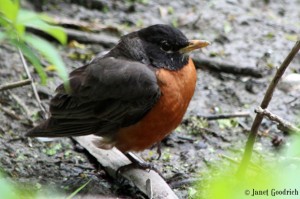 More recently, the girls and I came across a tailless robin and assumed it had lost its tail to a predator. Very likely it was someone’s outdoor cat — a subject Gilbert addresses strongly in Flyaway. I felt I had a kindred spirit as I read, because cats roaming through our yard have always infuriated me. We don’t have a cat, and don’t want one in our yard, prowling for birds and chipmunks. If you are a cat-lover, I support you wholeheartedly in it — as long as you keep your cat on your own property, as I do my dog.
But I digress. Back to the robin, about whom we called the same rehabber. He gave us the number of a woman who cares for injured songbirds and advised us to catch it and put it in a warm dark box will we could get it to her. “Throw some worms in there with it,” he recommended. “Good luck.”
We couldn’t catch it. It mustered enough flight power to motor to a willow branch that had broken and was leaning its base against the trunk and its end plunged into the pond a ways out. There the bird hopped unsteadily up to the trunk and out of reach. It had a robin friend (mate?) nearby with whom it discussed us indignantly, and waited us out.
So far, I’m a failure as a bird rescuer. Before reading this book, I felt sure I’d be a failure as a bird rehabber. I still think I would be. The knowledge required, as well as the plain courage and heart, are incredible. There are so many kinds of birds, and so many kinds of injuries. Suzie Gilbert and her network of wildlife rehabilitators are among the most enlightened generalists out there. I have enormous respect for them. And though the idea of joining that community is daunting, the idea of volunteering time and support seems like a possibility.
Suzie Gilbert’s website is here, and the children’s book Hawk Hill, our first introduction to her writing, is here. Both are worth checking out, as is Flyaway, an eloquent story about the perils and rewards of caring for living things.
-
Outdoor Hour Challenge: Pileated Woodpeckers
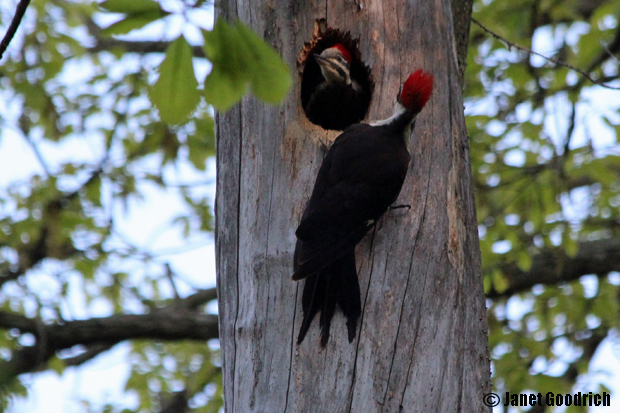
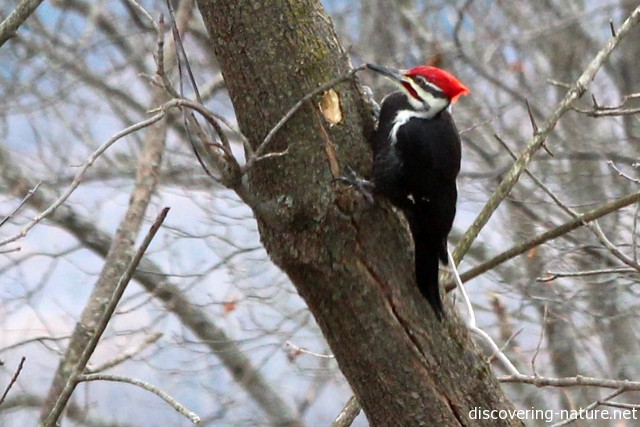
Back in mid-April, my daughters and I stumbled upon a pileated woodpecker nest on one of our walks in the woods. We noticed not one, but two adult birds on a dead tree. The female flew away; the male went inside.
When we went past the spot in subsequent weeks, it seemed like nothing was going on there. But more recently it has become apparent that it was — and is — an active nest after all.

This is the female woodpecker, nearly as large as a crow, preparing to feed. The youngsters are a male (with the red sideburns), and a female (with black sideburns).

The male adult has more red overall — a red crest that reaches all the way down his forehead, and red sideburns.
 I’ve posted some pictures of feeding here, and of a nest exchange here.
The girls and I compiled a list of the most interesting things we’ve learned about pileateds:
- Their tongues coil all the way around their skulls and are long, sharp spears with backward-facing barbs that can be extended and retracted.
- Zygodactylus feet — two toes face forward, two face backward. (A fun new word to pull out from time to time!)
- The nestlings’ solid waste is in small packets that the parent birds carry away. (I witnessed this one morning after a feeding.)
- They are “forest engineers,” excavating cavities that other birds and mammals use for their homes.
- Their call sounds like the wilderness. One of their nicknames among the early settlers was “the laughing woodpecker,” and they do have an wild-sounding laugh — it makes me think of Bertha Rochester in the attic (Jane Eyre).
- A normal clutch is four eggs.
- The parents feed by regurgitating from their crops directly into the eager beaks of their young.
- The male ends up doing the majority of the incubating.
- They have sleeping cavities in trees, and often these holes have escape routes.
- One of their main foods is carpenter ants.
Though my reflex is to think of them as wilderness birds, they have adapted quite well to human “landscape engineering.” I know of three pairs nearby, so I guess this provides some anecdotal evidence. They’re often compared to ivory-billed woodpeckers, which have fared very differently and are now, probably, extinct.
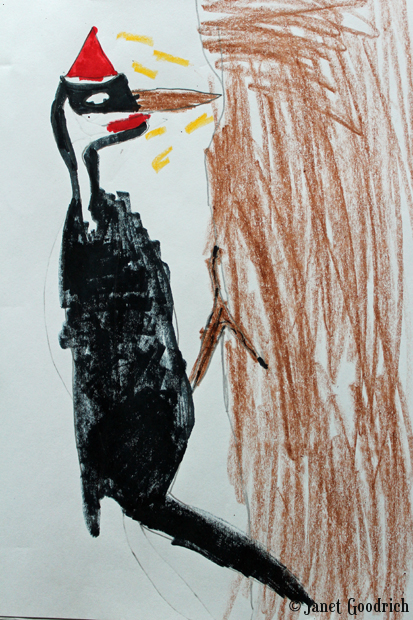
8-year-old's drawing 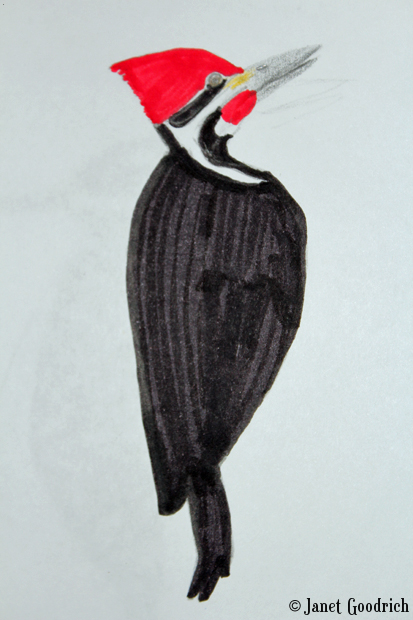
11-year-old's drawing Our favorite resources, in addition to observation, have been this website and several books, of which this one has been the most complete.
I remember hearing a pileated woodpecker while riding my bike a year ago, and working hard to get my first picture of one. It was far away and a little blurry, but I was completely thrilled. I never would have guessed the sights we had in store for us this year. If the trees had been fully leafed-out, we probably wouldn’t have seen this pair that day in April. And though the young make quite a racket begging for food when their parents are near, we might chalk the strange sound up to something else if we didn’t know the source. It’s been a good reminder for us to keep an open mind and alert senses in the woods.
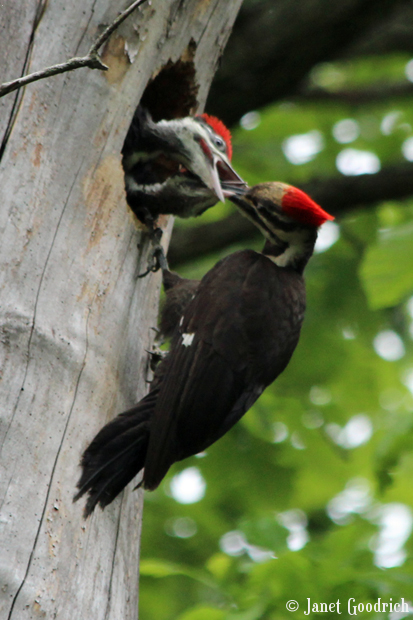
Feeding can be a hazardous occupation... I’m submitting this post to the Outdoor Hour Challenge, a great round-up of nature-study postings each month.
-
Back yard peace, front yard violence
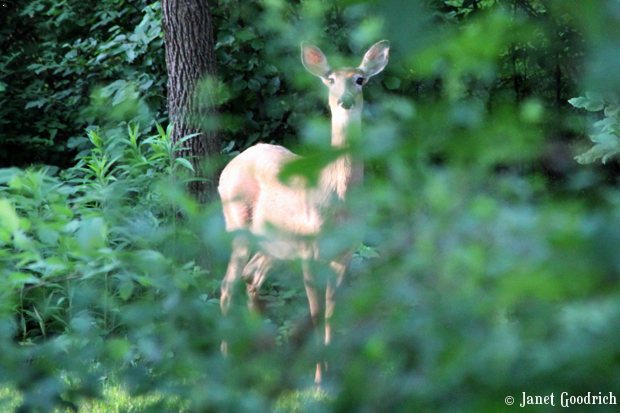
A few mornings ago, I sat in the back yard and enjoyed sights like these.
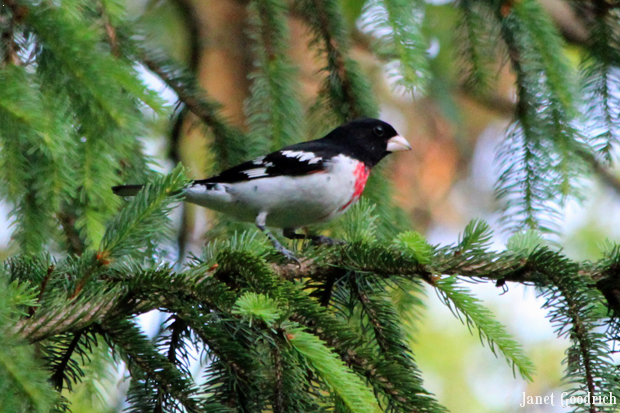
The rose-breasted grosbeak has a habit of singing quietly while he eats at the feeder. There were lots of other birds, and the continual scratch of squirrel claws on bark as the gray squirrels chased one another among the walnut branches. As a purely aesthetic experience, everything seemed very peaceful.
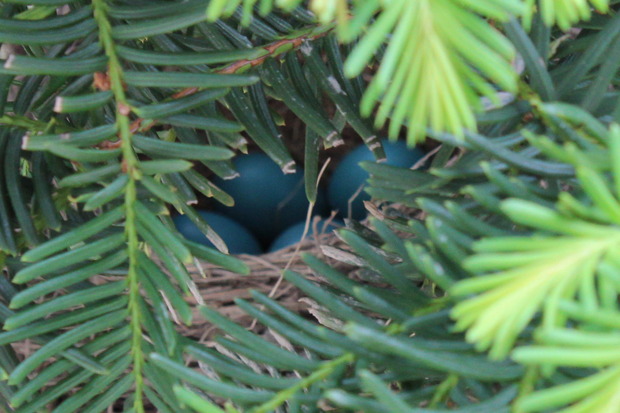
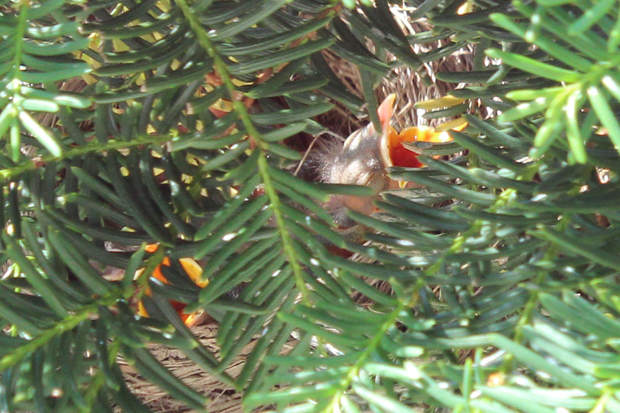
But out front, it was a different story, more revelatory of the underlying peril in all things natural. When I went inside, my youngest greeted me seriously with the announcement that she’d heard “two kerfuffles” involving wing-flapping just outside. When we went to the window to look at the robin’s nest in the shrub just beneath, there was only one nestling left.
By the end of the day, it looked, like this.
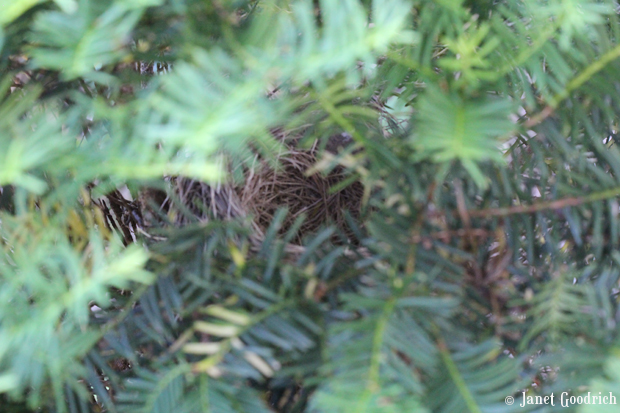
Previously it had looked, through the window, like this.
And then like this.
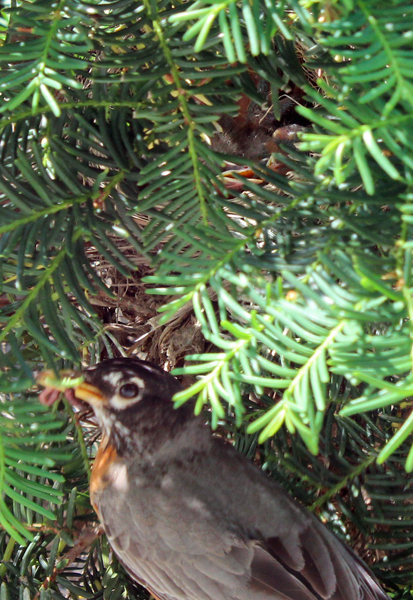
Crows robbed the nest.
I’m reading a book by a wildlife rehabilitator, and in one scene a Cooper’s hawk nabs a newly-released young blue jay she had raised from a nestling. It’s devastating, yet she can’t blame the hawk for needing to eat. “Whose side are you on?” her husband asks her.
“I’m on everyone’s side,” she replies.
I wish I could be that magnanimous. I know crows are incredibly smart. I respect them and respect their need to eat and recognize the irrelevance to them of the human moral code. But anyone who has ever seen nestlings holds that sight in mind as the archetype of utter defenselessness and fragility. They were a week old.
We took the nest out of the bush just in case the robins might try a second clutch in the same location. It’s not a good spot — too exposed. We feared that from the start, and had been careful not to go near the nest or otherwise draw attention to it. Predators are the most attentive nature observers.
It’s also more of a front-row seat than I want to have again any time soon.
The life of the birds, especially of our migratory songbirds, is a series of adventures and of hairbreadth escapes by flood and field. Very few of them probably die a natural death, or even live out half their appointed days… They lead the darkest kind of pioneer life, even in our gardens and orchards, and under the walls of our houses. Not a day or a night passes, from the time the eggs are laid till the young are flown, when the chances are not greatly in favor of the nest being rifled and its contents devoured — by owls, skunks, minks, and coons at night, and by crows, jays, squirrels, weasels, snakes, and rats during the day. Infancy, we say, is hedged about by many perils; but the infancy of birds is cradled and pillowed in peril. (John Burroughs, “The Tragedies of the Nests”)
-
Cornell Hawks: Preparing for Takeoff
We’ve visited the red-tailed hawks at Cornell a couple of times. Yesterday, we saw them again, and I couldn’t help but wonder if it would be our last time. The hawklets may be flying before we get back!
They’re large enough to see easily from the ground now. We got there in the late afternoon, and over the hour or so that we were there, we saw two of them; the third, we saw on the nest cam, was resting out of our sight.
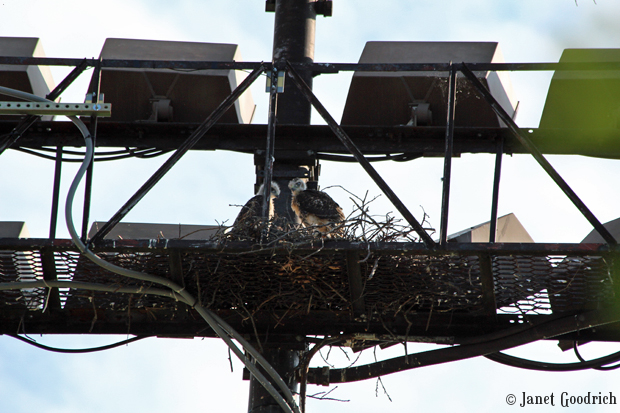
It was a hot one, and they were panting. (So were we!)
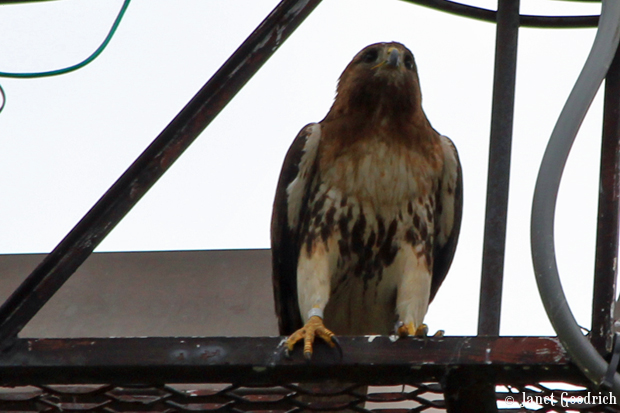
Ezra was on a nearby light pole, keeping an eye on things. Initially we didn’t see Big Red, but after a few minutes we saw her on the nest with the chicks. I’m not sure whether she flew in while our eyes were elsewhere, or whether she just changed position so we could see her better. In any case, she had a mission in mind that involved a short flight.
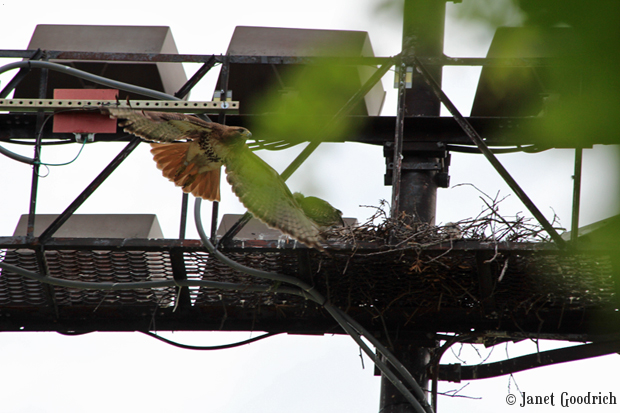
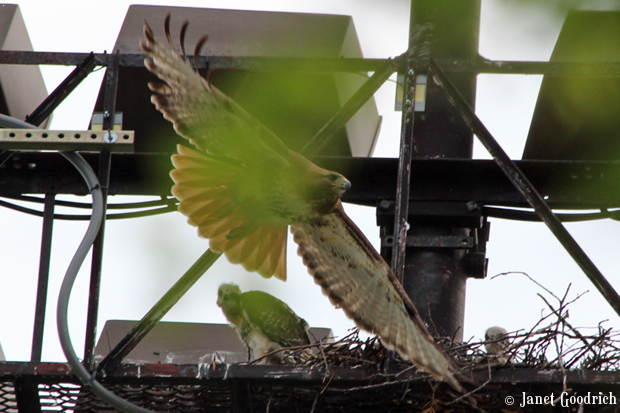
“Someday I’m gonna fly like Mom!” Obviously I was photographing this in a window through the trees. She flew over Older Daughter and me, and into a small tree about 40 feet from where my husband and Younger Daughter sat on the steps of the building across the street! There she proceeded to rip some home improvements from the tree while a chorus of small birds scolded from the neighboring branches.
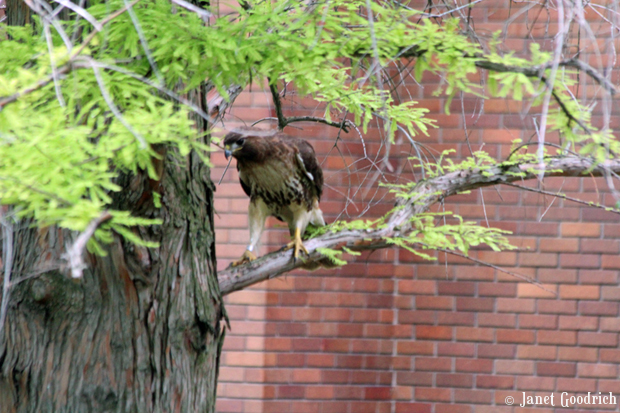
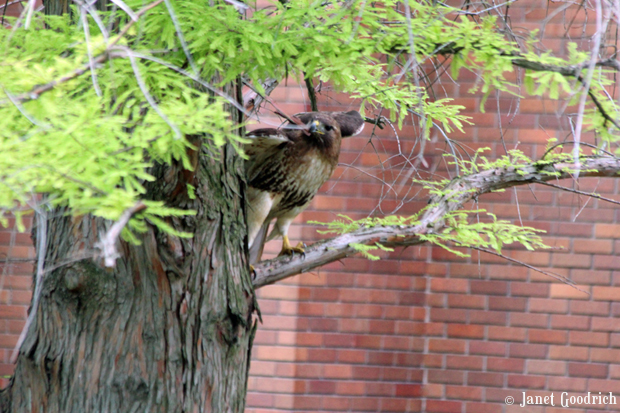
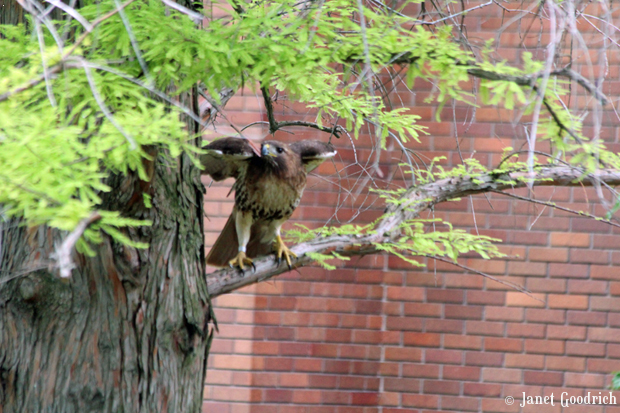
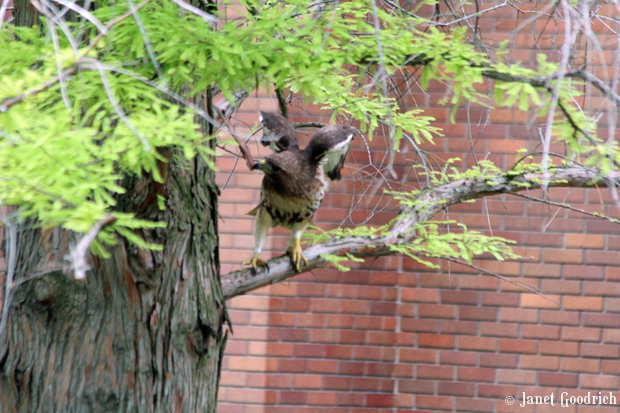
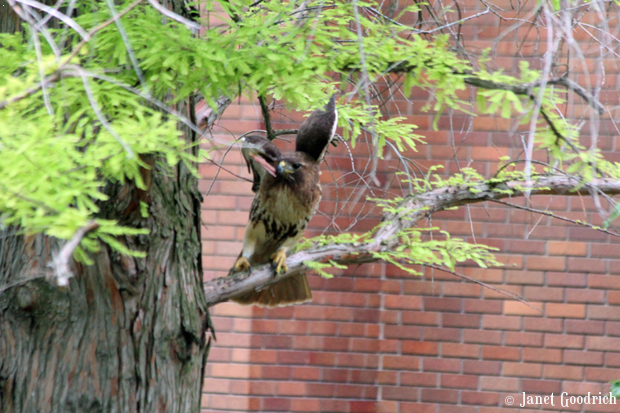
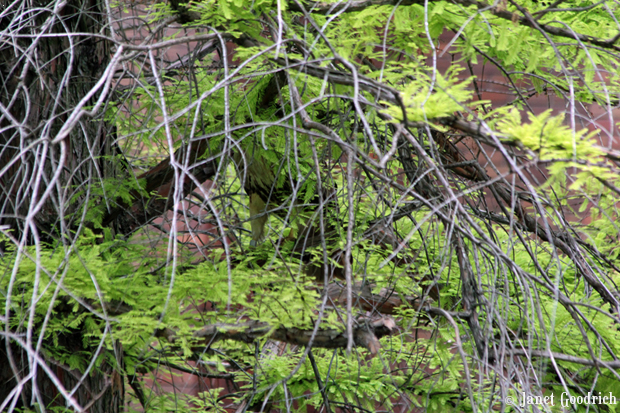
Hidden picture exercise: Find that raptor! She flew back to the nest with her hard-won beakfull of bark. It was hazy, and the light doesn’t bring out her color as much as I’d like, but she is so amazing in flight — beautifully marked and powerful.
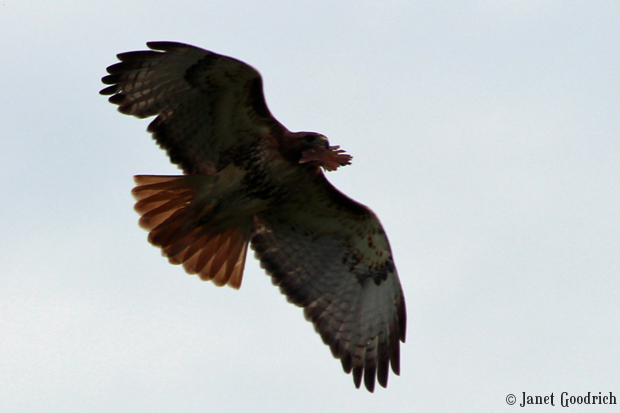


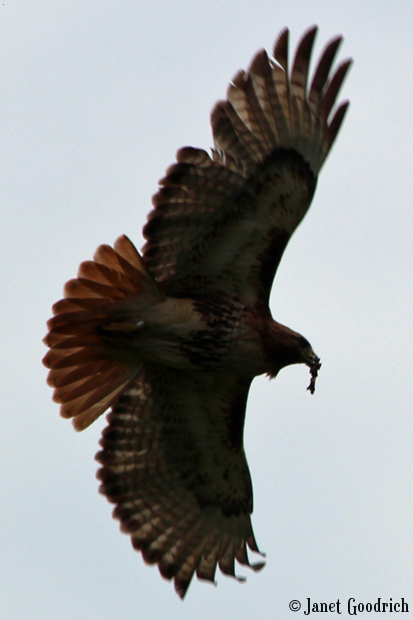
Back at the nest, she deposited the bark and headed off across the neighboring athletic field. She perches farther away than Ezra, who has picked a lightpost on the same field as the nest both times we’ve visited recently. She spent her time eating something atop the pole, circling a little, and landing on a neighboring pole.
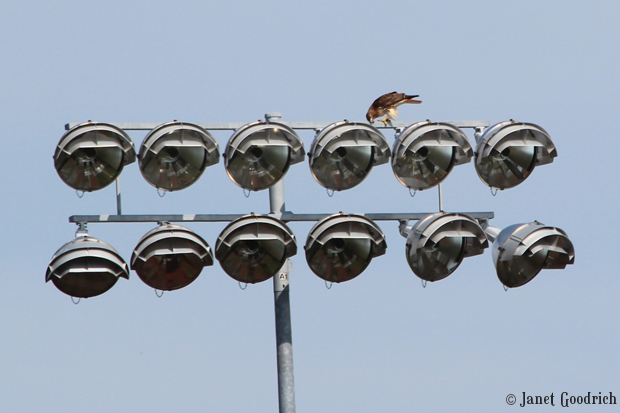
Do red-tails wipe their beaks? This is after she finished eating. 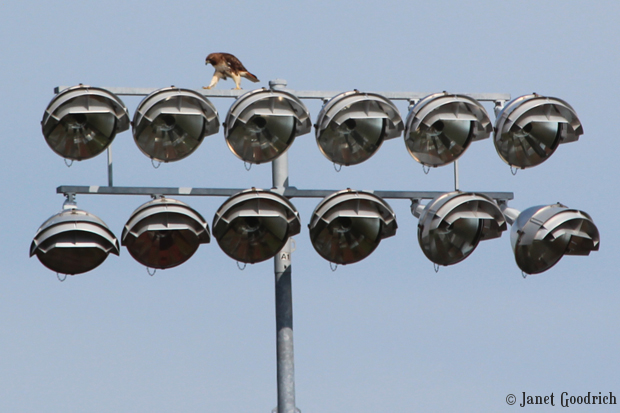
Walking to the other end… Meantime, back at the nest, one of the hawklets practiced flapping.
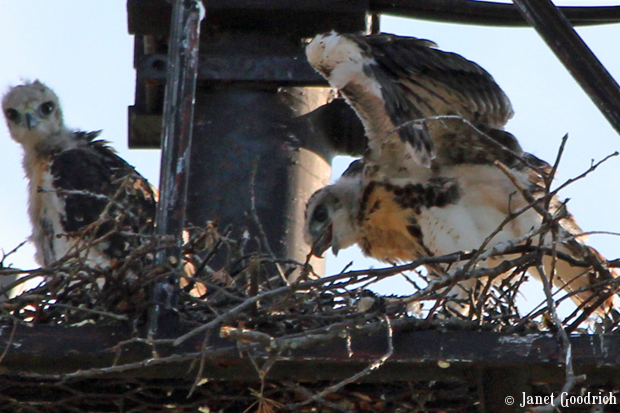
“Can we help you with something?” 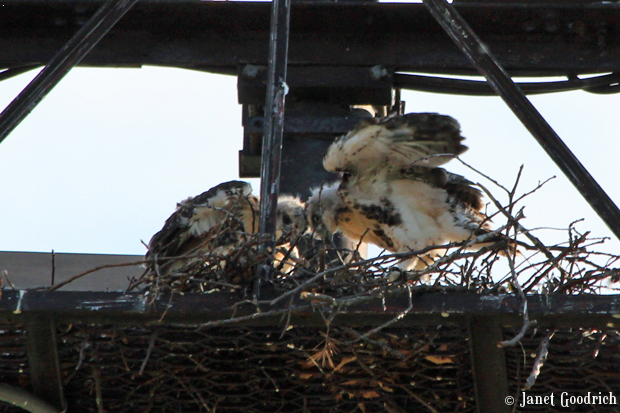
Head bump (or assist) 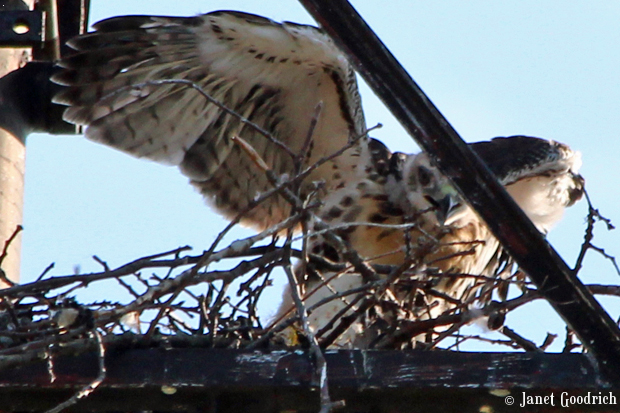
Ezra had taken off shortly after we arrived, and we saw him getting mobbed across the field.
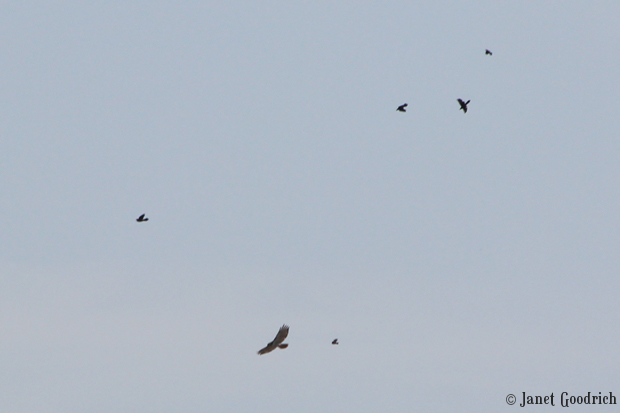
He must have held his own, because he arrived back at a lightpost near the nest.
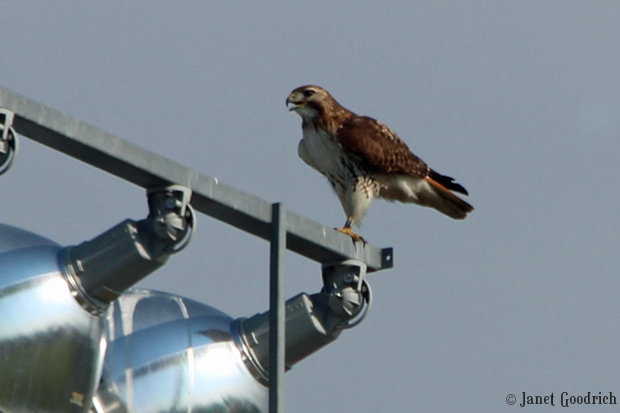

“You with the camera again??” We were about ready to leave, but we waited a few minutes more just in case Red flew back across to the nest. Instead, Ezra launched from his post, and she followed a few moments later. They circled together and went out of sight.
We decided to take their cue and head out ourselves. We’d seen what we came to see. The most incredible experience was seeing Red in that tree, so close, yet so intent on her bark-ripping!
I wrote about our other two hawk visits here (at my other blog) and here.
-
Pileated Woodpecker Feeding
I watched the pileated woodpeckers feeding their young yesterday morning. The sun was just peeking over the horizon, and I was still rustling around in dry leaves trying to find a good spot to settle, when the female showed up.
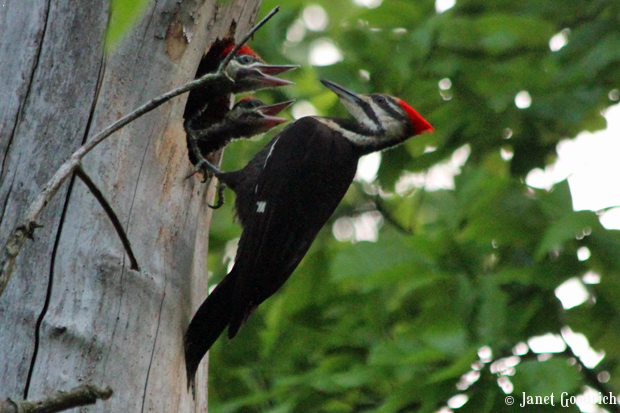

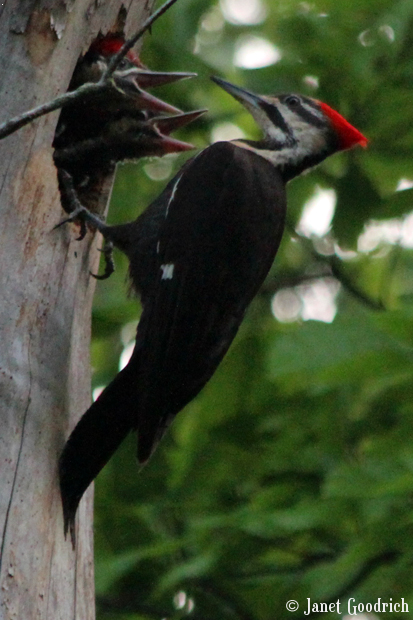
The youngsters made an incredible racket declaring their ravenous appetites, sounding like a combination of rasping hinge and buzzing insect. When she left, they continued calling for food.
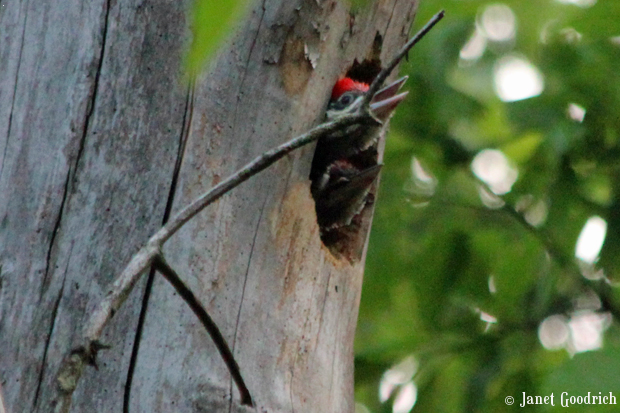
The male came next, regurgitating directly into their beaks with his own formidable tweezers. (He came quickly, before I had time to move so that twig wasn’t in the way…)
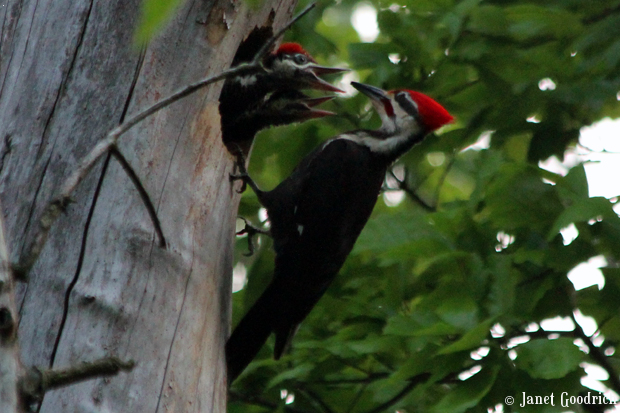
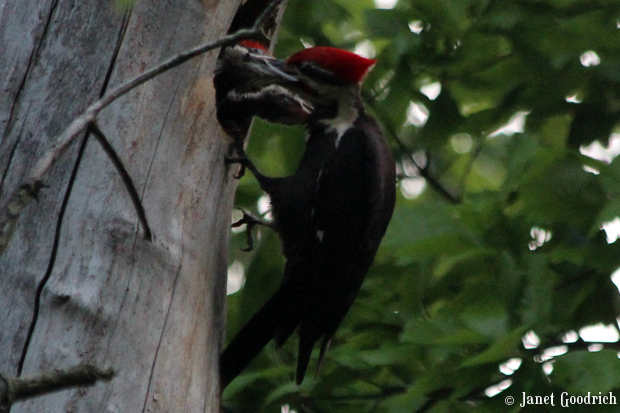

How does he dare thrust in, open-eyed, among those stabbing beaks?
Unlike the female, when he finished the feeding he pushed the young back inside.
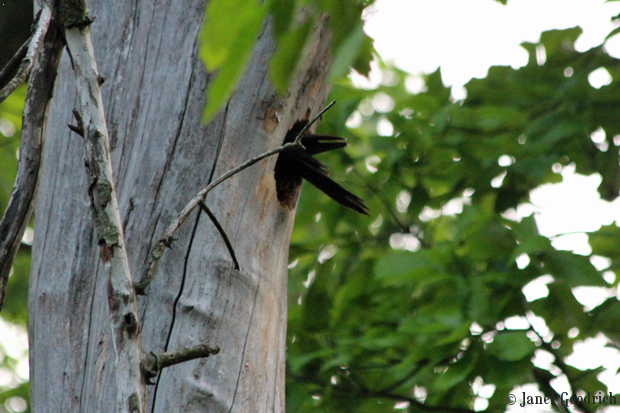
Normal clutch size is four eggs, but I’ve seen only these two young woodpeckers. Maybe there were only two successful eggs. Or maybe a predator has gotten the other two — a snake or an owl, either of which could reach into the cavity. It’s not a possibility I like to think about.
What an amazing experience to get to see the feeding! A year ago I never would have dreamed of it — I would have heard the occasional pileated call and felt a thrill, but the idea of seeing this kind of activity close in wouldn’t even have occurred to me.
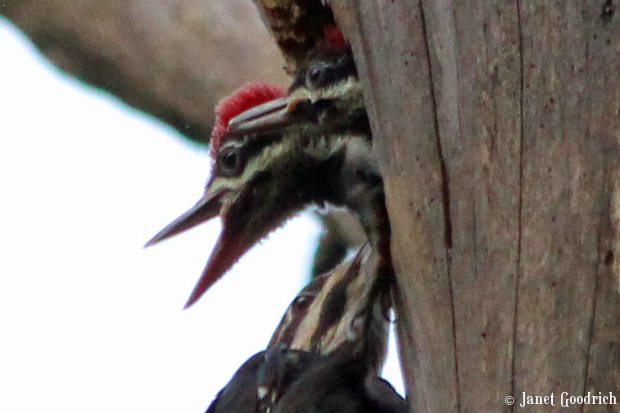
The only disappointment is the graininess of my pictures in the low-light conditions. Maybe I will get another try some sunny blue day, when the sun is higher in the sky. But it’s hard to imagine two such opportunities… and the time is getting short. These young’uns seem like they must be close to fledging.