Birds
-
New-to-me warbler
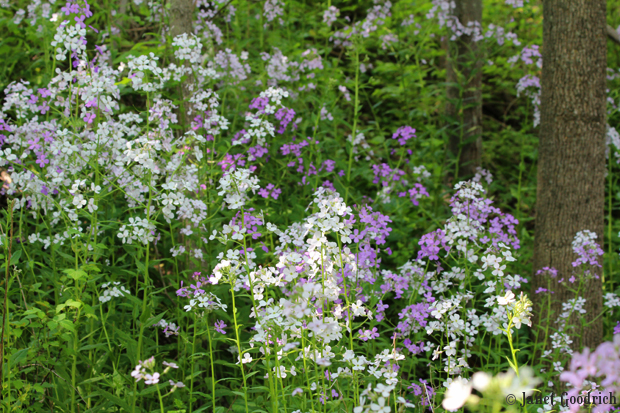
Yesterday morning, I heard what I was sure was a yellow warbler out back in the brush. It turned out not to be a yellow warbler at all — a fact I discovered as I waded through shoulder-high phlox and bushes in my running clothes and bedroom slippers, scanning the trees.
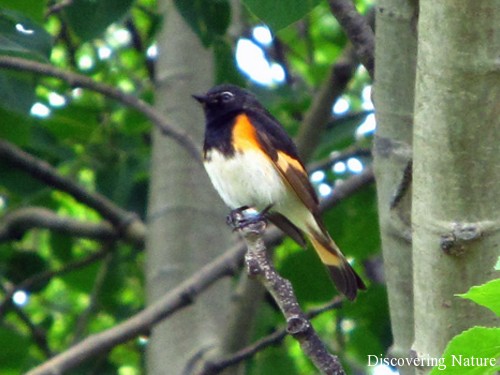
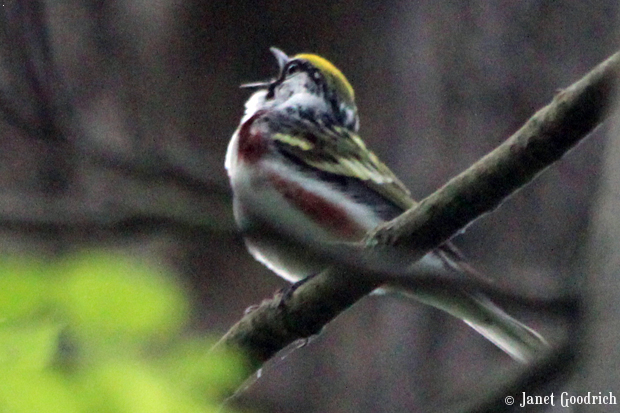
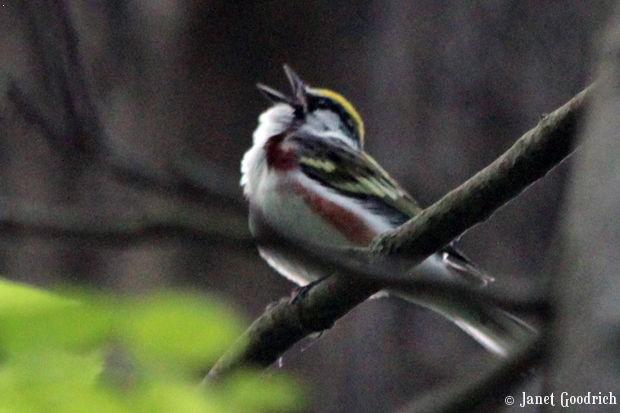
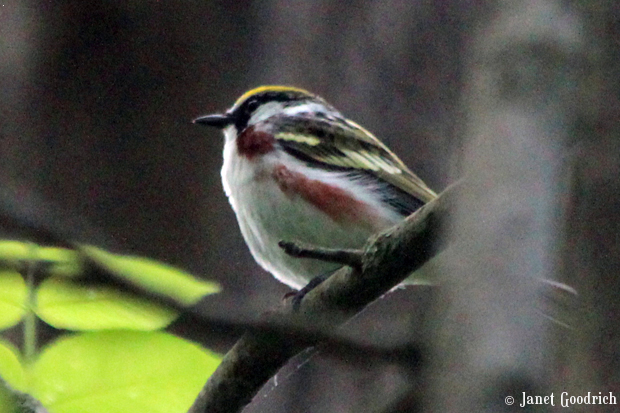
It was this handsome little fellow.
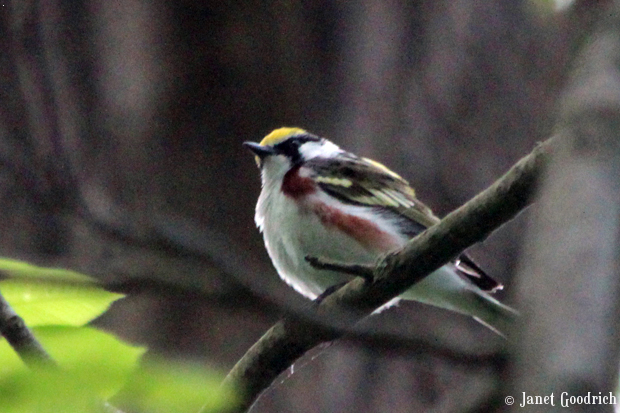
He was impossibly small and impossibly loud — singing his head off.
I heard the garage door go up — the signal that my husband was leaving for work — and crashed back out of the brush to find him standing in the driveway, waiting for me. “Did you see it?” he asked.
“It’s not a yellow warbler!” I said excitedly.
“That right there?” he asked, nodding toward the earsplitting birdsong. I thrust out my camera and showed him.
“Sure enough! What kind is it? Girls, new bird!” he called up to the open dining room window where both girls huddled, waiting to wave goodbye. “Mommy ‘shot’ him!” He understands the fascination with tracking down mystery birds. Last week he spent part of his lunch hour searching bushes near the parking lot where he works until he found that the source of the sonar-like song he was hearing was a prairie warbler.
Back inside, I looked the bird up and learned that he’s a chestnut-sided warbler. (My 11-year-old knew the minute she looked at my picture what kind of warbler it was. That’s what comes of poring over field guides for pleasure!)
I wish my photos were less grainy, but even grainy he’s a remarkable sight — another reminder that the more you look, the more you see.
-
Walk at the Pond
The sun was out yesterday morning, and I urged the girls on in their schoolwork, dangling the carrot of a walk in the sun. They rose to the challenge, and we headed off in good time.
First to sound the alarm was this guy: “Humans! Humans!”
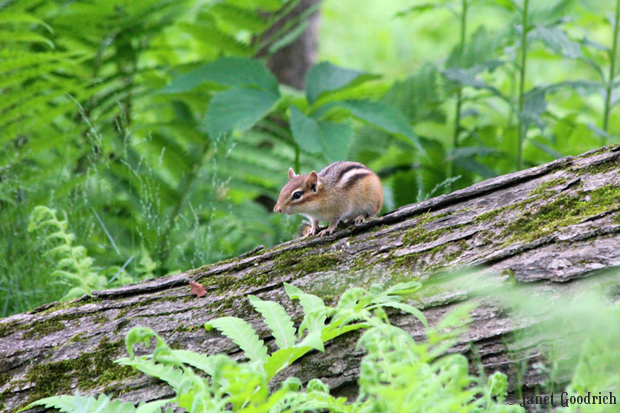
Apparently he was ignored, because just beyond him we saw a couple of green herons.
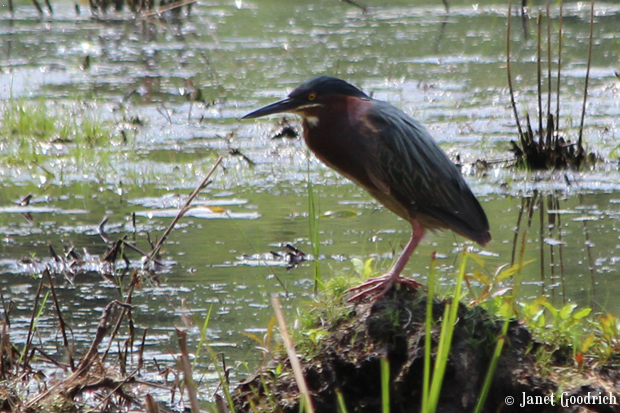
This one looked pretty typical... 
...till the wind blew and gave it a punk makeover. There was a whole cavalcade of geese camped out on the berm across the pond. They made an impressive racket as they took off. We could almost feel the wind from their beating wings.
There were some other water birds around too.


There were several great blue herons there — 4 or 5. They may be feeding young at the heronry down the river.
The bracken was particularly lush…
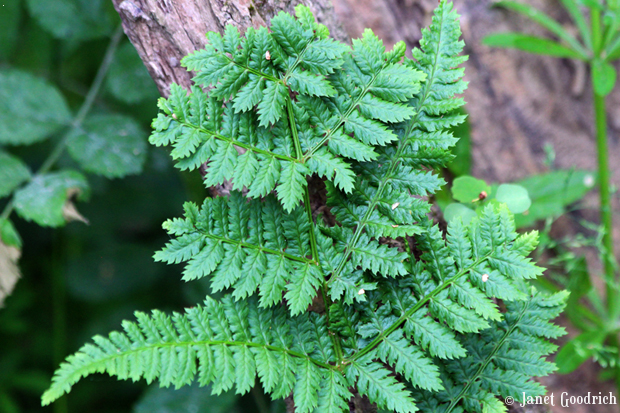
And there were some wildflowers around. Learning the names is helping me to feel more like I belong in this place.
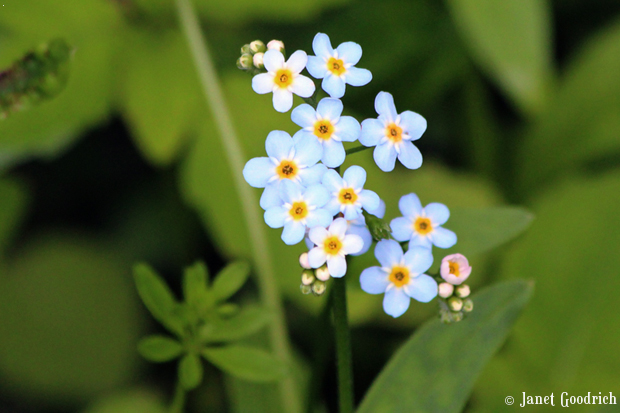
Forget-me-nots 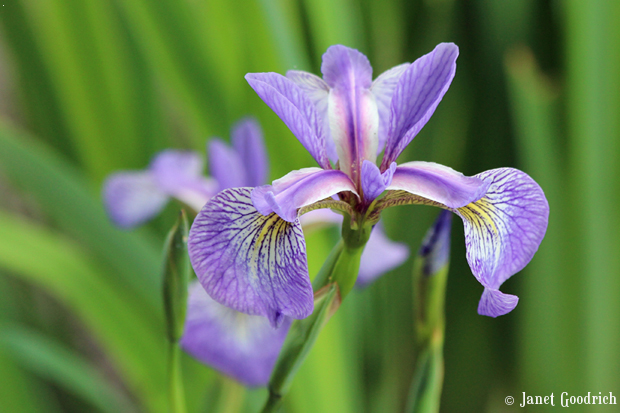
Blue flags 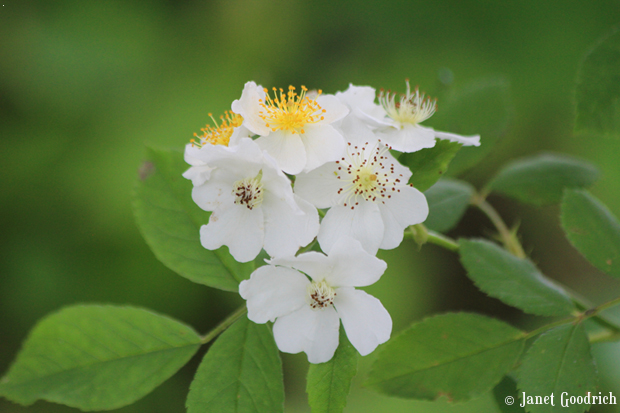
Bramble (I think) 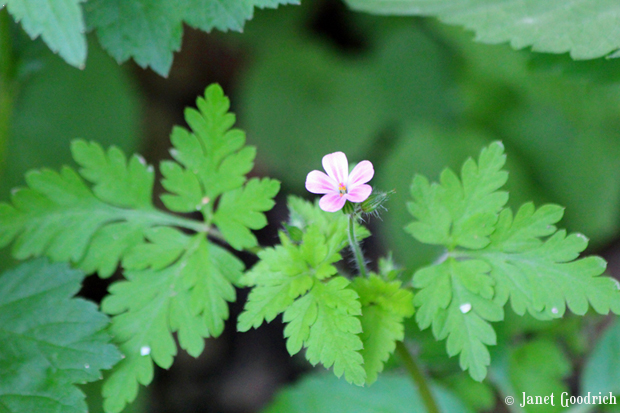
Mystery flower Back at the car, the oriole that usually hangs out in Old Man Willow was humming his way through lunch. I thought that the Burgess Bird Book named the oriole “Glory,” but it’s actually “Goldie.” I prefer Glory. It doesn’t get any more glorious than this colorful bird with his agreeable warble.
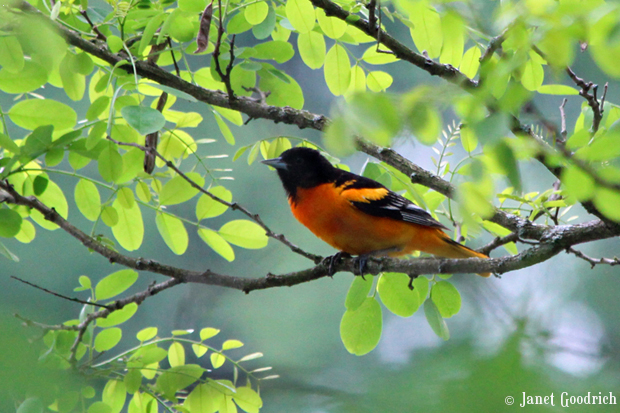
Glory the Oriole 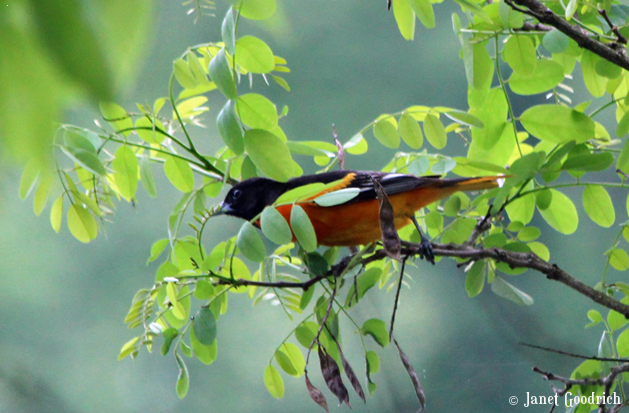
By then the sun was retreating behind a bank of clouds, so the flash of fire from Mr. Oriole was all the more welcome.
When we got home, Younger Daughter requested tree swallow coloring pages. Older Daughter requested a library book on caring for injured robins (for reasons I’ll share in a later post). I’ve been slacking on official nature journal pages, but I think we should probably get back into them. They’re not necessary for learning, I don’t think, and only sometimes are they an aid to seeing. But they do document the experiences of our various walks together. Someday I want the girls to have them to look back through. Once they learn the name of a flower or the habits of a bird, they will remember. But the particular treasures of particular walks may fade or get mixed up over time.
-
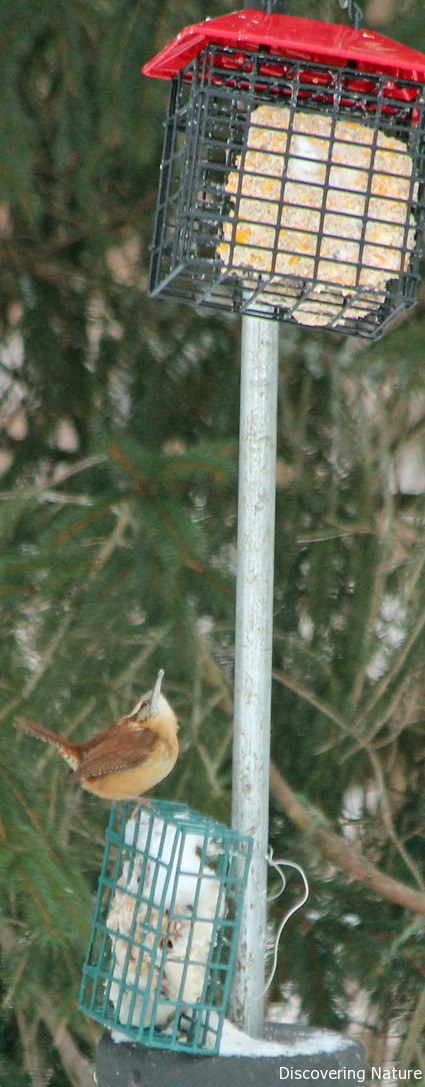
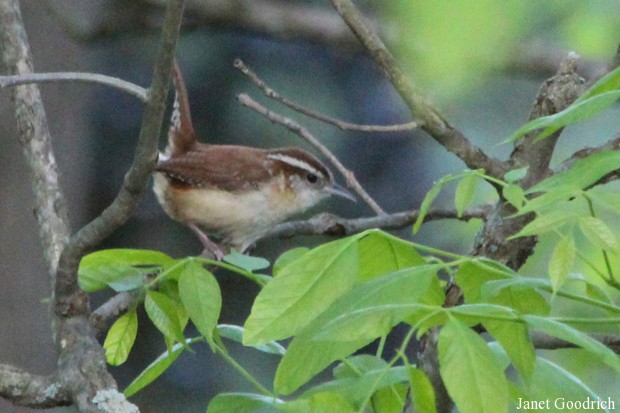
Carolina wren
TEA-kettle TEA-kettle TEA! TEA-kettle TEA-kettle TEA!!
Pause. Shake out feathers and puff up round like a pom-pom. Hop into the air, do a 180, and prepare to send your boisterous call out over the landscape in the other direction.
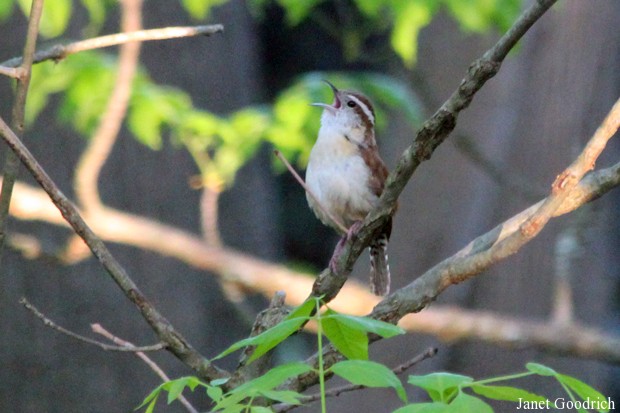 He’s no bigger than a golf ball, but inside he’s the ruler of all he surveys.
This little bird is a great favorite in our family. He and his mate have a nest somewhere in the brushy area over our back bank. He and his family will help us out by consuming lots and lots of insects that might otherwise consume lots and lots of our garden.
Apparently these wrens nest in some unusual places! — line-drying overalls, laundry rooms, old boots, planters. Ours are more conservative and just nest in the bushes. It always strikes me as a paradox to see him singing so loudly, telling the world where his territory is, in this season of secrecy for birds who keep their nests hidden away.
-
Beaks!
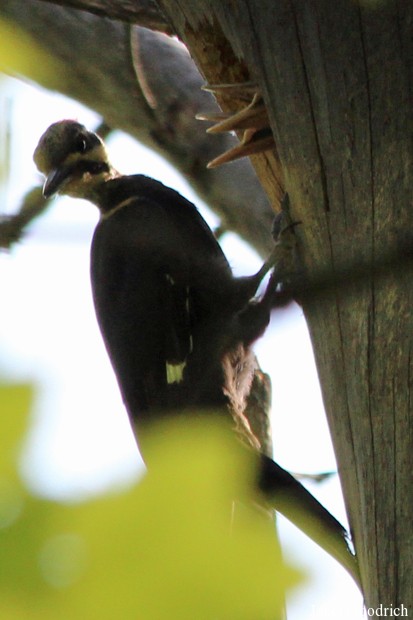
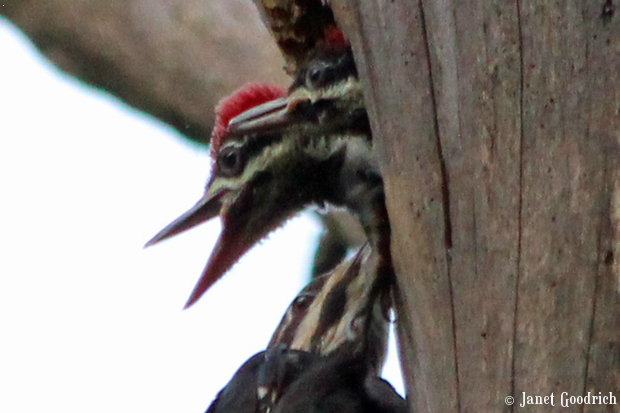
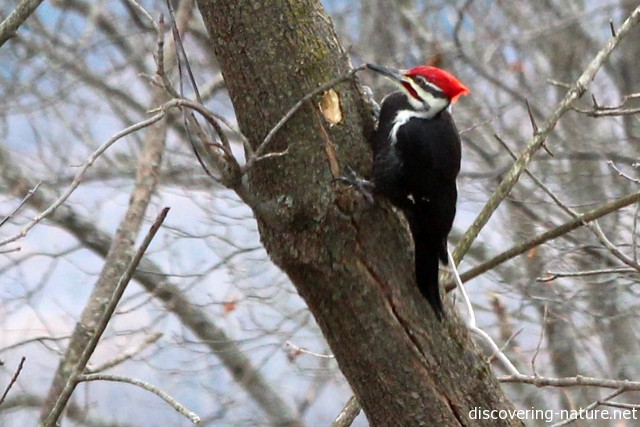
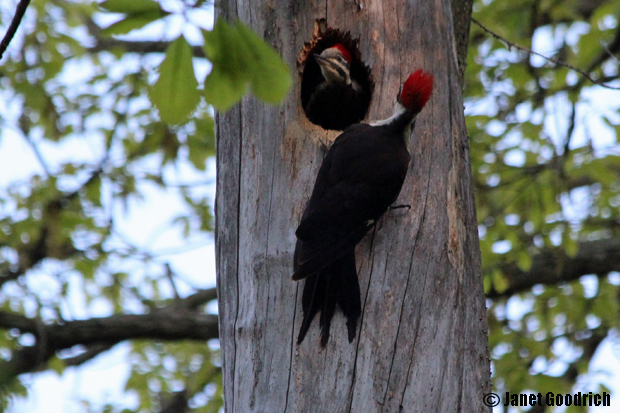
Just after I expressed my wish to see little beaks at some point at the pileated nest, I did!
My husband and kids and I were taking my parents for a walk along the trail, and Mrs. P appeared.
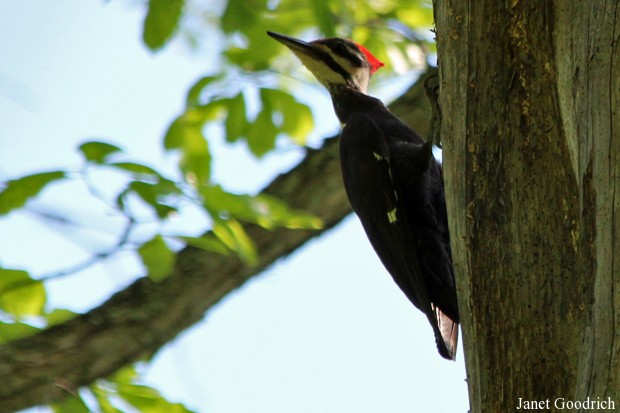
She was there for a few minutes, then left. Mr P appeared then and went inside — briefly.
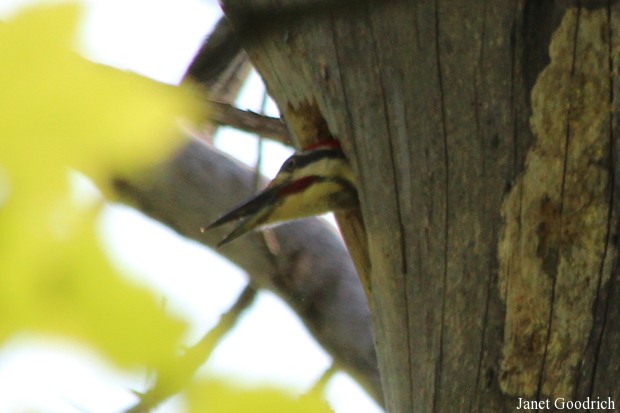
I’ve read that clutch size is typically 4 eggs, though it can vary. It’s likely that there are more youngsters in there.
I also read that adults have yellow eyes. This is true of the male, but the female’s eyes look pretty dark. But I’ll reserve judgment unless and until I get some better pictures.
This site is helpful on pileated woodpeckers.
-
Pileated Pair
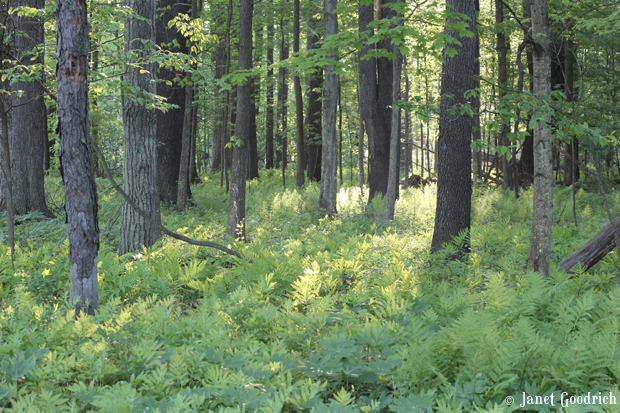
Yesterday I crouched in ferny woods for 45 minutes or so, waiting for the pileated woodpeckers to show themselves. It was 6:30 in the morning when I settled myself on a damp fallen log in the tick-infested woods, within view of the nest, but not too close.
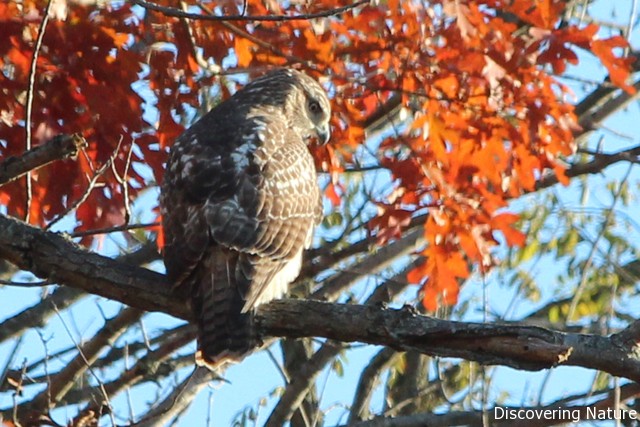
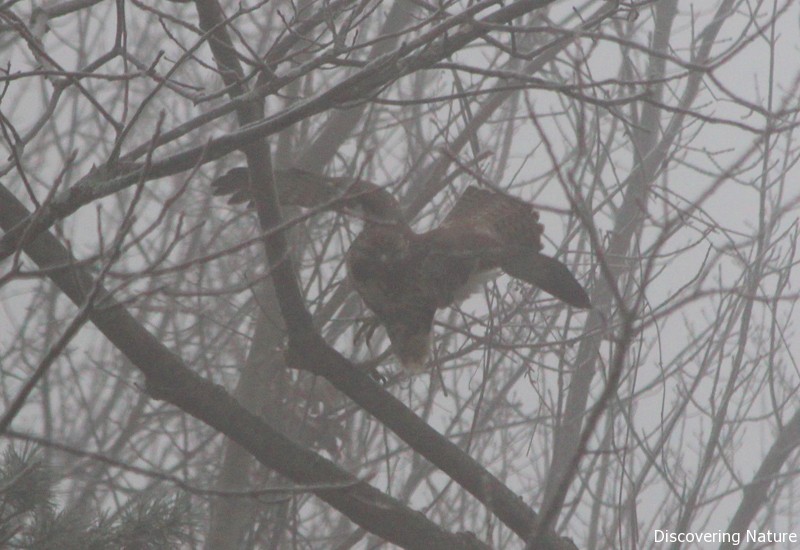
I watched red-winged blackbirds chasing one another and sounding off. A broad-winged hawk lit on a branch over my head and gave me one brief, piercing look before taking flight to escape some marauding grackels. By 7:00 I was getting chilled, my feet were falling asleep, and my trick neck was threatening to jam as I looked up wistfully at the woodpecker cavity.
Suddenly, Mrs. Pileated appeared, a silhouette against the sky on a neighboring tree. She pecked away quietly, making sure the coast was clear, then whooshed to the tree and went inside.

She wasn’t in there long before Mr. Pileated appeared. He surveyed the scene carefully from several different trees, including one right in front of me.
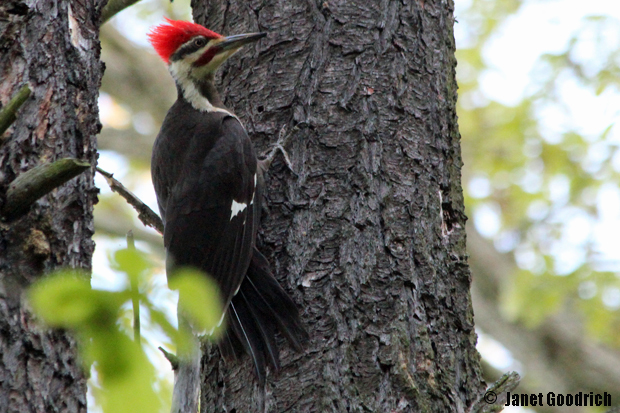
Then he made his move.


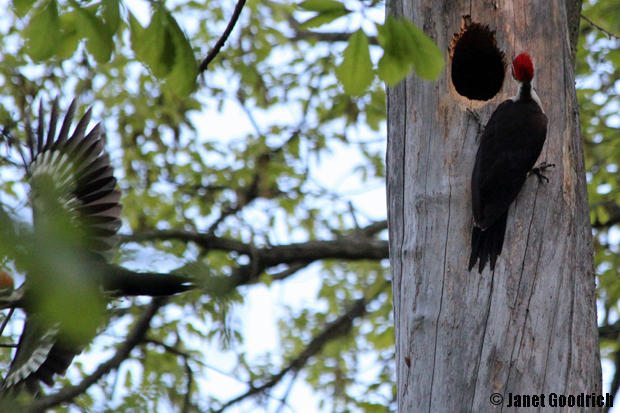
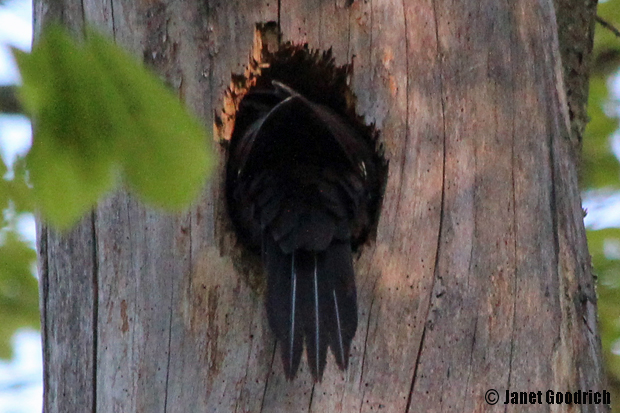
I left, being careful to use a different route than the one I took coming in.
It was thrilling. I think of pileated woodpeckers as belonging to the wilderness, and I felt privileged to see them going through their routines together. I still haven’t seen any little beaks poking out. How many nestlings do they have? When will they fledge? I don’t want to hound them by coming too often, but I hope I’ll see a glimpse of the youngsters at some point. I’ve never seen a juvenile pileated woodpecker.
What is it that drives me to such an activity early on a Saturday morning? I’ve been thinking about it today. My woodland explorations have come to seem like some of the most real moments of my life. It’s the ultimate “unplugged” experience, for one thing. The sights and sounds and smells are all vivid and direct. For another, there is no pretense in nature. All around me are creatures busy at the task of survival. They need food; they need to mate and raise young; they need to stake out territory to provide for themselves. It’s life and death for them, and it exposes many of my human rituals and “concerns” as simply trivial. Which brings us to humility. It’s humbling to get these glimpses of the complexity and variety and beauty of the non-human world. Humbling, and deeply inspiring.
What better way could there be to start a weekend?
-
Sparrows
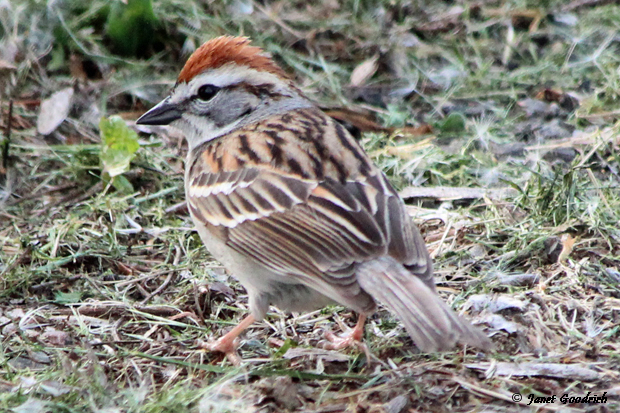
Sparrows are so “common” — little brown birds hopping in the periphery almost everywhere. But last year, it was this little chipping sparrow, who would come to the feeder and throw his head back in song, that jolted me into paying attention to birds.
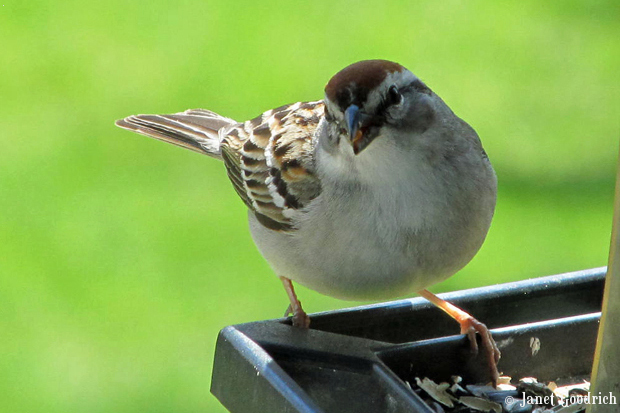 It’s so beautifully colored and marked, and so busy and sociable. Anna Botsford Comstock is quite emphatic in the Handbook of Nature Study about its helpfulness to humans by consuming garden pests, but even without such “utility” it’s appealing.
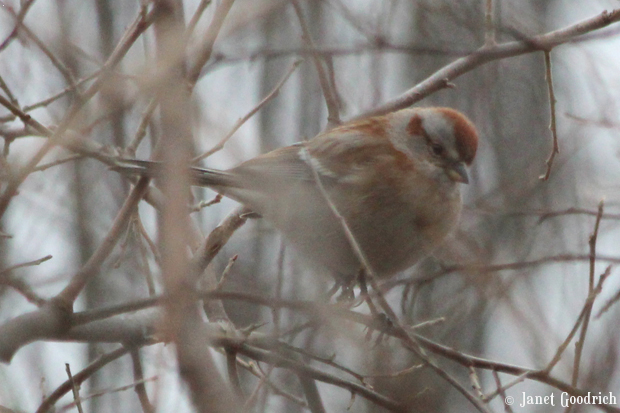
Since then I’ve begun to distinguish different kinds of sparrows, and there is an amazing variety. Back in the winter, I noticed tree sparrows for the first time. They’re very similar in appearance to the chipping sparrows, but they stay all winter — the season so nearly bereft of color when it’s overcast, as it was when I snapped this.
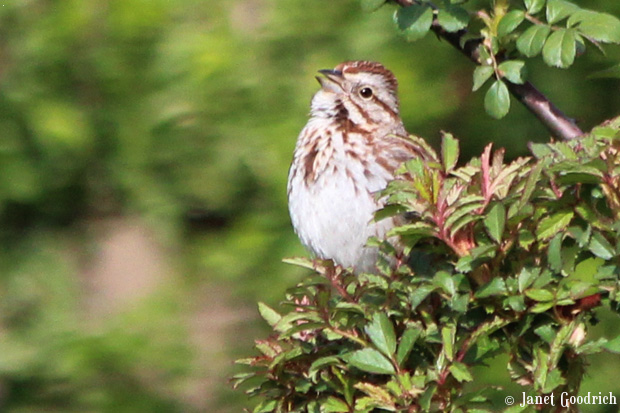
 One of the first birds to break the winter silence was the song sparrow. Now that I’m aware of it, I hear it everywhere.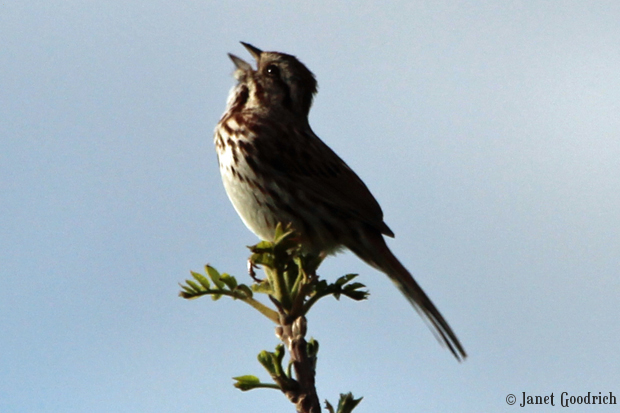
I love the wholeheartedness — head thrown back, belting it out into the morning. Thornton Burgess names him “Little Friend.”
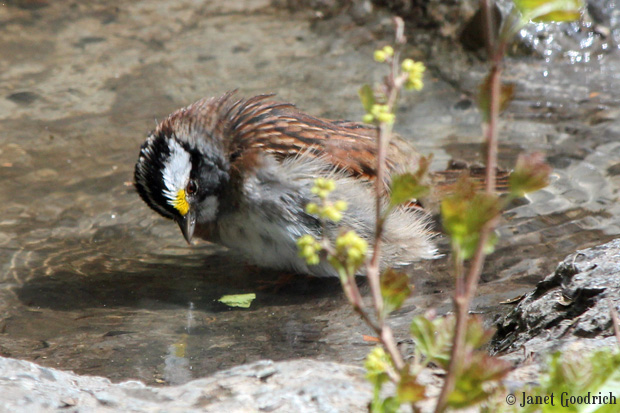
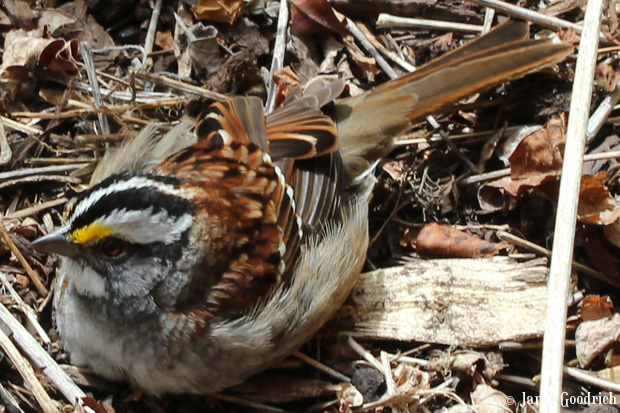
White-throated sparrows, which I’ve always associated with the Adirondacks, stayed here for a few weeks on their way back northward. Till this year I heard but never saw one. Their song is very high and sweet and lonesome, and I would have pictured a more diminutive bird. I think they’re beautiful with that dash of yellow and those crisp stripes. How could I have missed them before this year?
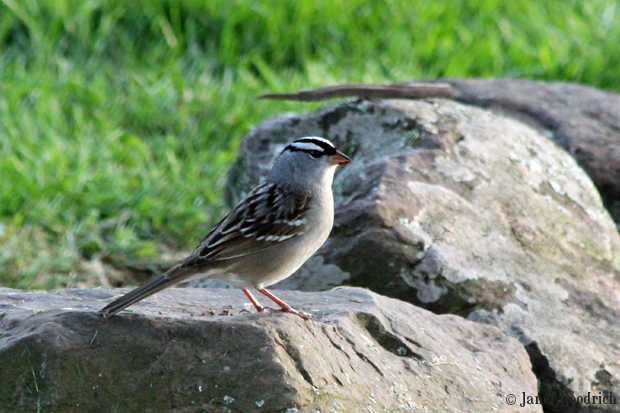
Just a few days ago, I saw another one that’s new to me: a white-crowned sparrow.
 There are also English sparrows, seen everywhere from parking lots to barns to other birds’ nests. I don’t have a photo of one. And there are others that I haven’t seen yet that I have heard or can expect to see — swamp, vesper, and field sparrows, for instance.
So many varieties of “common.” I’m reminded of the passage in Zen and the Art of Motorcycle Maintenance where the writing teacher encourages a girl to break through writer’s block not by choosing a larger subject, but a smaller, more narrowly focused one:
He’d been having trouble with students who had nothing to say. At first he thought it was laziness but later it became apparent that it wasn’t. They just couldn’t think of anything to say.
One of them, a girl with strong-lensed glasses, wanted to write a 500-word essay about the United States. He was used to the sinking feeling that comes from statements like this, and suggested without disparagement that she narrow it down to just Bozeman.
When the paper came due she didn’t have it and was quite upset. She had tried and tried but she just couldn’t think of anything to say…
It just stumped him. Now he couldn’t think of anything to say. A silence occurred, and then a peculiar answer: “Narrow it down to the main street of Bozeman.” It was a stroke of insight.
She nodded dutifully and went out. But just before her next class she came back in real distress, tears this time, distress that had obviously been there for a long time. She still couldn’t think of anything to say, and couldn’t understand why, if she couldn’t think of anything about all of Bozeman, she should be able to think of something about just one street.
He was furious. “You’re not looking!” he said. A memory came back of his own dismissal from the University for having too much to say. For every fact there is an infinity of hypotheses. The more you look the more you see. She really wasn’t looking and yet somehow didn’t understand this.
He told her angrily, “Narrow it down to the front of one building on the main street of Bozeman. The Opera House. Start with the upper left-hand brick.”
Her eyes, behind the thick-lensed glasses, opened wide.
She came in the next class with a puzzled look and handed him a five-thousand-word essay on the front of the Opera House on the main street of Bozeman, Montana. “I sat in the hamburger stand across the street,” she said, “and started writing about the first brick, and the second brick, and then by the third brick it all started to come and I couldn’t stop…”
“Nature” is a large subject. But to narrow the focus is to find that it’s even larger, more intricate, more extravagant. You could probably write well over 5,000 words about sparrows alone.
-
Migration Celebration
On Saturday we visited the Cornell Lab of Ornithology for their Migration Celebration. It was an opportunity to see the many kinds of work they do at the lab: raptors, bird banding, nest and birdwatching walks, audio and video archiving, crafts and face-painting and ice cream. (Okay those last three aren’t especially bird-related…)
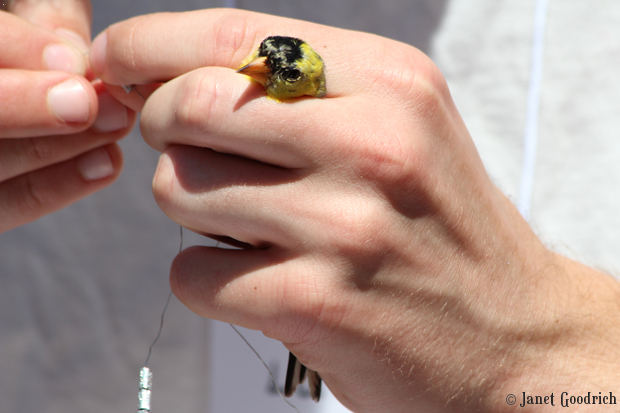
A highlight for my daughters was the bird banding demo. They got to see the mist nets used to catch birds because there were some set up near the feeders. We saw them band a goldfinch, two downy woodpeckers, a mourning dove, and a chickadee.
I have mixed feelings about bird banding. I’m sure it yields interesting information. But is it interesting enough to make the birds wear those bracelets forever on their delicate legs? I never really thought about it till I read David Kline’s Great Possessions. He quotes Gene Hill:
I have nothing against scientific observation, census, or just plain curiosity. I am as interested as the next ignoramus about the curious life cycle of the migrating butterfly or the whereabouts of the black-footed ferrets, but I think there are some technological gadgets that we could resist in the name of decency, even if life is a little more incomplete without them.
I’m alone in my ambivalence, however. My whole family LOVED the banding. (My husband even wants to learn how to become licensed as a bird bander.) And there was certainly great emphasis on reducing the stress of the whole experience as much as possible for the captured birds. Both girls got to release a banded bird, which, from the looks on their faces, was an incomparable experience.
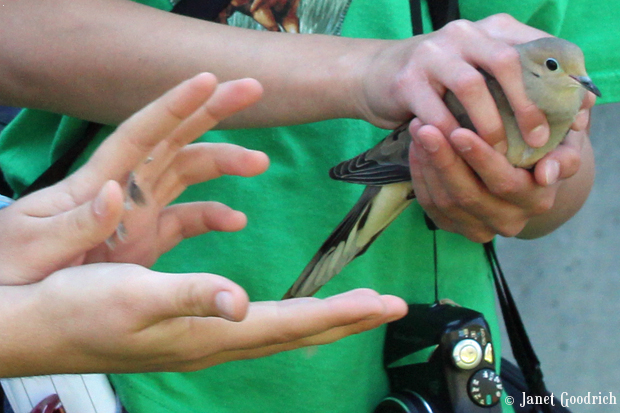 We went on a walk with an ornithologist who brought recordings of birds — chickadees and titmice sounding the alarm over a screech owl — to lure the birds in close. I’ve always been hesitant about such walks because I thought the birds would stay hidden from a group of people making noise, but we saw several birds — yellow warblers, common yellowthroats, chickadees, titmice, woodpeckers, grackels. We also saw (and heard) a bird that I’ve heard of but never seen: a blue-winged warbler.
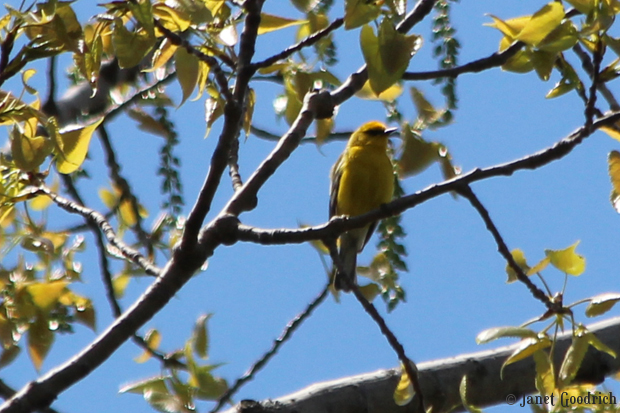 It was an impressive showing, especially given that it was high noon! I learned to distinguish the calls of the blue-wing and the yellowthroat, so on the whole it was quite educational.
Out back were a number of raptors on display. It’s always a thrill to see one up close, and to glean tidbits from their handlers.
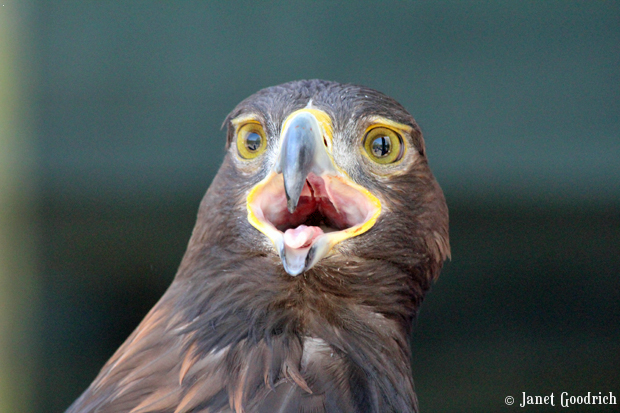
Golden eagle panting in the heat 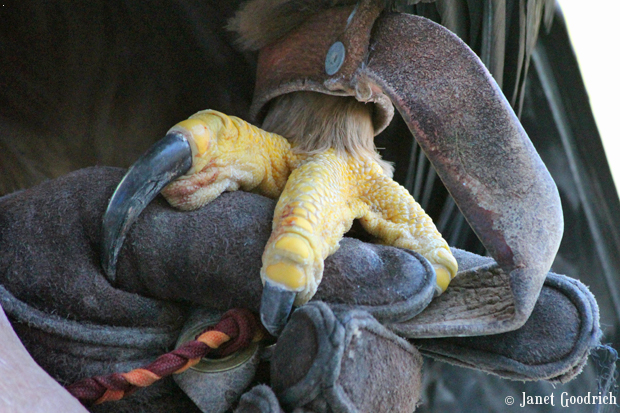
Golden eagle talon 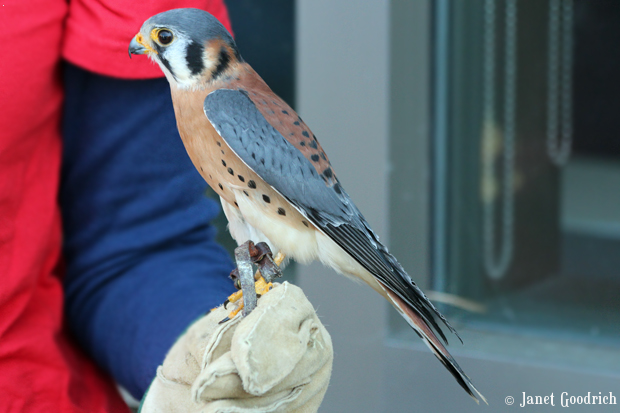
American kestrel 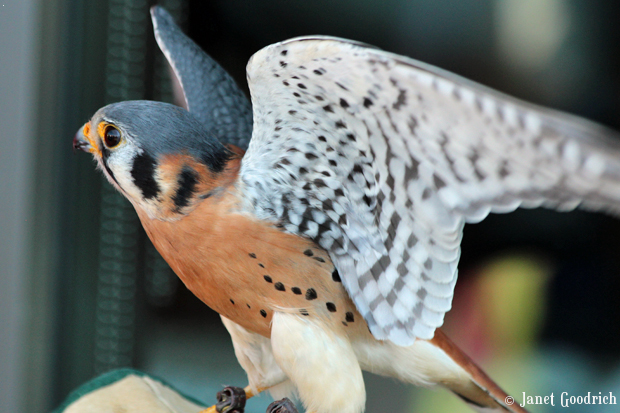
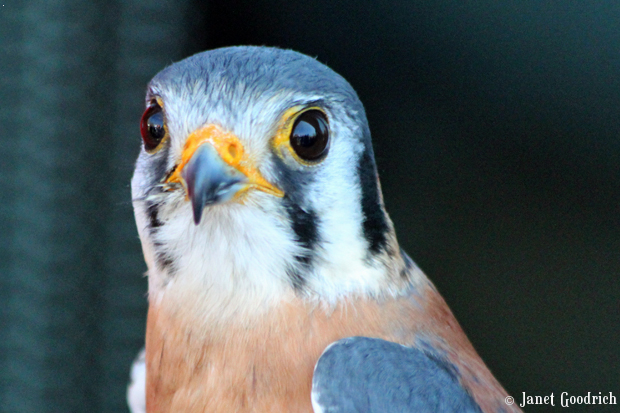
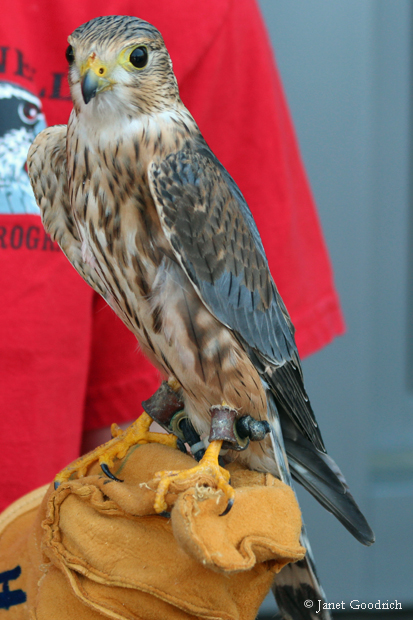
Merlin 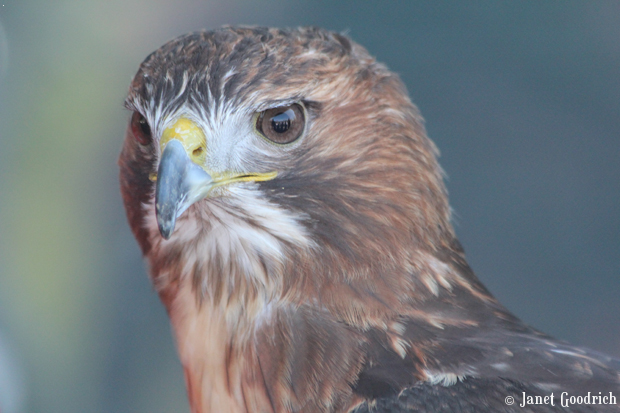
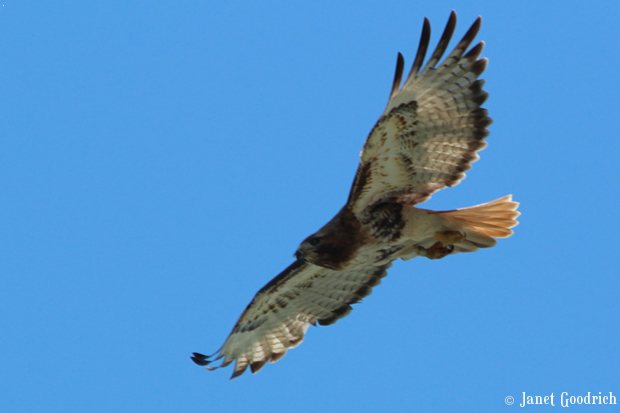
Red-tail 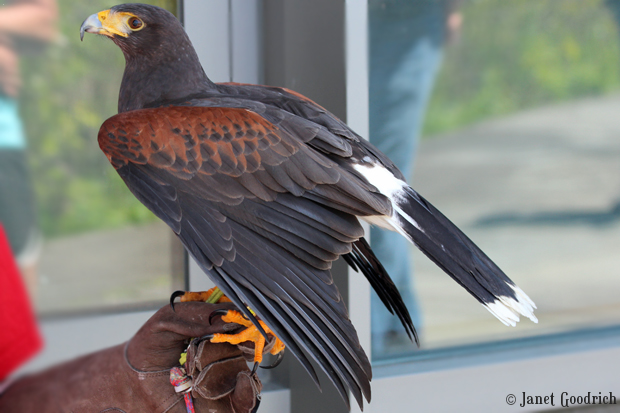
Harris hawk 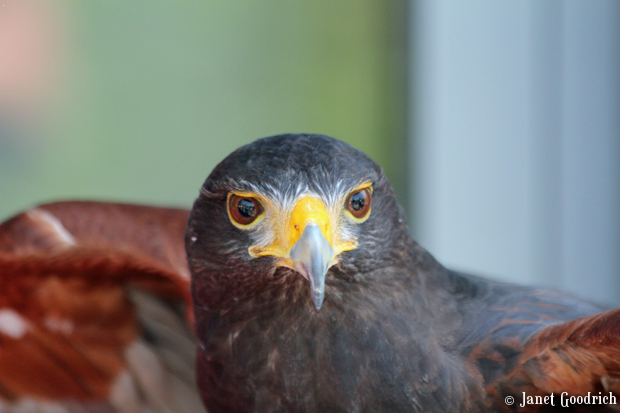
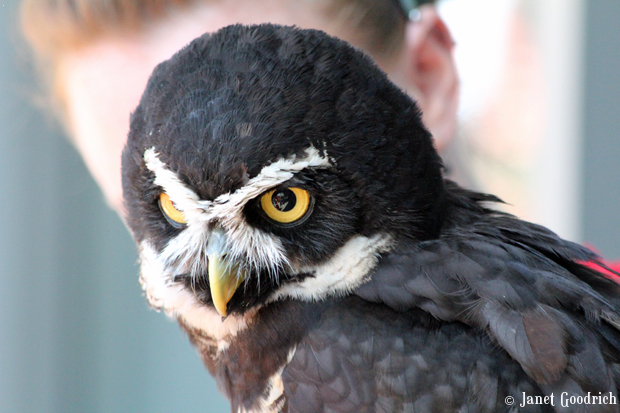
Spectacled owl 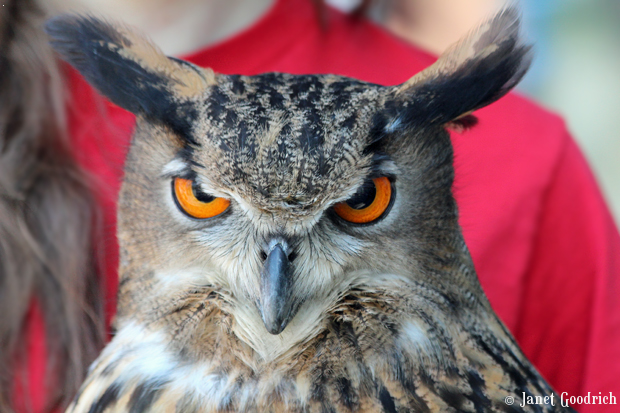
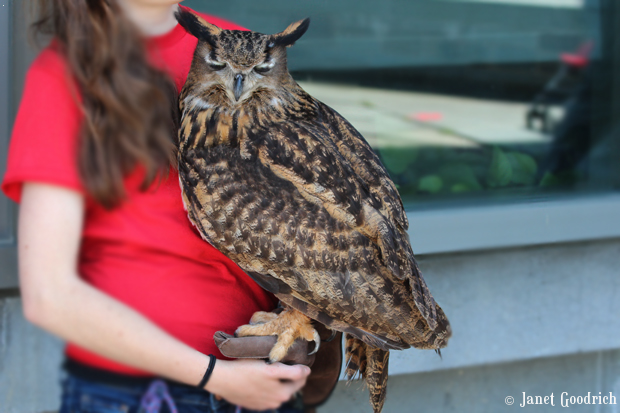
Great horned owl 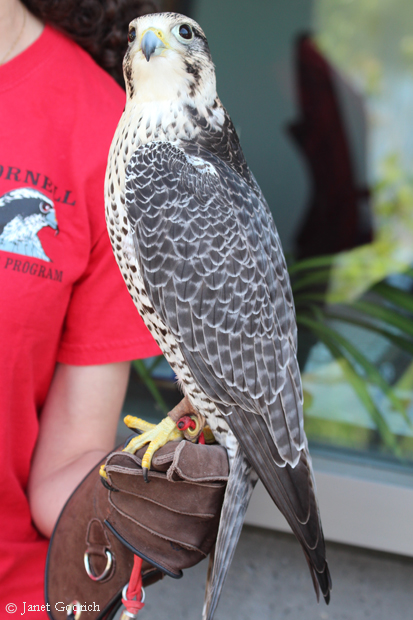
Mix of three kinds of falcons 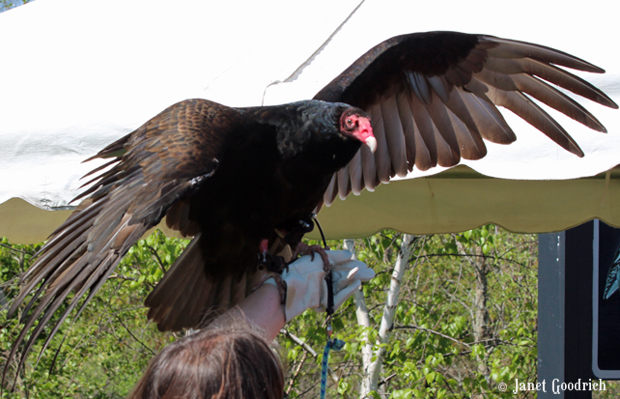
Tuvu the turkey vulture greeted everyone on their way in. We had a gorgeous sunny day for the event and found it all very stimulating, but the eagle owl reminded us that he was out past bedtime!
-
Cornell Hawks and Hawklings
We made our second trip to visit the hawks featured on Cornell’s webcam on May 12. It was Cornell Lab of Ornithology’s Migration Festival, and our family went to the lab to enjoy this opportunity to get a glimpse of all the many aspects of the Lab’s work. I’ll write more about it in another post.
After a full schedule of events there, we stopped by the hawk nesting site on Tower Road to see what we could see. Ezra (the male) was on the nest when we arrived, and Big Red (the female) was perched on a light tower across the athletic field from the nest.

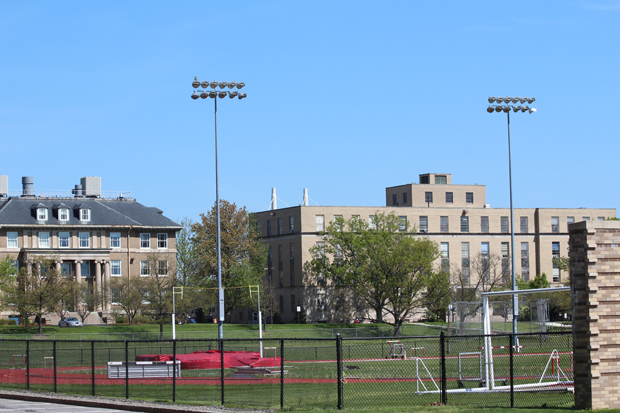
Big Red is perched atop the left-hand pole. 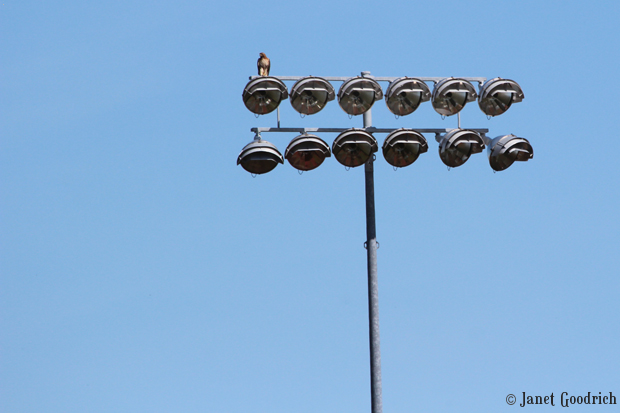 We stayed for about 15 minutes, but that was all the time we had. As we started for the car, I saw Red flapping back toward the nest. I was not in the best position any longer, shooting toward the sun, but I snapped a few shots of the shift-change. Big Red was quite vocal when she returned to the tower, and Ezra didn’t wait long to dive off and head for a nearby light pole.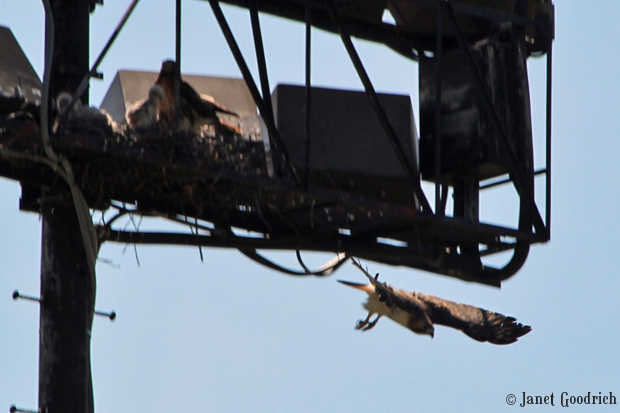
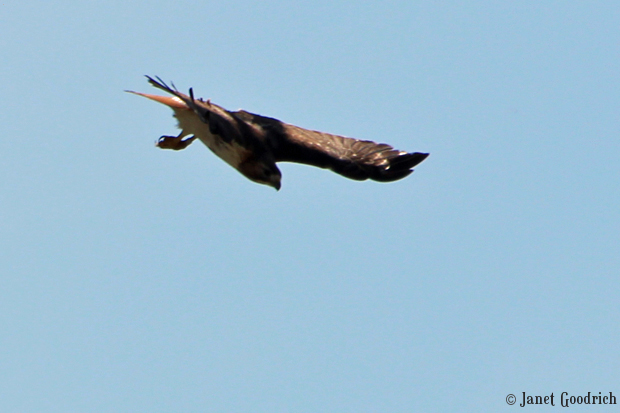
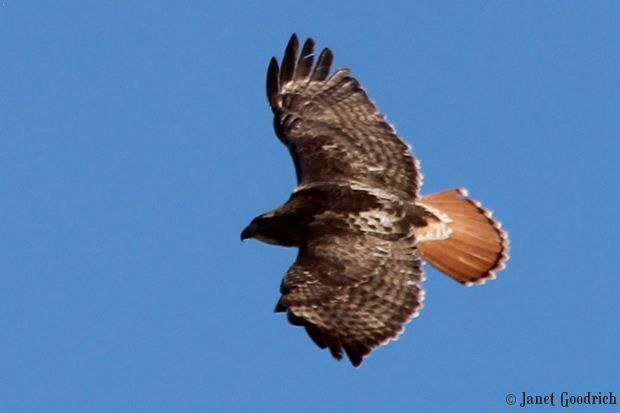

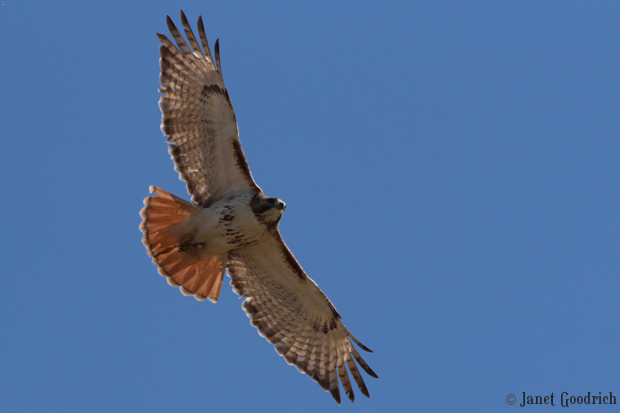
He seemed to consider for a few moments. Then he took off and sailed into the blue. He was aware of us but didn’t appear to be threatened at all.

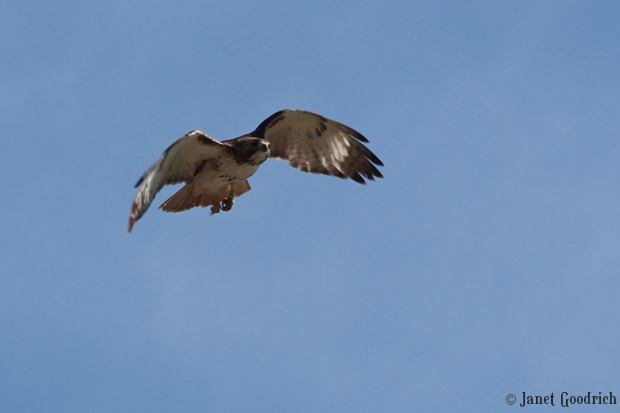
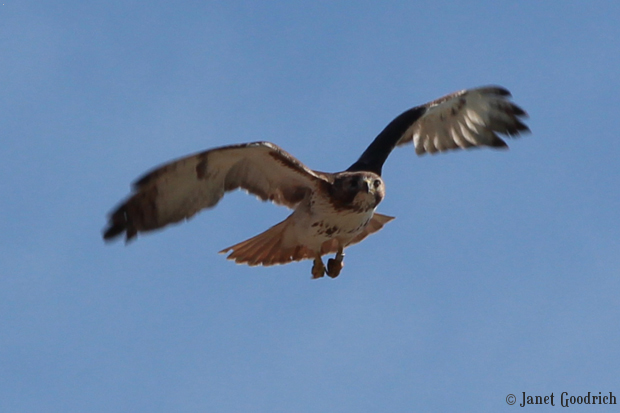
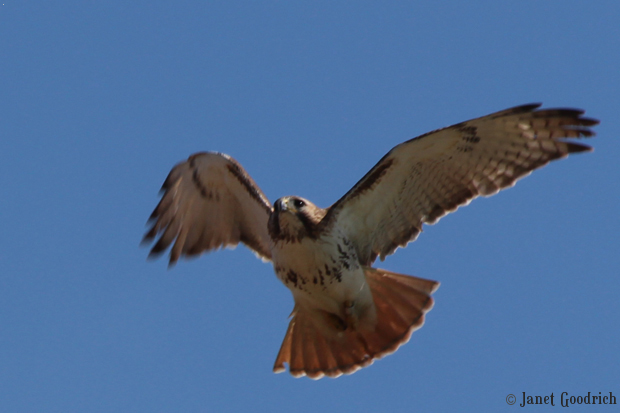
It’s strangely stirring to see a hawk taking flight. Science can answer so many questions, but not all of them. In the end we’re one species observing another, separated by a gulf of differentness, but joined by a kind of respect and wonder in watching the strength and grace of that spiral into the sky.