-
Walk at the Pond
The sun was out yesterday morning, and I urged the girls on in their schoolwork, dangling the carrot of a walk in the sun. They rose to the challenge, and we headed off in good time.
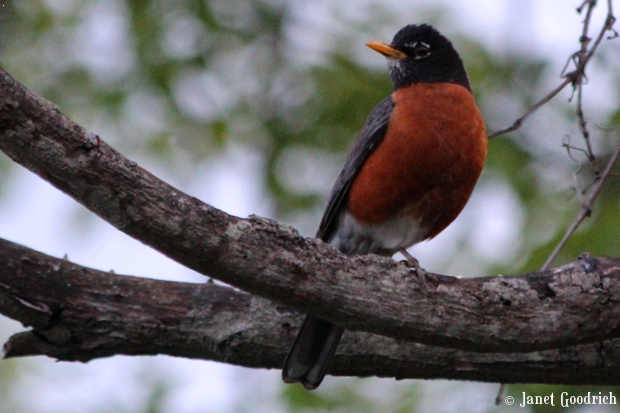
First to sound the alarm was this guy: “Humans! Humans!”
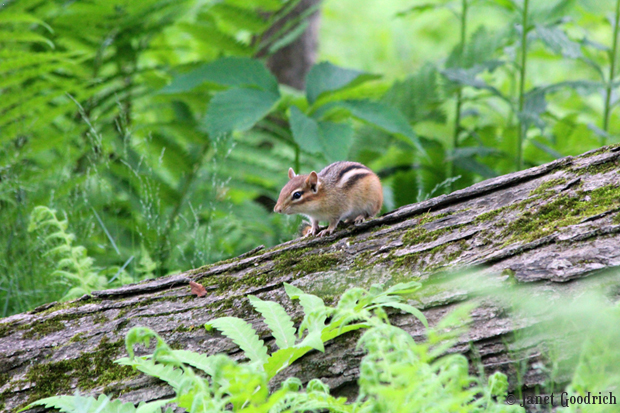
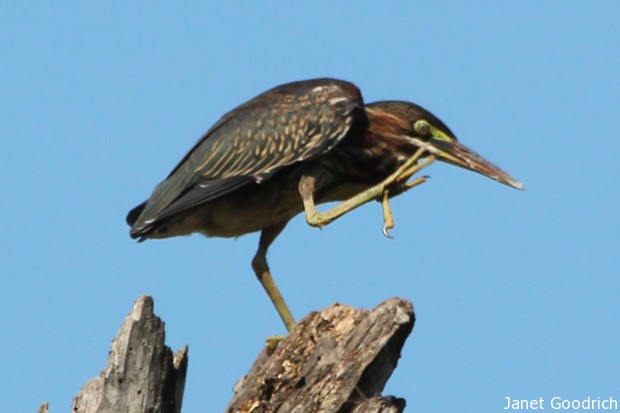
Apparently he was ignored, because just beyond him we saw a couple of green herons.
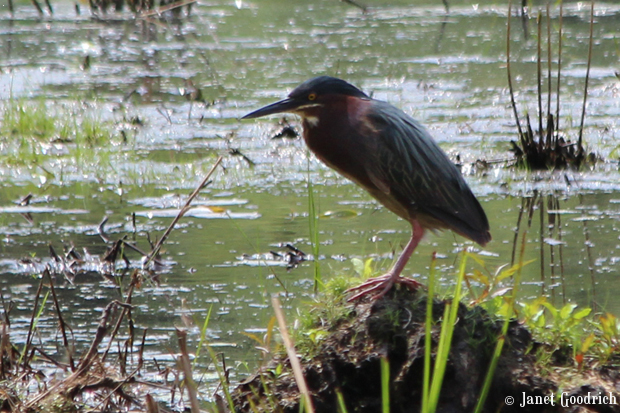
This one looked pretty typical... 
...till the wind blew and gave it a punk makeover. There was a whole cavalcade of geese camped out on the berm across the pond. They made an impressive racket as they took off. We could almost feel the wind from their beating wings.
There were some other water birds around too.


There were several great blue herons there — 4 or 5. They may be feeding young at the heronry down the river.
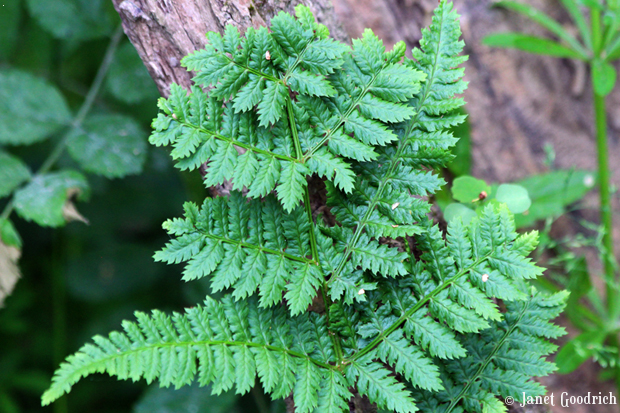
The bracken was particularly lush…
And there were some wildflowers around. Learning the names is helping me to feel more like I belong in this place.
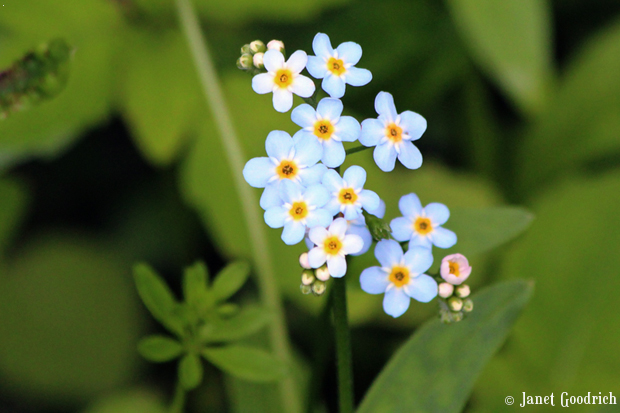
Forget-me-nots 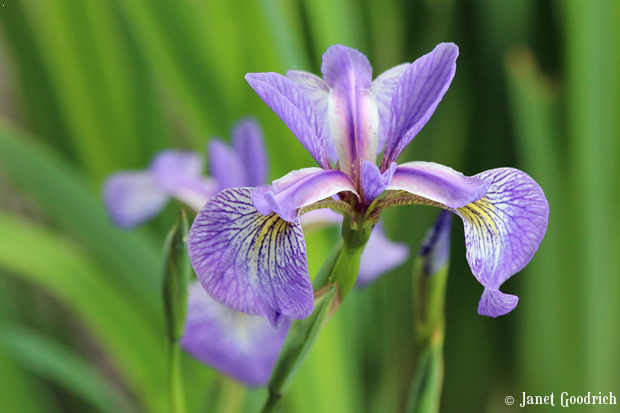
Blue flags 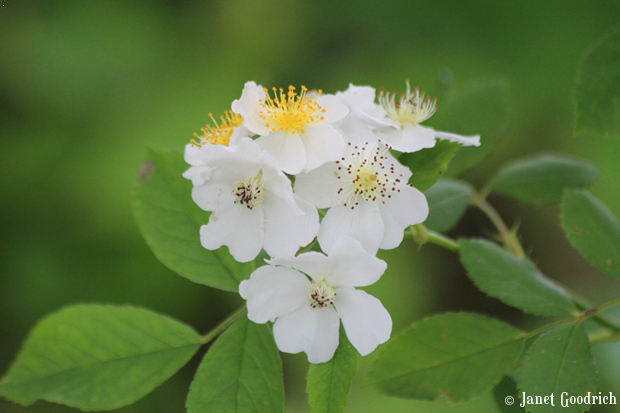
Bramble (I think) 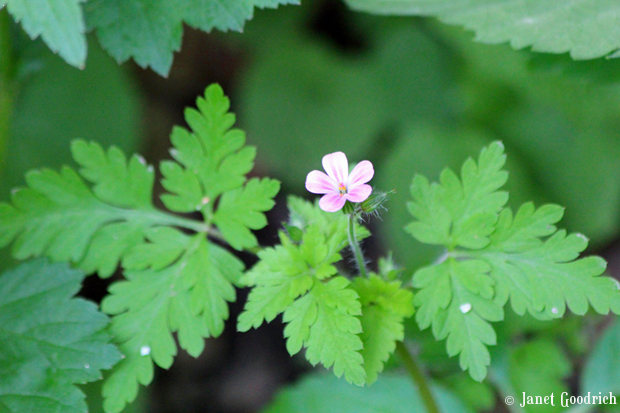
Mystery flower Back at the car, the oriole that usually hangs out in Old Man Willow was humming his way through lunch. I thought that the Burgess Bird Book named the oriole “Glory,” but it’s actually “Goldie.” I prefer Glory. It doesn’t get any more glorious than this colorful bird with his agreeable warble.
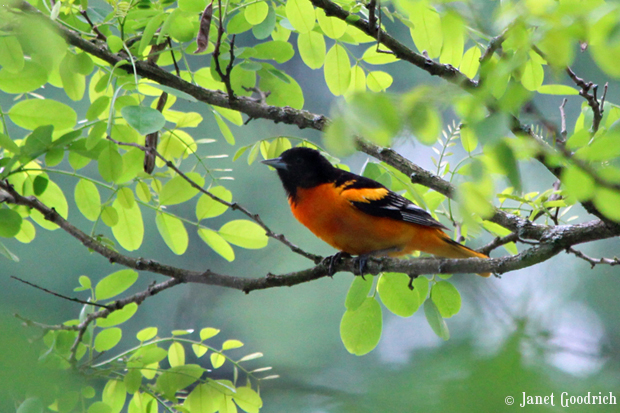
Glory the Oriole 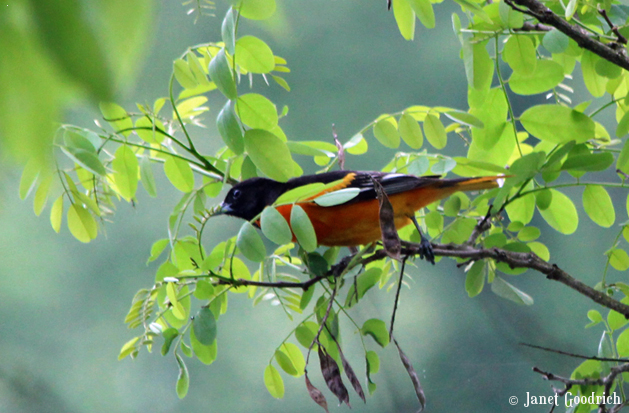
By then the sun was retreating behind a bank of clouds, so the flash of fire from Mr. Oriole was all the more welcome.
When we got home, Younger Daughter requested tree swallow coloring pages. Older Daughter requested a library book on caring for injured robins (for reasons I’ll share in a later post). I’ve been slacking on official nature journal pages, but I think we should probably get back into them. They’re not necessary for learning, I don’t think, and only sometimes are they an aid to seeing. But they do document the experiences of our various walks together. Someday I want the girls to have them to look back through. Once they learn the name of a flower or the habits of a bird, they will remember. But the particular treasures of particular walks may fade or get mixed up over time.
-
Spring White
The whiteness of winter gets oppressive after awhile. Even in winters like this last one, which dropped very little snow, the sky is often a dull white overcast, and there’s a general absence of color.
Considering this, it’s strange how happily I welcome the flowers of spring — even though so many of them are white. Theirs is a more vibrant white than snow, often accented with a delicate touch of color here or there, and wrapped up in the transition to brighter days and new life.
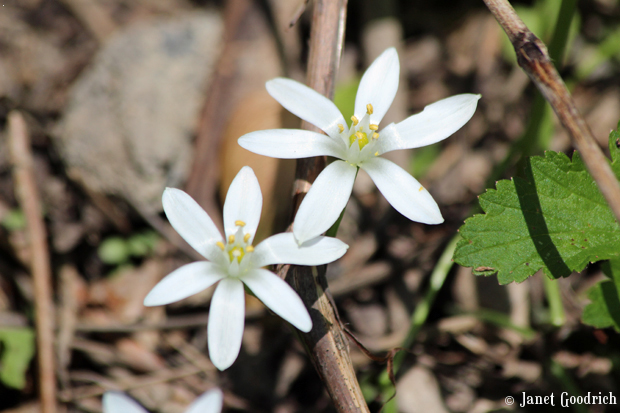
What are these? I don’t find them in our Peterson’s First Guide.
I don’t find these either.
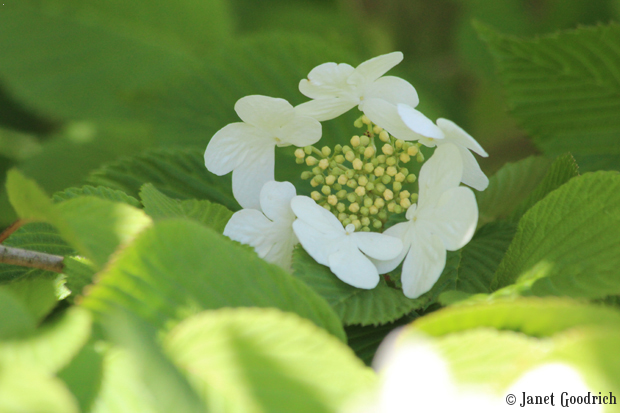
This next one is Dame’s Rocket, I think.
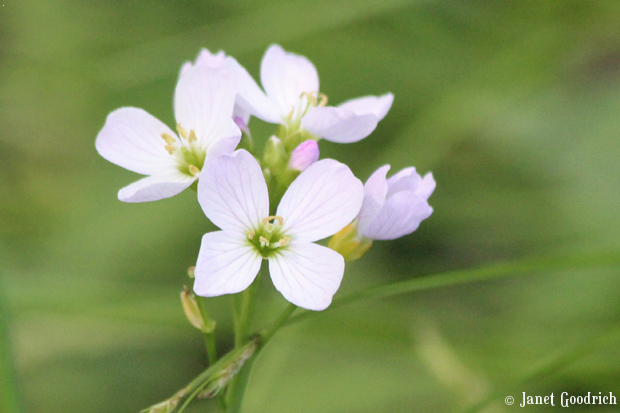
Here are a few more:
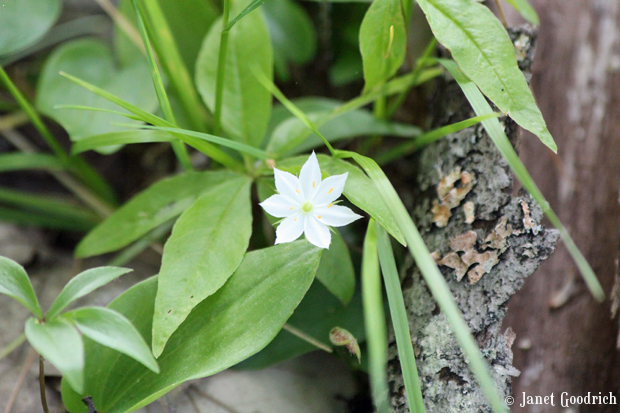
Star Flower 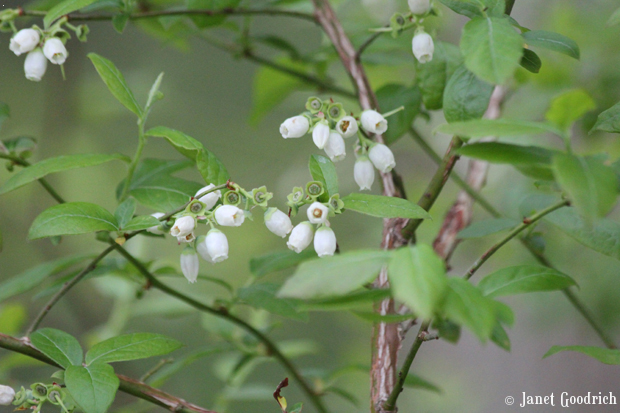
Wild Blueberry 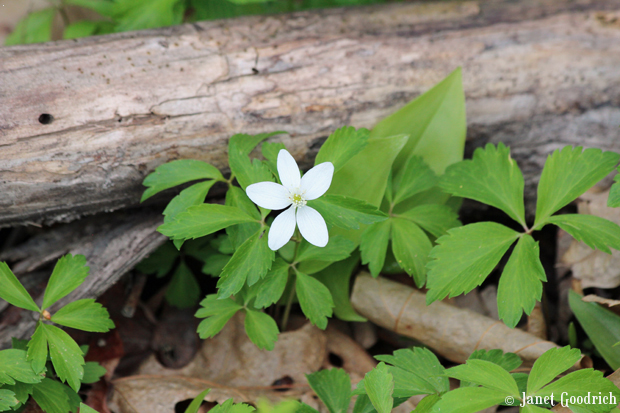
Wood Anemone 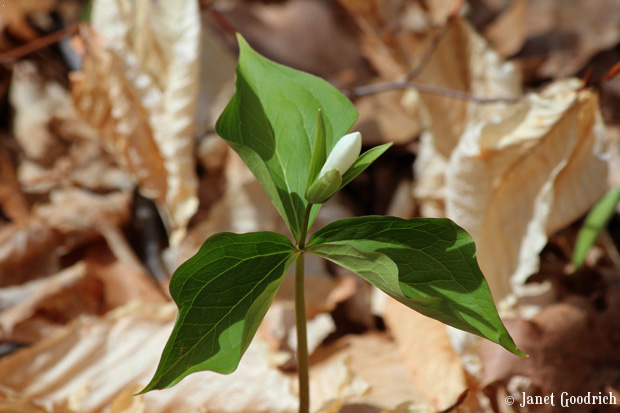
Trillium -- not quite blooming! 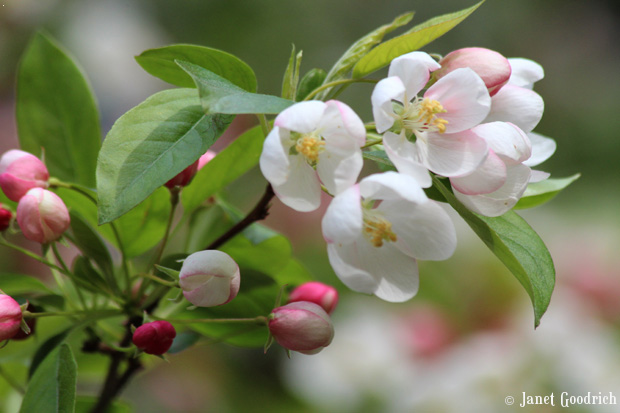
Wild Cherry (I think...) These two I posted previously, but I can’t leave them out.
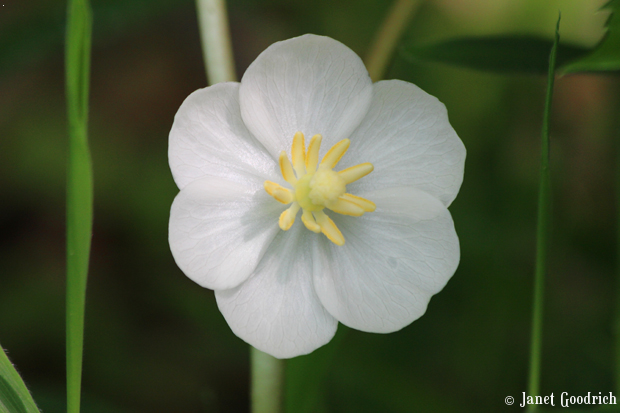
May Apple 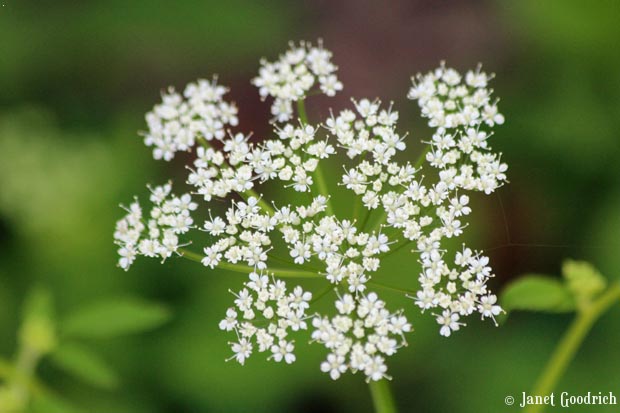
Queen Anne's Lace I’m simply learning their names. Each bloom has a story to tell, but for now I’m just getting familiar with the titles!
-
Evening
Last night, my older daughter and I went for a walk at a nearby preserve called Brick Pond. We loved seeing this rainbow!
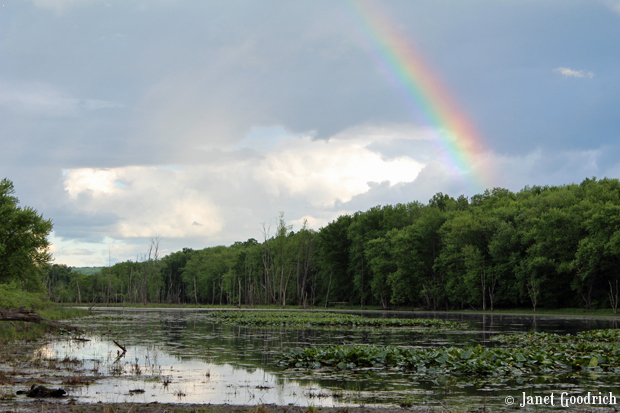
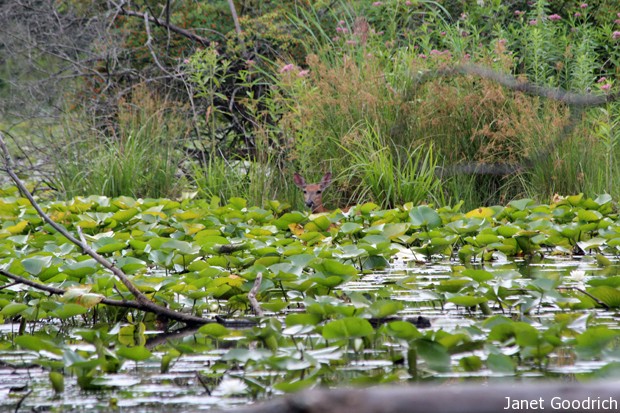
Other sights: great blue herons, green herons, wood ducks, a mallard and her brood, a killdeer, a muskrat, geese with goslings, tons of polliwogs, and an enormous bass. It must have been 6 or 7 inches deep, from the top of its head to its chin. There were a couple of kingfishers at work, and we heard yellow warblers and a Baltimore oriole. Two deer fled when they saw us coming. The first blue flag of the season bloomed by itself among some ferns. Any number of familiar birds — robins, catbirds, red-winged blackbirds, grackels, chickadees, woodpeckers — discussed us. Some kind of flycatcher fluttered overhead, but the light was too poor to identify it — or to take many photos.
-
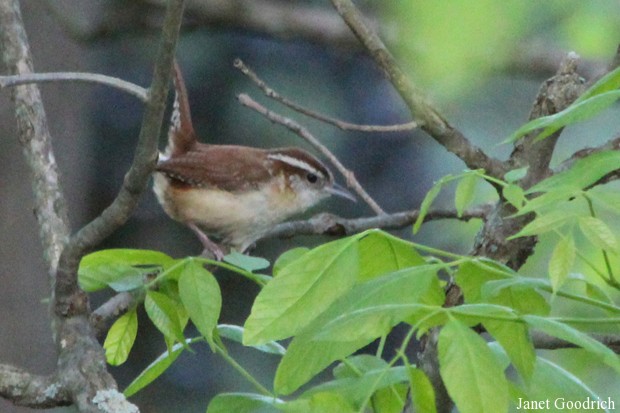
Carolina wren
TEA-kettle TEA-kettle TEA! TEA-kettle TEA-kettle TEA!!
Pause. Shake out feathers and puff up round like a pom-pom. Hop into the air, do a 180, and prepare to send your boisterous call out over the landscape in the other direction.
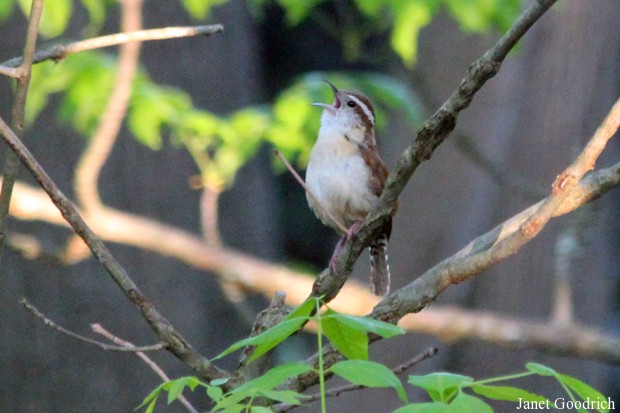 He’s no bigger than a golf ball, but inside he’s the ruler of all he surveys.
This little bird is a great favorite in our family. He and his mate have a nest somewhere in the brushy area over our back bank. He and his family will help us out by consuming lots and lots of insects that might otherwise consume lots and lots of our garden.
Apparently these wrens nest in some unusual places! — line-drying overalls, laundry rooms, old boots, planters. Ours are more conservative and just nest in the bushes. It always strikes me as a paradox to see him singing so loudly, telling the world where his territory is, in this season of secrecy for birds who keep their nests hidden away.
-
Beaks!
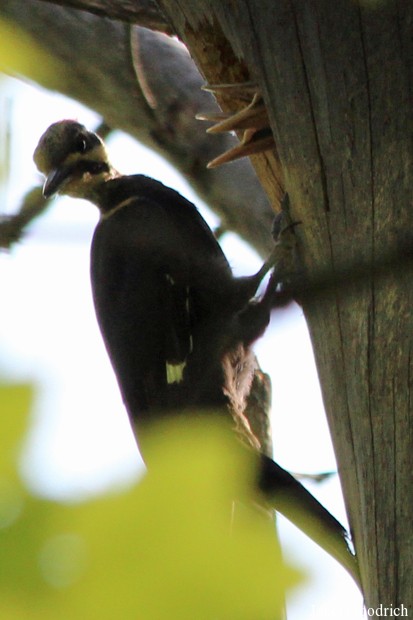
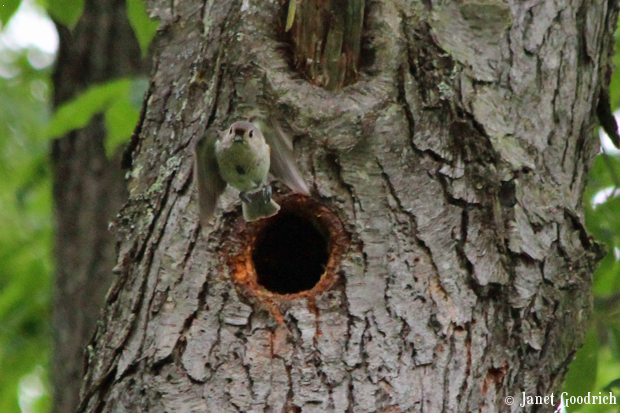
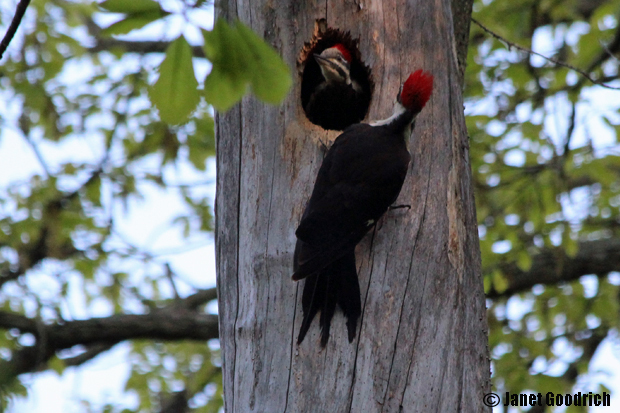
Just after I expressed my wish to see little beaks at some point at the pileated nest, I did!
My husband and kids and I were taking my parents for a walk along the trail, and Mrs. P appeared.
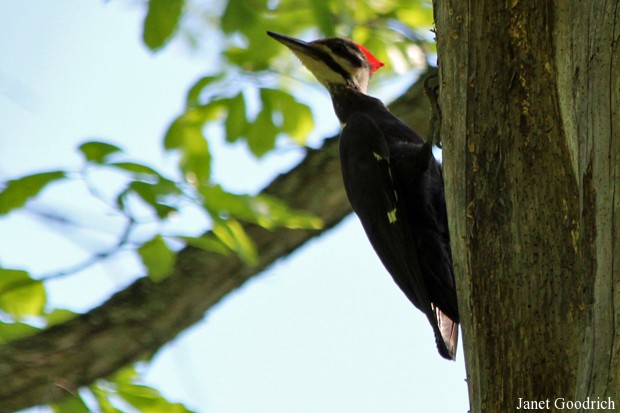
She was there for a few minutes, then left. Mr P appeared then and went inside — briefly.
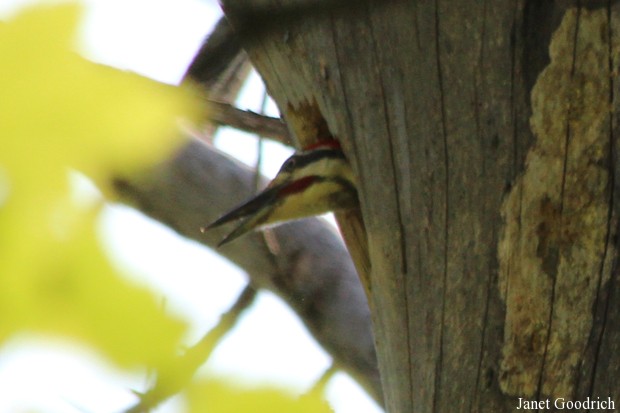
I’ve read that clutch size is typically 4 eggs, though it can vary. It’s likely that there are more youngsters in there.
I also read that adults have yellow eyes. This is true of the male, but the female’s eyes look pretty dark. But I’ll reserve judgment unless and until I get some better pictures.
This site is helpful on pileated woodpeckers.
-
Ferns
There are more varieties of fern than I’ve noticed before.
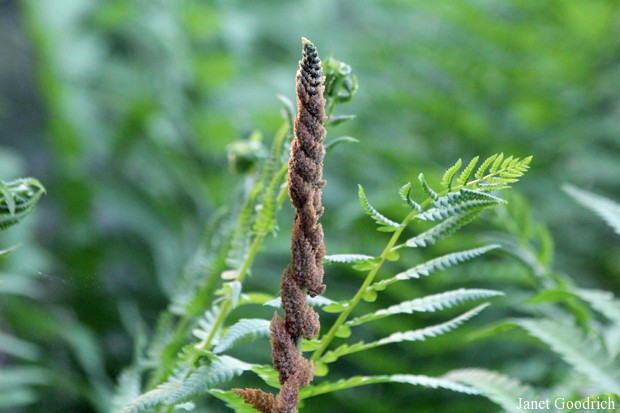
Cinnamon Fern 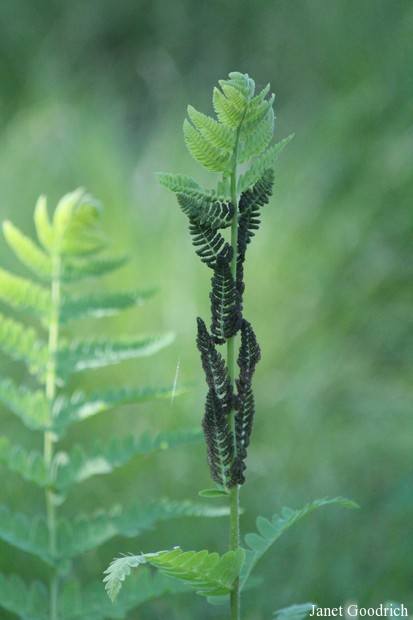
Interrupted Fern 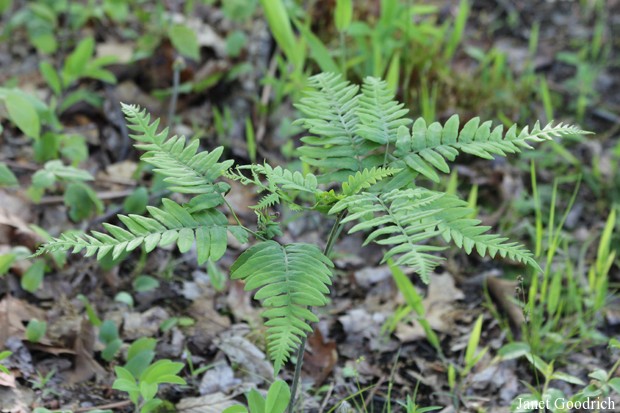
Bracken Fern 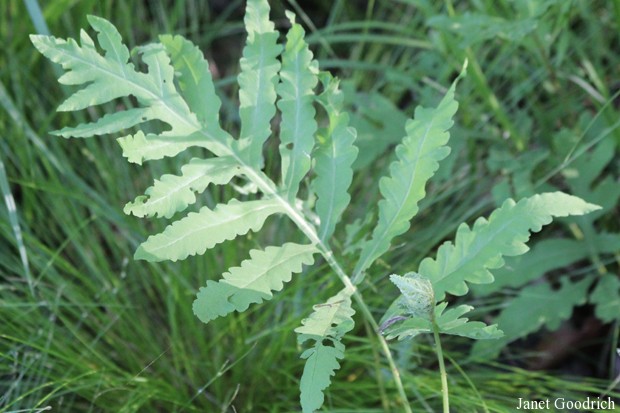
Sensitive Fern We’ve seen these four kinds of fern on our walks of late. I’ve been comparing them on the basis of the shapes of the pinnules, the manner in which the fronds grow from the main stem, and the manner in which the spore cases grow — whether as separate fronds, or as interspersed pinnae. The shades of green are slightly different too.
A little vocabulary I’m learning: The main stem is the stipe; the frond stem is the rachis; the whole “arm” is the frond; the individual “fingers” growing from the frond are the pinnae; the individual “leaves” growing from the pinnae are the pinnules.
-
Pileated Pair
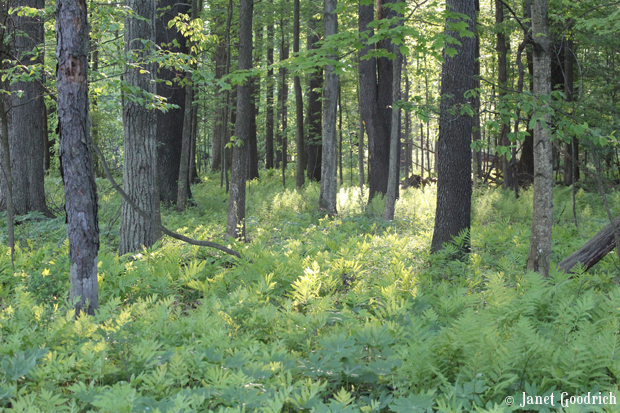
Yesterday I crouched in ferny woods for 45 minutes or so, waiting for the pileated woodpeckers to show themselves. It was 6:30 in the morning when I settled myself on a damp fallen log in the tick-infested woods, within view of the nest, but not too close.
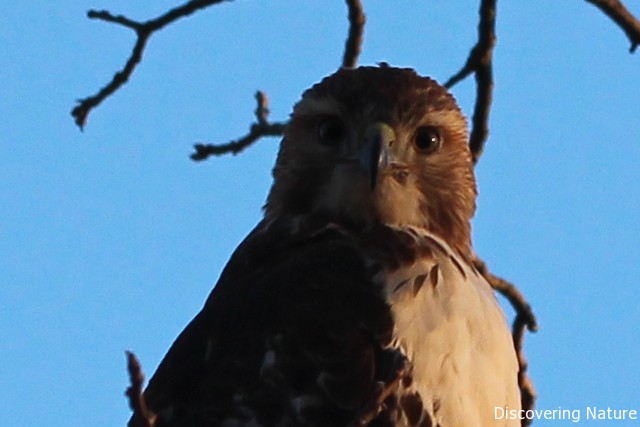
I watched red-winged blackbirds chasing one another and sounding off. A broad-winged hawk lit on a branch over my head and gave me one brief, piercing look before taking flight to escape some marauding grackels. By 7:00 I was getting chilled, my feet were falling asleep, and my trick neck was threatening to jam as I looked up wistfully at the woodpecker cavity.
Suddenly, Mrs. Pileated appeared, a silhouette against the sky on a neighboring tree. She pecked away quietly, making sure the coast was clear, then whooshed to the tree and went inside.

She wasn’t in there long before Mr. Pileated appeared. He surveyed the scene carefully from several different trees, including one right in front of me.
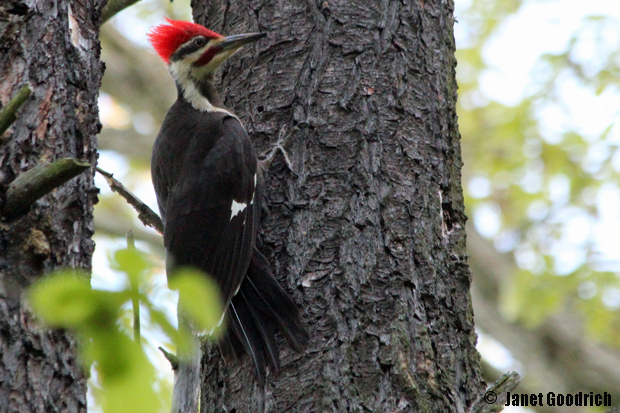
Then he made his move.


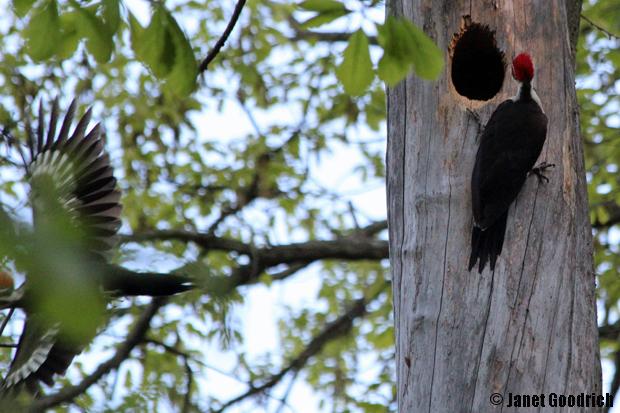
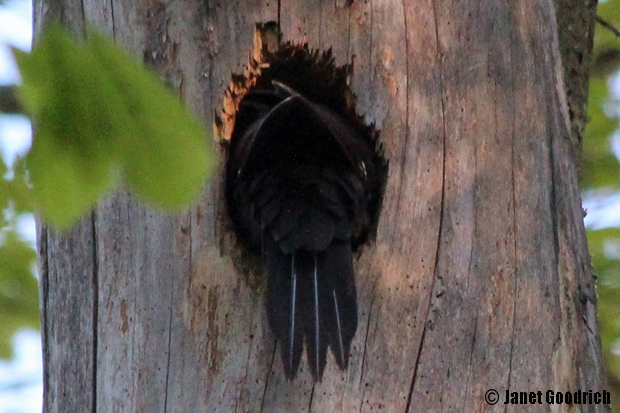
I left, being careful to use a different route than the one I took coming in.
It was thrilling. I think of pileated woodpeckers as belonging to the wilderness, and I felt privileged to see them going through their routines together. I still haven’t seen any little beaks poking out. How many nestlings do they have? When will they fledge? I don’t want to hound them by coming too often, but I hope I’ll see a glimpse of the youngsters at some point. I’ve never seen a juvenile pileated woodpecker.
What is it that drives me to such an activity early on a Saturday morning? I’ve been thinking about it today. My woodland explorations have come to seem like some of the most real moments of my life. It’s the ultimate “unplugged” experience, for one thing. The sights and sounds and smells are all vivid and direct. For another, there is no pretense in nature. All around me are creatures busy at the task of survival. They need food; they need to mate and raise young; they need to stake out territory to provide for themselves. It’s life and death for them, and it exposes many of my human rituals and “concerns” as simply trivial. Which brings us to humility. It’s humbling to get these glimpses of the complexity and variety and beauty of the non-human world. Humbling, and deeply inspiring.
What better way could there be to start a weekend?
-
John James Audubon for Children
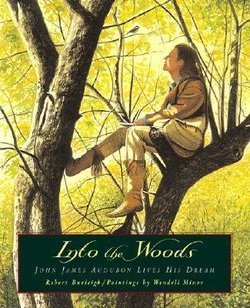
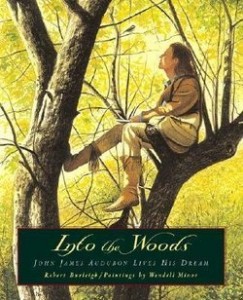 Into the Woods: John James Audubon Lives His Dream is structured fictionally as a letter from Audubon to his father. “Be a shopkeeper,” his father advises. Into the Woods represents the young man’s answer.
The book is written as a combination of poetry and prose. Each page has a rhymed couplet from the young naturalist’s letter to his father back in France, describing his passion for observing and documenting the natural world through art. After several attempts in business, Audubon decides to follow his dream of exploring and depicting nature.
Accompanying each couplet is an excerpt from Audubon’s actual writings, describing the episode referred to — drawing a hawk or a dove, noting the changes to the land, his travels and ambitions. The illustrations by Wendell Minor are a beautiful complement to the text, and some of Audubon’s drawings are interspersed as well. The book concludes with a brief biographical note about John James Audubon and his significance.
My daughters found this book very appealing, and today dawns with my youngest planning a drawing session in which we’re all supposed to sit together drawing birds.
 I couldn’t help but compare this book with The Boy Who Drew Birds, a book more narrowly focused on a period of the young Audubon’s life. Sent from France to his father’s Pennsylvania farm to escape being drawn into Napolean’s army, the 18-year-old boy wanders the countryside observing and wondering about nature. He even ties silver thread around the legs of some of the birds on his farm to see if they will return the following spring.
Both tales are good introductions to the life of a naturalist and artist who has made great contributions to the fields of ornithology and nature study in general. The combination of artistic enterprise and interest in the outdoors, highlighted beautifully in both of these books, is sure to appeal to any child through ages 11-12.
Though these two are the only books on Audubon that we’ve read so far, if the girls show interest in further reading there are others to choose from:
- John James Audubon: Wildlife Artist by Peter Anderson
- Audubon: Painter of Birds in the Wild Frontier by Jennifer Armstrong
- First Impressions: John James Audubon by Peter Kastner
- John Audubon: Young Naturalist by Miriam E. Mason
- John James Audubon (Conservation Heroes) by Patrice Sherman
You May Also Like
Flyaway
-
Yellowthroats and Other Wonders
Yesterday we visited the Nature Preserve managed by the State University here in town. It was our first time back since the trees were just starting to bud, and the bright green of maples gave the woods an enchanted feel. Tossing leaves dappled the ground with shifting shadows.
Younger Daughter (8) spotted this tiny flower first thing. When I got home I looked for it in our Peterson’s First Guide, but I didn’t find it.
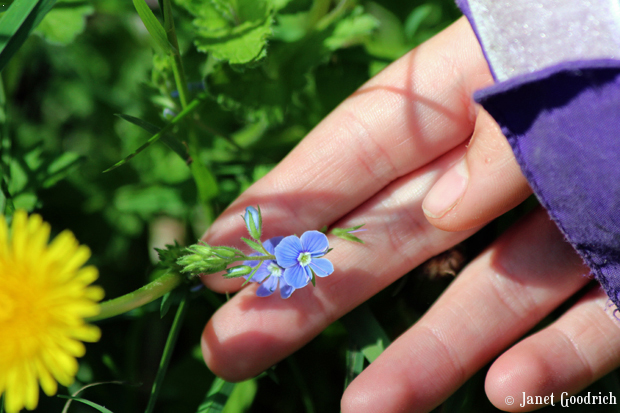
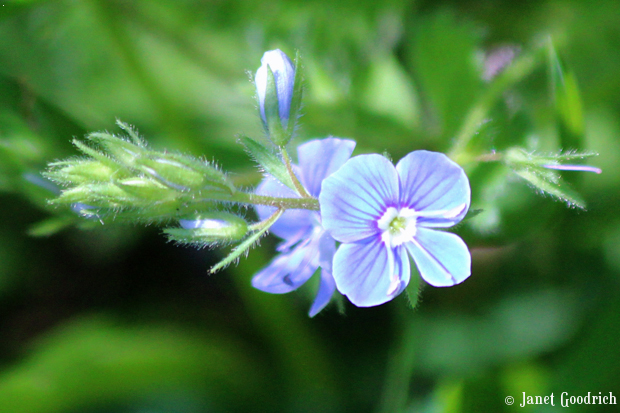
*Edited to add: I think it’s called bird’s-eye speedwell! Hat-tip to Ramble.
We visited the vernal pool that was so active in early spring with salamanders, wood frogs, spring peepers, and the eggs of all three.
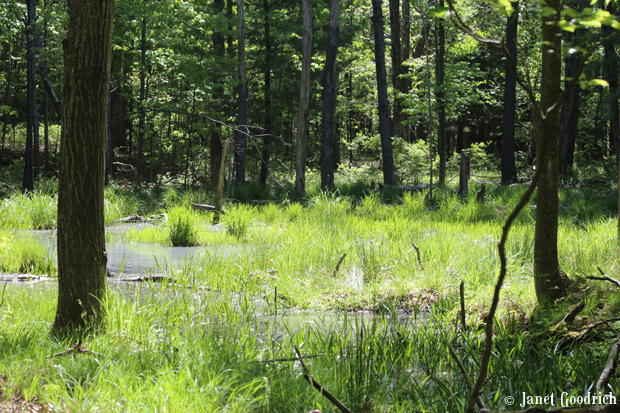
We saw a few salamanders, frogs and turtles, but compared to before, it had the air of a place winding down. It was much quieter. But some species were still busy reproducing. We saw this enormous spider hustling along with its egg sac. Given that I’ve just reread Tolkien’s Two Towers with its memorable Spiderish Monster, I named it Shelob.

The resident brown creeper was there, too.
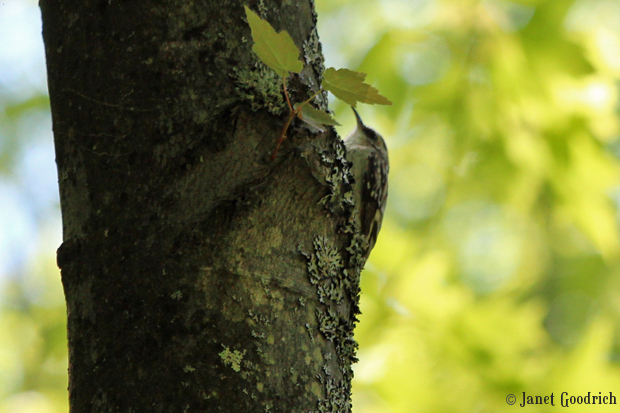
We ventured on past an abandoned beaver lodge and numerous stands of fern.

At the pond, a song sparrow greeted us, and directed our attention to a goose practicing her figure skating.
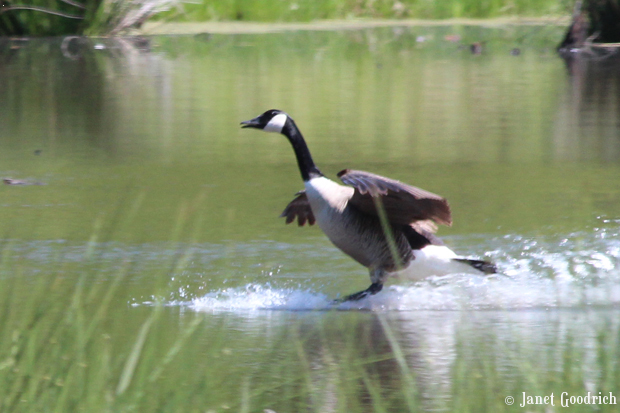
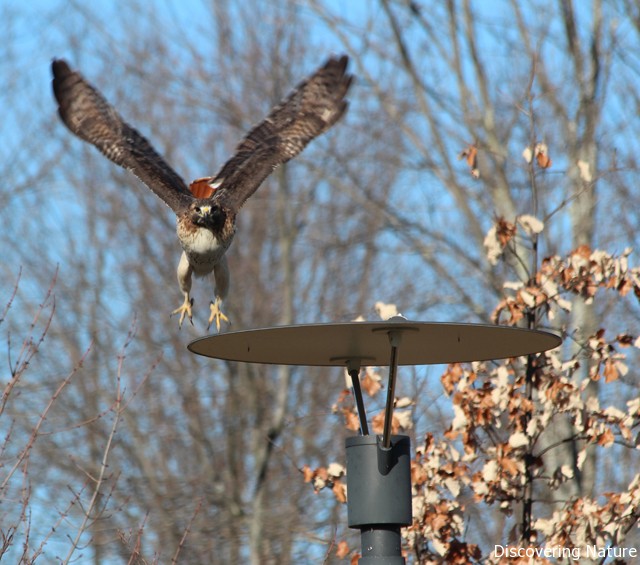
There were a few water snakes, sunfish, bullheads, a Baltimore oriole, yellow warblers, and catbirds buzzing about. We also saw a water-loving mammal munching among the grasses. It was leaner and quicker and darker than a muskrat, so we guessed it was a mink. Out across the water, a hermit thrush or wood thrush was singing, and two red-tails were circling together over a spot on the hillside. I’m guessing they may have a nest there.
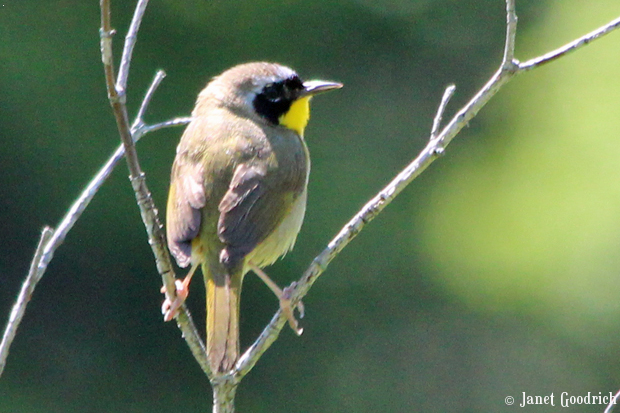
A common yellowthroat was trumpeting his “wichity wichity wichity” call, and he let me get a few pictures, quick though he was.

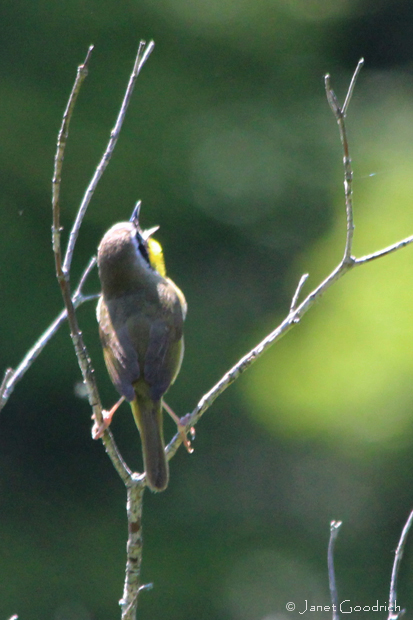
There was another photographer there, one with a 200-500 lens. Mine is a 70-300. He suggested getting a hood and a polarizer to cut down on glare. I actually have a polarizing filter; it came along with the plain UV filter I bought when I first got my lens. I tried it out after I got home, but as before when I’d tried using it, I wasn’t impressed. Maybe it’s not the best quality. I don’t have a hood, but I’d like to try one. I noticed that last weekend at the Migration Celebration, quite a few folks were using them.
On the way out, I enjoyed these flowers. They’re quite tiny, and like many of the other spring flowers they’re plain white. I wish my picture had better focus (I couldn’t move far enough away for the lens), but even as is it has a certain dreamlike quality.

-
A walk in the sun
The girls and I drank in the sunshine yesterday with a saunter through the woods.
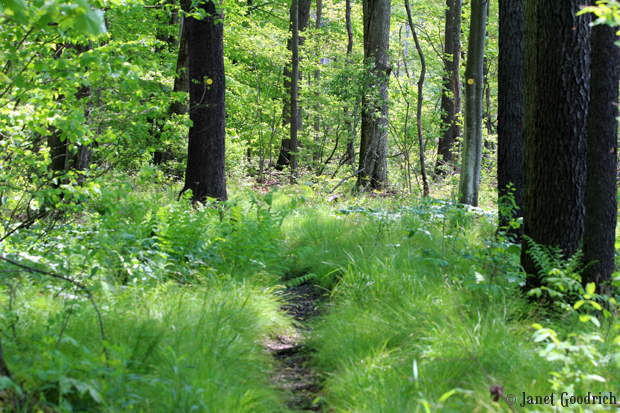
Every time we come here, we see new wildflowers appearing. This time we saw May apple.
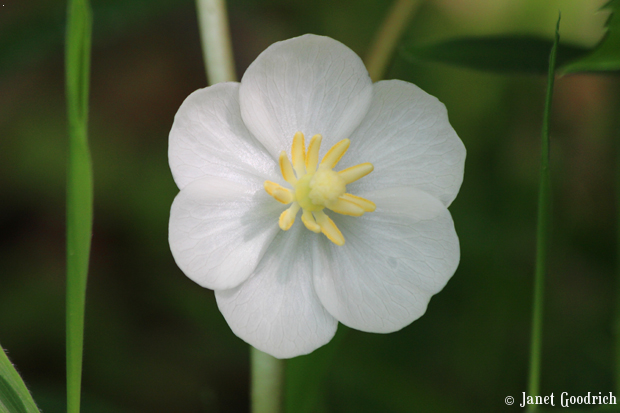
Apparently the flower will morph into a yellow berry that can be made into jelly. (The rest of the plant is poisonous.) I’ve noticed the broad-leaved plant for a few weeks now, carpeting the ground, but this was the first time we saw the blooms.
Here’s how it looked two weeks ago.

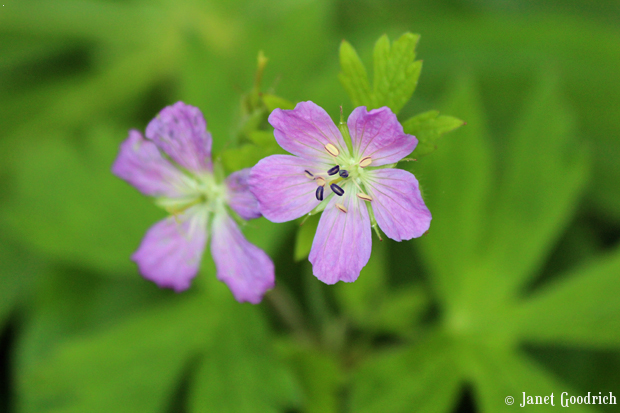
May apple in early May This delicate flower is apparently wild geranium.
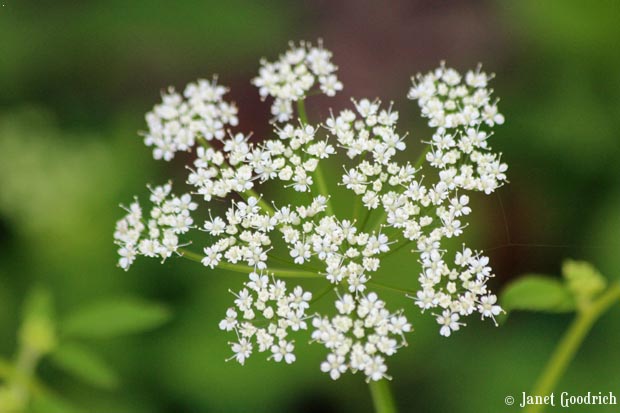
Queen Anne’s Lace makes me sneeze, but I think it’s quite pretty — not as threadbare as it looks as first glance.
We were on our way to check on the pileated woodpecker nest we discovered in April. This photo was taken on April 19, and I haven’t surpassed it — yet.
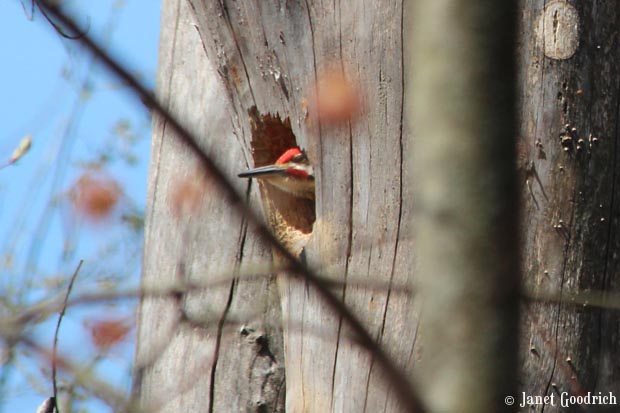
At this point I assume the adult birds are feeding youngsters. One of these days, I hope to see some little beaks poking out. But for now we content ourselves with seeing the adult birds flying to the cavity and disappearing inside, or suddenly bursting out and flying away. It must be some deep cavity! These are large birds, and presumably there are nestlings in there too, but you can’t see any trace of them inside.
We did see the adult birds change shifts — the female arrived and the male flew off. On our way in we received another treat: a chance to watch a Northern flicker excavating a nesting cavity.

Northern Flicker 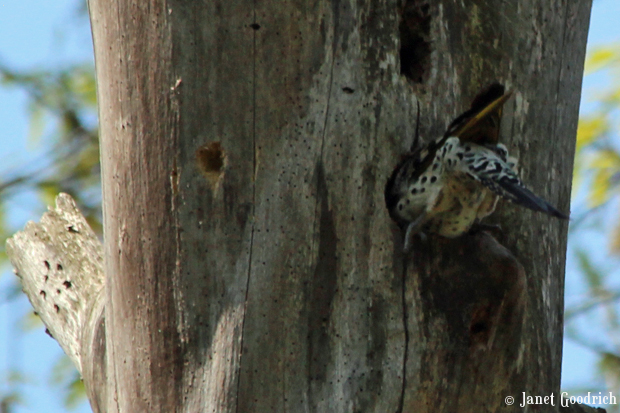
Flicker fanny... 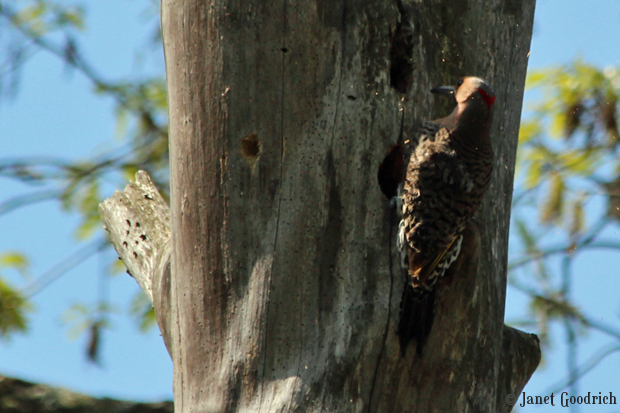
Flicker shaking off particles of sawdust before ducking inside for more excavating. I read that these birds are in decline. Starlings compete for their nesting sites and usually win. It made the knowledge of this nest all the more exciting. This is the fourth nest we’ve discovered: the robin in our front shrub, the pileated pair, a red-bellied woodpecker nest at another site, and now the flicker. There’s a feeling of privilege in being able to observe such things.
The day was so nice that we took another short stroll at a different place. We stumbled upon a buttercup carpet.
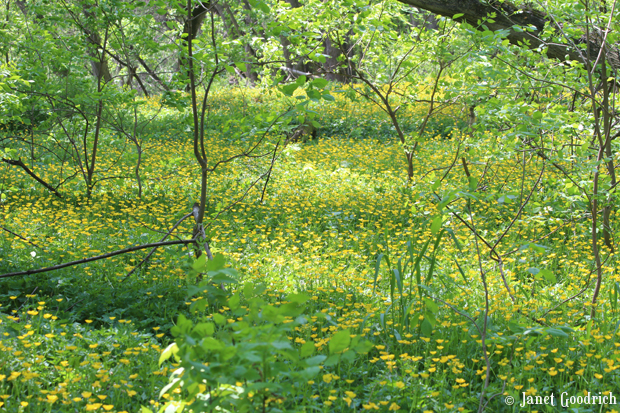
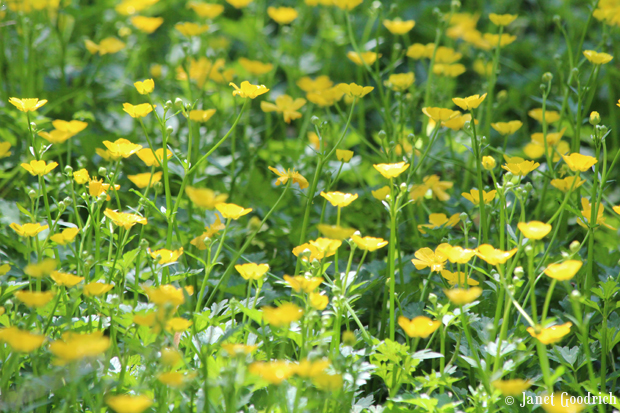
These are just a few of the sights and sounds we enjoyed. We also saw many yellow warblers, mockingbirds, catbirds, robins, chipping sparrows and song sparrows and tree swallows. Off in the woods, we heard a hermit thrush sing its rippling, echoing song. A Baltimore oriole flitted about in the treetops overhead, warbling conversationally.
Beauty everywhere. It was inspiring and quieting in the best ways.