-
Yellowthroats and Other Wonders
Yesterday we visited the Nature Preserve managed by the State University here in town. It was our first time back since the trees were just starting to bud, and the bright green of maples gave the woods an enchanted feel. Tossing leaves dappled the ground with shifting shadows.
Younger Daughter (8) spotted this tiny flower first thing. When I got home I looked for it in our Peterson’s First Guide, but I didn’t find it.
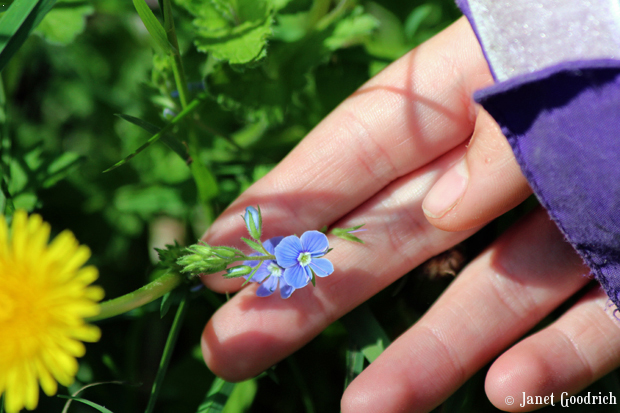
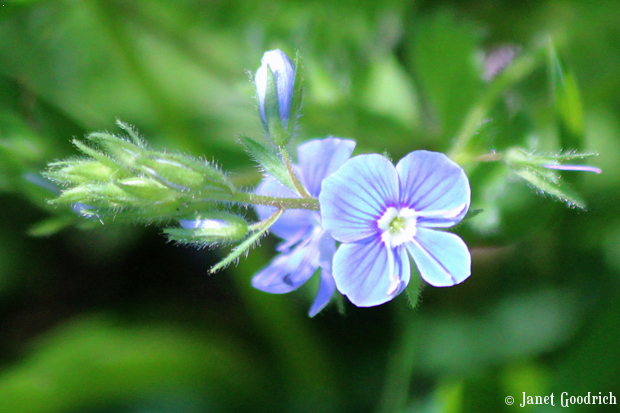
*Edited to add: I think it’s called bird’s-eye speedwell! Hat-tip to Ramble.
We visited the vernal pool that was so active in early spring with salamanders, wood frogs, spring peepers, and the eggs of all three.
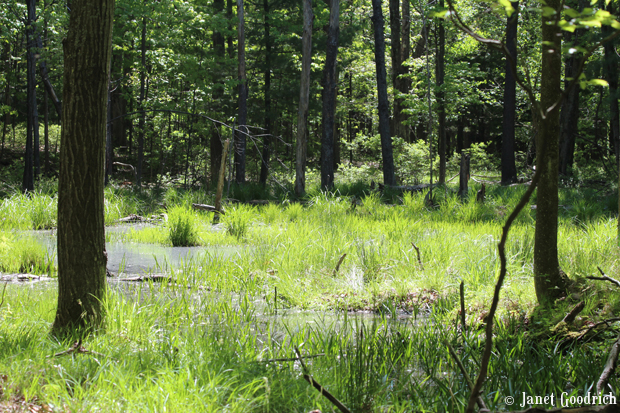
We saw a few salamanders, frogs and turtles, but compared to before, it had the air of a place winding down. It was much quieter. But some species were still busy reproducing. We saw this enormous spider hustling along with its egg sac. Given that I’ve just reread Tolkien’s Two Towers with its memorable Spiderish Monster, I named it Shelob.

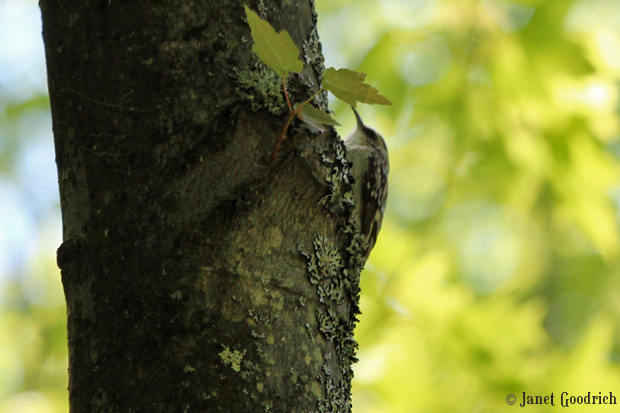
The resident brown creeper was there, too.
We ventured on past an abandoned beaver lodge and numerous stands of fern.

At the pond, a song sparrow greeted us, and directed our attention to a goose practicing her figure skating.
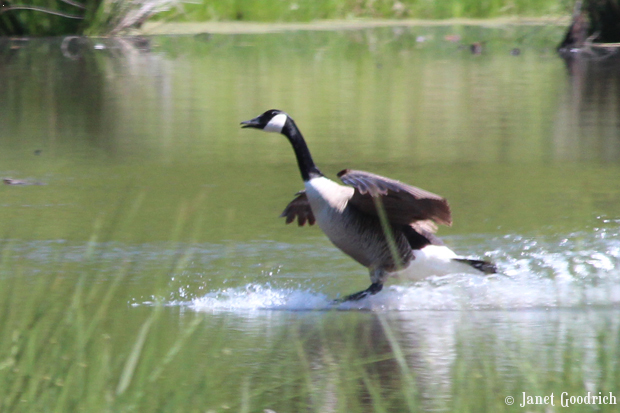
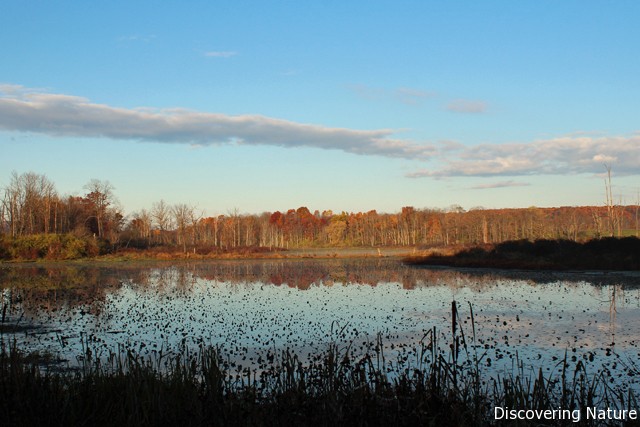
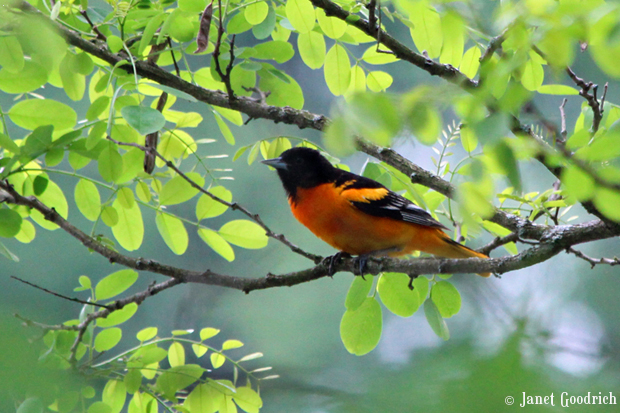
There were a few water snakes, sunfish, bullheads, a Baltimore oriole, yellow warblers, and catbirds buzzing about. We also saw a water-loving mammal munching among the grasses. It was leaner and quicker and darker than a muskrat, so we guessed it was a mink. Out across the water, a hermit thrush or wood thrush was singing, and two red-tails were circling together over a spot on the hillside. I’m guessing they may have a nest there.
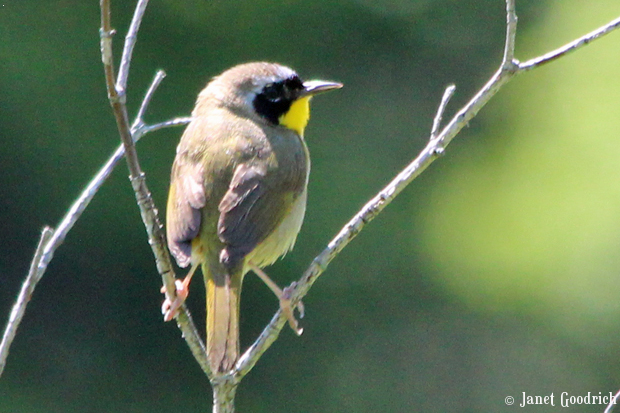
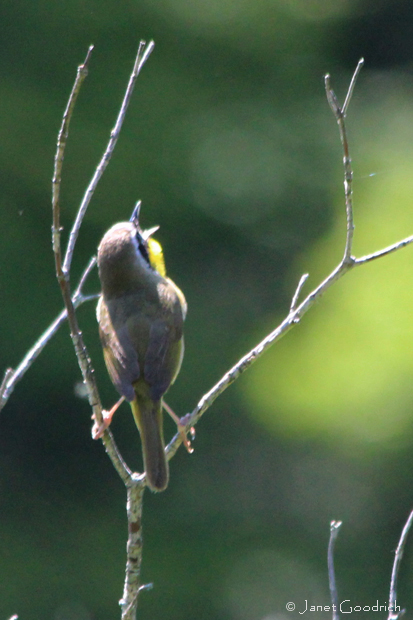
A common yellowthroat was trumpeting his “wichity wichity wichity” call, and he let me get a few pictures, quick though he was.

There was another photographer there, one with a 200-500 lens. Mine is a 70-300. He suggested getting a hood and a polarizer to cut down on glare. I actually have a polarizing filter; it came along with the plain UV filter I bought when I first got my lens. I tried it out after I got home, but as before when I’d tried using it, I wasn’t impressed. Maybe it’s not the best quality. I don’t have a hood, but I’d like to try one. I noticed that last weekend at the Migration Celebration, quite a few folks were using them.
On the way out, I enjoyed these flowers. They’re quite tiny, and like many of the other spring flowers they’re plain white. I wish my picture had better focus (I couldn’t move far enough away for the lens), but even as is it has a certain dreamlike quality.

-
A walk in the sun
The girls and I drank in the sunshine yesterday with a saunter through the woods.
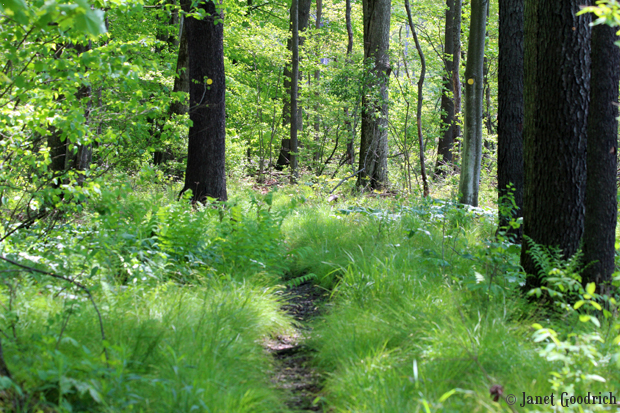
Every time we come here, we see new wildflowers appearing. This time we saw May apple.
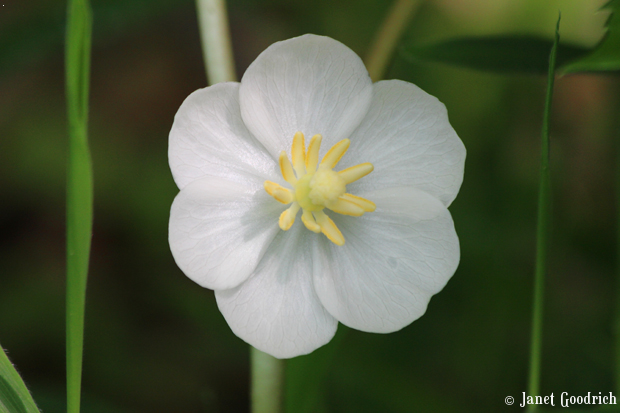
Apparently the flower will morph into a yellow berry that can be made into jelly. (The rest of the plant is poisonous.) I’ve noticed the broad-leaved plant for a few weeks now, carpeting the ground, but this was the first time we saw the blooms.
Here’s how it looked two weeks ago.

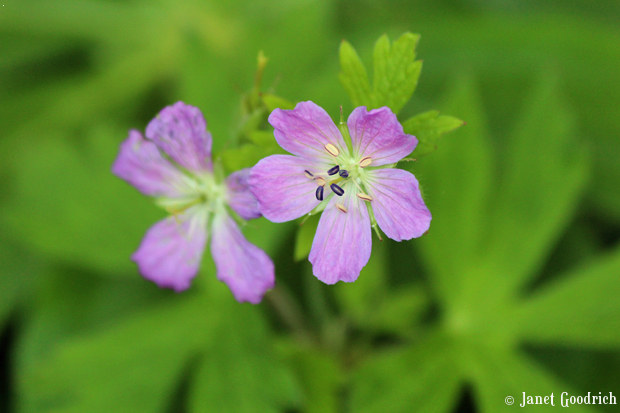
May apple in early May This delicate flower is apparently wild geranium.
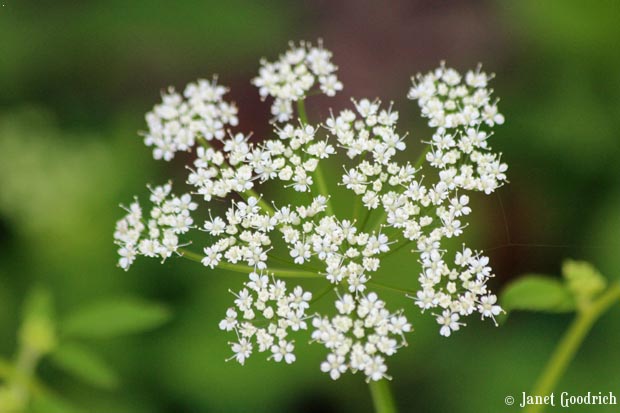
Queen Anne’s Lace makes me sneeze, but I think it’s quite pretty — not as threadbare as it looks as first glance.
We were on our way to check on the pileated woodpecker nest we discovered in April. This photo was taken on April 19, and I haven’t surpassed it — yet.
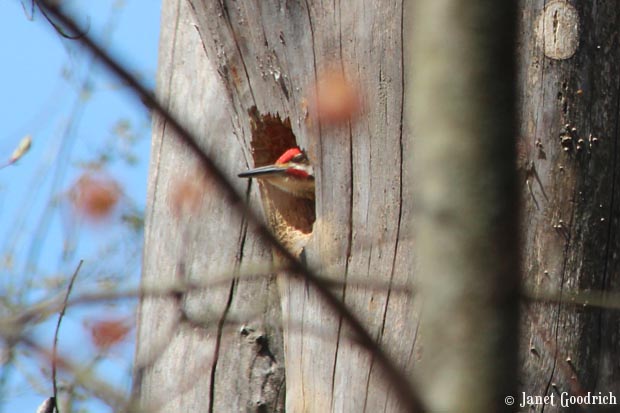
At this point I assume the adult birds are feeding youngsters. One of these days, I hope to see some little beaks poking out. But for now we content ourselves with seeing the adult birds flying to the cavity and disappearing inside, or suddenly bursting out and flying away. It must be some deep cavity! These are large birds, and presumably there are nestlings in there too, but you can’t see any trace of them inside.
We did see the adult birds change shifts — the female arrived and the male flew off. On our way in we received another treat: a chance to watch a Northern flicker excavating a nesting cavity.

Northern Flicker 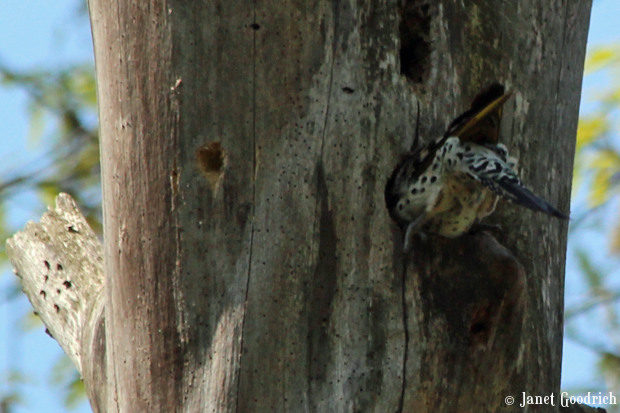
Flicker fanny... 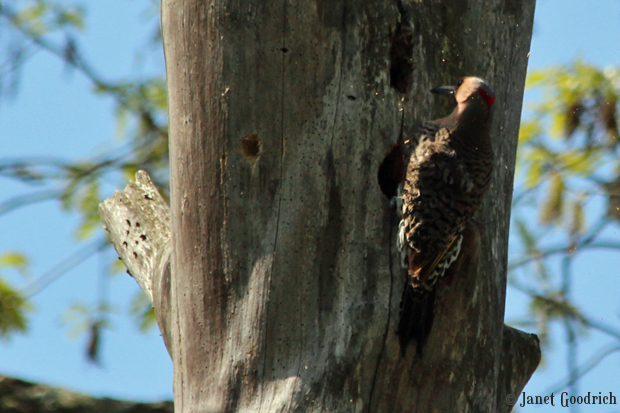
Flicker shaking off particles of sawdust before ducking inside for more excavating. I read that these birds are in decline. Starlings compete for their nesting sites and usually win. It made the knowledge of this nest all the more exciting. This is the fourth nest we’ve discovered: the robin in our front shrub, the pileated pair, a red-bellied woodpecker nest at another site, and now the flicker. There’s a feeling of privilege in being able to observe such things.
The day was so nice that we took another short stroll at a different place. We stumbled upon a buttercup carpet.
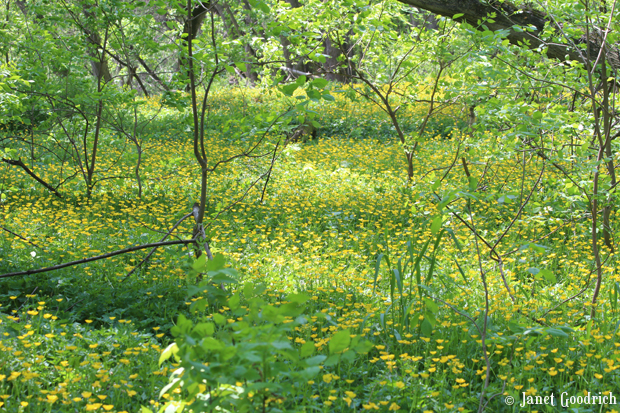
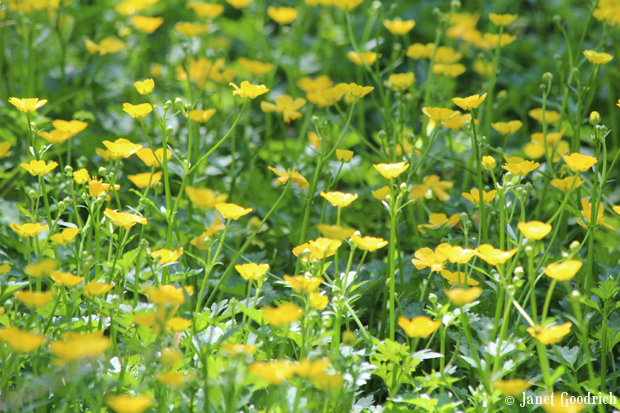
These are just a few of the sights and sounds we enjoyed. We also saw many yellow warblers, mockingbirds, catbirds, robins, chipping sparrows and song sparrows and tree swallows. Off in the woods, we heard a hermit thrush sing its rippling, echoing song. A Baltimore oriole flitted about in the treetops overhead, warbling conversationally.
Beauty everywhere. It was inspiring and quieting in the best ways.

-
Sparrows
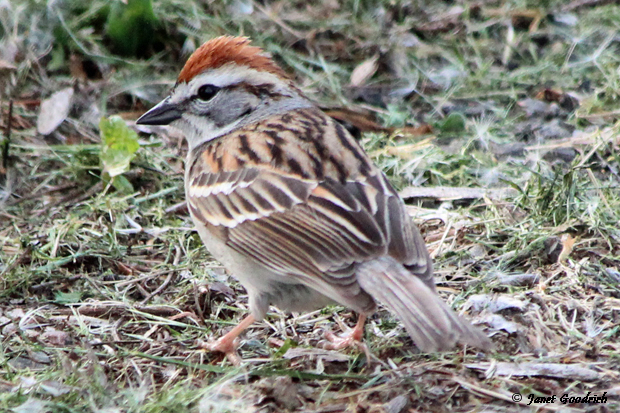
Sparrows are so “common” — little brown birds hopping in the periphery almost everywhere. But last year, it was this little chipping sparrow, who would come to the feeder and throw his head back in song, that jolted me into paying attention to birds.
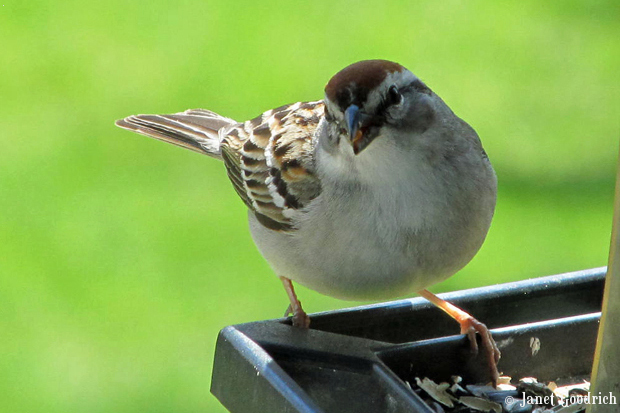 It’s so beautifully colored and marked, and so busy and sociable. Anna Botsford Comstock is quite emphatic in the Handbook of Nature Study about its helpfulness to humans by consuming garden pests, but even without such “utility” it’s appealing.
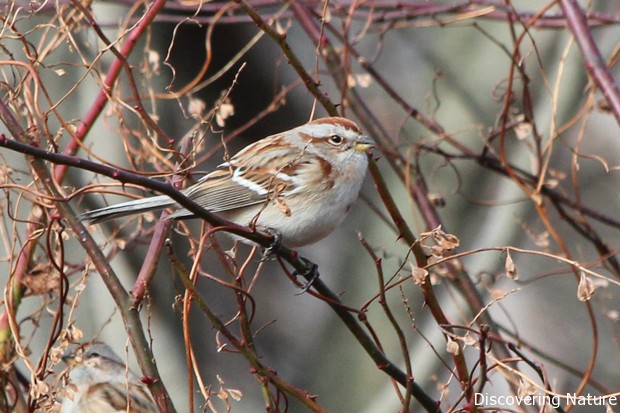
Since then I’ve begun to distinguish different kinds of sparrows, and there is an amazing variety. Back in the winter, I noticed tree sparrows for the first time. They’re very similar in appearance to the chipping sparrows, but they stay all winter — the season so nearly bereft of color when it’s overcast, as it was when I snapped this.
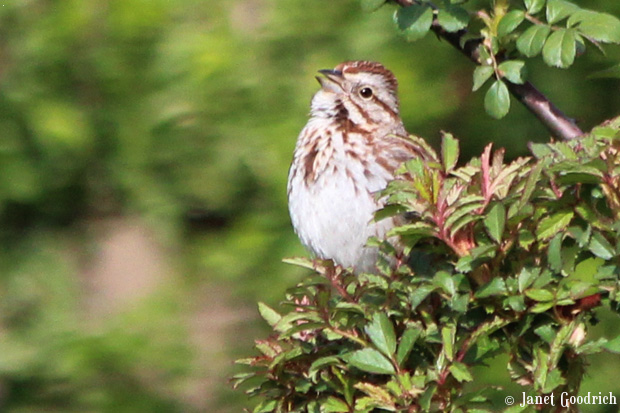
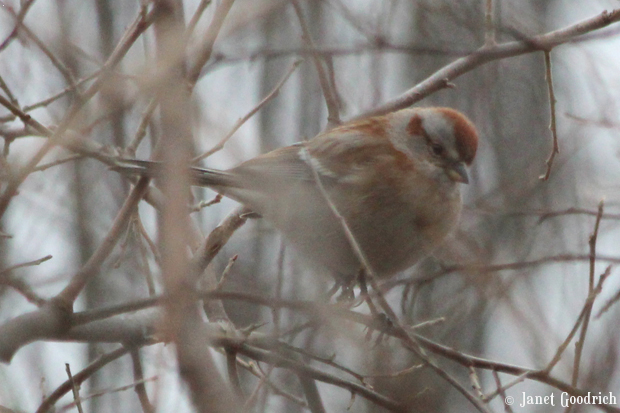 One of the first birds to break the winter silence was the song sparrow. Now that I’m aware of it, I hear it everywhere.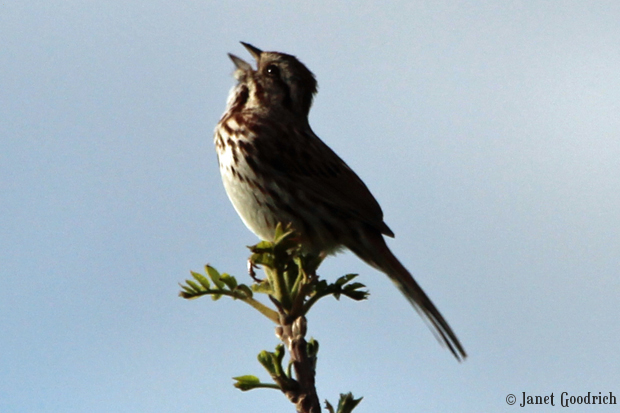
I love the wholeheartedness — head thrown back, belting it out into the morning. Thornton Burgess names him “Little Friend.”
White-throated sparrows, which I’ve always associated with the Adirondacks, stayed here for a few weeks on their way back northward. Till this year I heard but never saw one. Their song is very high and sweet and lonesome, and I would have pictured a more diminutive bird. I think they’re beautiful with that dash of yellow and those crisp stripes. How could I have missed them before this year?
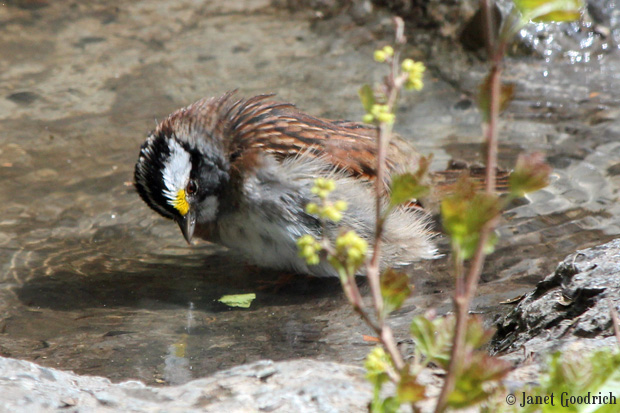
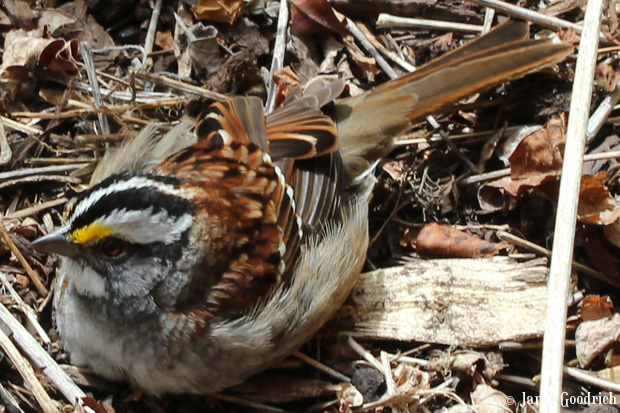
Just a few days ago, I saw another one that’s new to me: a white-crowned sparrow.
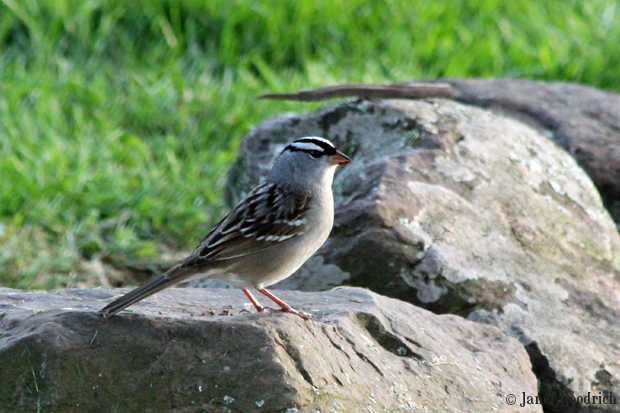 There are also English sparrows, seen everywhere from parking lots to barns to other birds’ nests. I don’t have a photo of one. And there are others that I haven’t seen yet that I have heard or can expect to see — swamp, vesper, and field sparrows, for instance.
So many varieties of “common.” I’m reminded of the passage in Zen and the Art of Motorcycle Maintenance where the writing teacher encourages a girl to break through writer’s block not by choosing a larger subject, but a smaller, more narrowly focused one:
He’d been having trouble with students who had nothing to say. At first he thought it was laziness but later it became apparent that it wasn’t. They just couldn’t think of anything to say.
One of them, a girl with strong-lensed glasses, wanted to write a 500-word essay about the United States. He was used to the sinking feeling that comes from statements like this, and suggested without disparagement that she narrow it down to just Bozeman.
When the paper came due she didn’t have it and was quite upset. She had tried and tried but she just couldn’t think of anything to say…
It just stumped him. Now he couldn’t think of anything to say. A silence occurred, and then a peculiar answer: “Narrow it down to the main street of Bozeman.” It was a stroke of insight.
She nodded dutifully and went out. But just before her next class she came back in real distress, tears this time, distress that had obviously been there for a long time. She still couldn’t think of anything to say, and couldn’t understand why, if she couldn’t think of anything about all of Bozeman, she should be able to think of something about just one street.
He was furious. “You’re not looking!” he said. A memory came back of his own dismissal from the University for having too much to say. For every fact there is an infinity of hypotheses. The more you look the more you see. She really wasn’t looking and yet somehow didn’t understand this.
He told her angrily, “Narrow it down to the front of one building on the main street of Bozeman. The Opera House. Start with the upper left-hand brick.”
Her eyes, behind the thick-lensed glasses, opened wide.
She came in the next class with a puzzled look and handed him a five-thousand-word essay on the front of the Opera House on the main street of Bozeman, Montana. “I sat in the hamburger stand across the street,” she said, “and started writing about the first brick, and the second brick, and then by the third brick it all started to come and I couldn’t stop…”
“Nature” is a large subject. But to narrow the focus is to find that it’s even larger, more intricate, more extravagant. You could probably write well over 5,000 words about sparrows alone.
-
Migration Celebration
On Saturday we visited the Cornell Lab of Ornithology for their Migration Celebration. It was an opportunity to see the many kinds of work they do at the lab: raptors, bird banding, nest and birdwatching walks, audio and video archiving, crafts and face-painting and ice cream. (Okay those last three aren’t especially bird-related…)
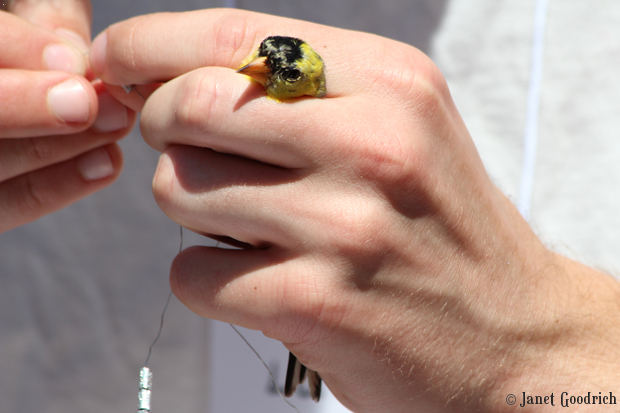
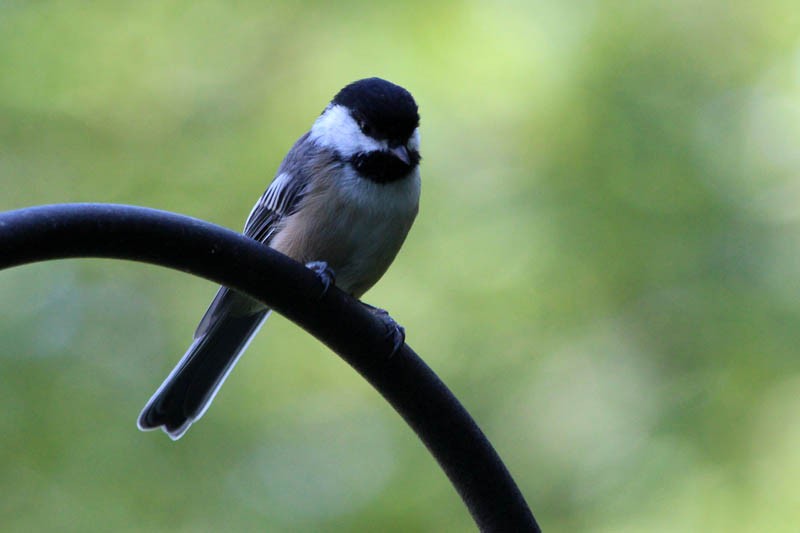
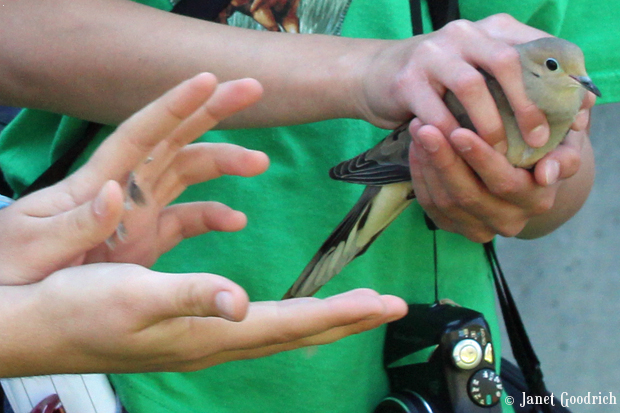
A highlight for my daughters was the bird banding demo. They got to see the mist nets used to catch birds because there were some set up near the feeders. We saw them band a goldfinch, two downy woodpeckers, a mourning dove, and a chickadee.
I have mixed feelings about bird banding. I’m sure it yields interesting information. But is it interesting enough to make the birds wear those bracelets forever on their delicate legs? I never really thought about it till I read David Kline’s Great Possessions. He quotes Gene Hill:
I have nothing against scientific observation, census, or just plain curiosity. I am as interested as the next ignoramus about the curious life cycle of the migrating butterfly or the whereabouts of the black-footed ferrets, but I think there are some technological gadgets that we could resist in the name of decency, even if life is a little more incomplete without them.
I’m alone in my ambivalence, however. My whole family LOVED the banding. (My husband even wants to learn how to become licensed as a bird bander.) And there was certainly great emphasis on reducing the stress of the whole experience as much as possible for the captured birds. Both girls got to release a banded bird, which, from the looks on their faces, was an incomparable experience.
 We went on a walk with an ornithologist who brought recordings of birds — chickadees and titmice sounding the alarm over a screech owl — to lure the birds in close. I’ve always been hesitant about such walks because I thought the birds would stay hidden from a group of people making noise, but we saw several birds — yellow warblers, common yellowthroats, chickadees, titmice, woodpeckers, grackels. We also saw (and heard) a bird that I’ve heard of but never seen: a blue-winged warbler.
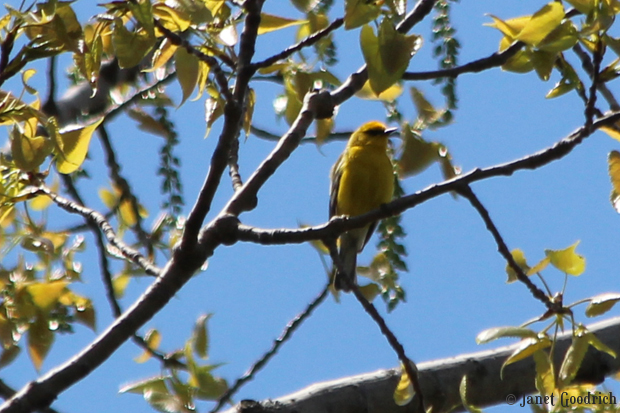 It was an impressive showing, especially given that it was high noon! I learned to distinguish the calls of the blue-wing and the yellowthroat, so on the whole it was quite educational.
Out back were a number of raptors on display. It’s always a thrill to see one up close, and to glean tidbits from their handlers.
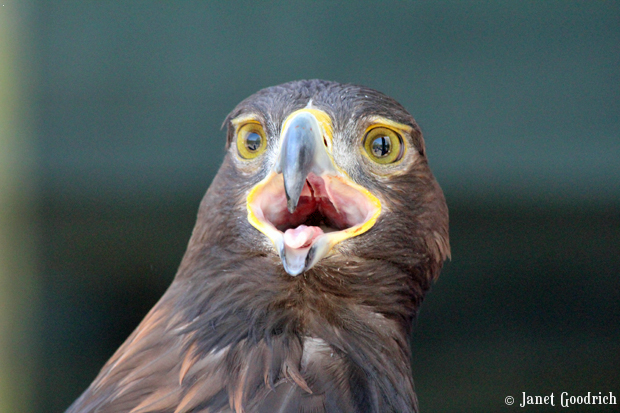
Golden eagle panting in the heat 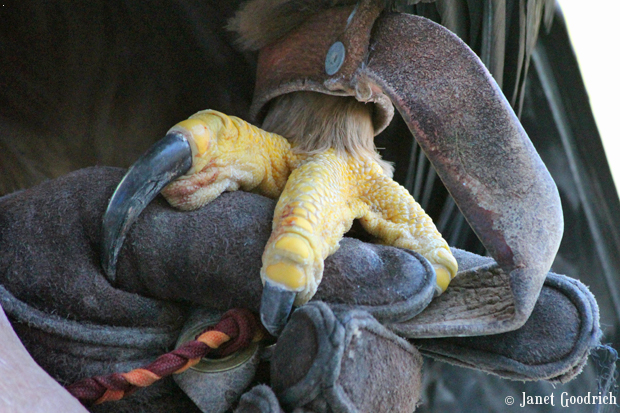
Golden eagle talon 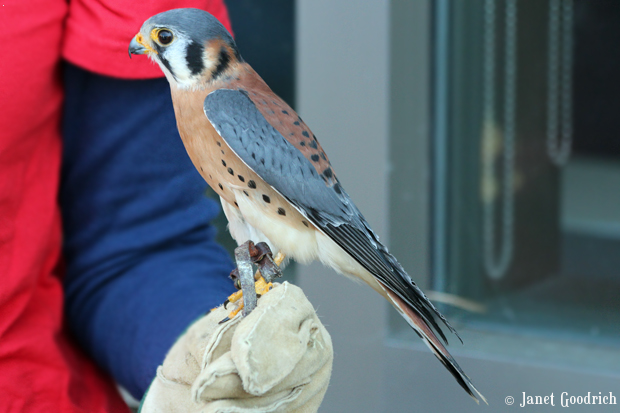
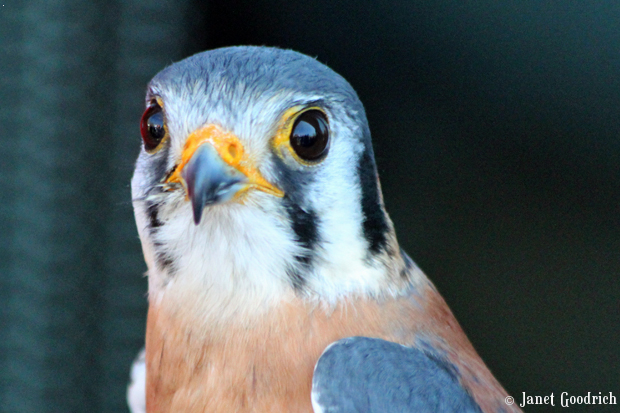
American kestrel 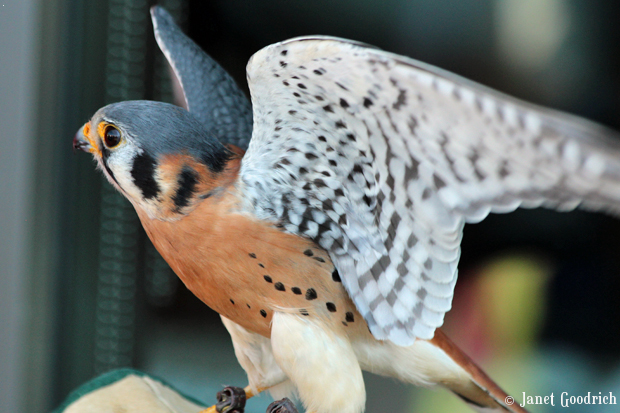
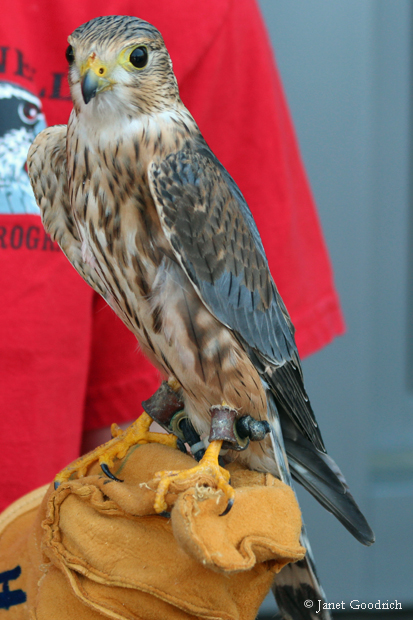
Merlin 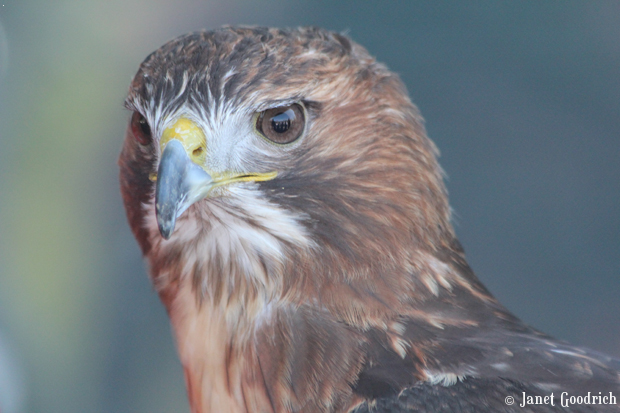
Red-tail 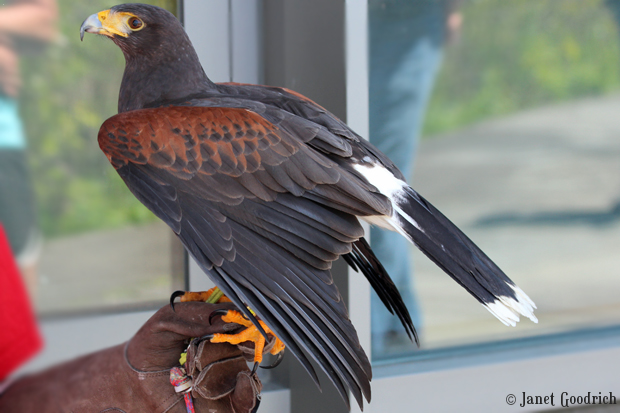
Harris hawk 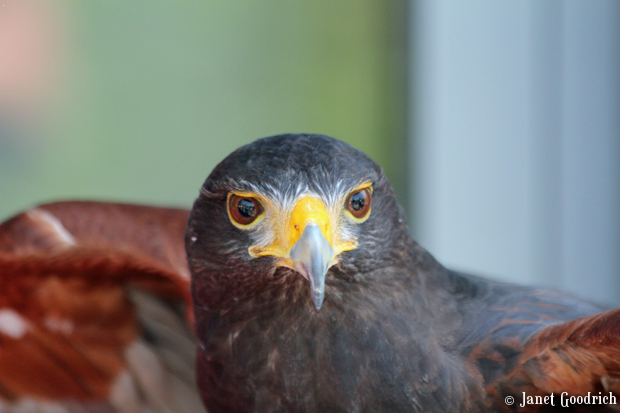
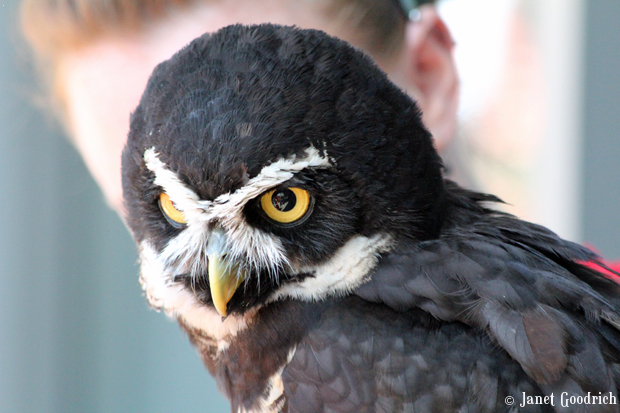
Spectacled owl 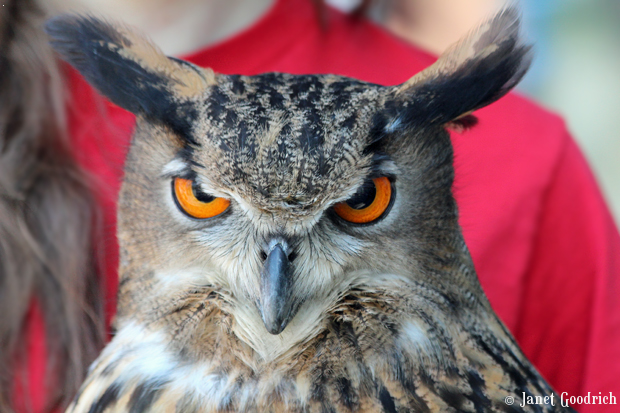
Great horned owl 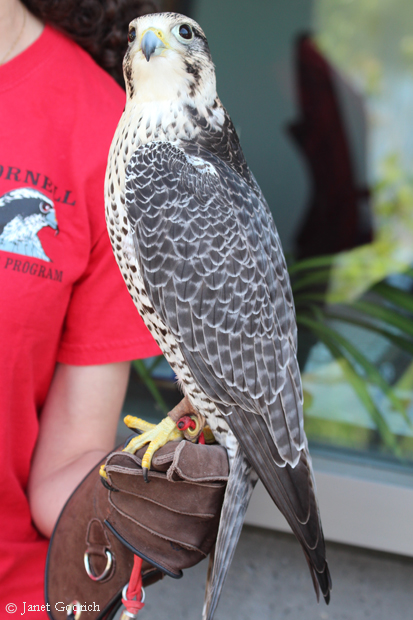
Mix of three kinds of falcons 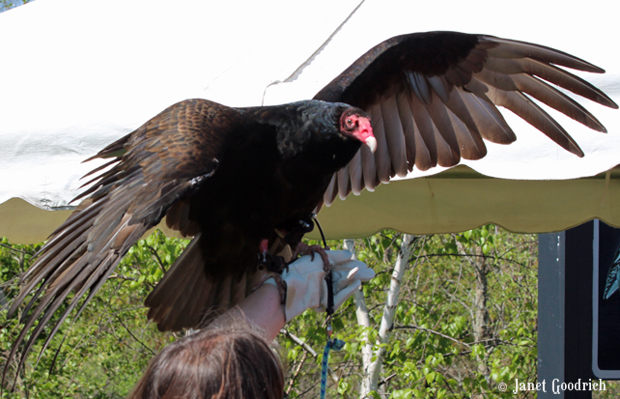
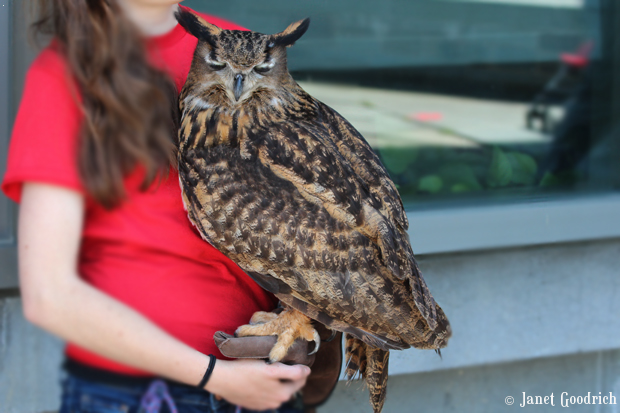
Tuvu the turkey vulture greeted everyone on their way in. We had a gorgeous sunny day for the event and found it all very stimulating, but the eagle owl reminded us that he was out past bedtime!
-
Cornell Hawks and Hawklings
We made our second trip to visit the hawks featured on Cornell’s webcam on May 12. It was Cornell Lab of Ornithology’s Migration Festival, and our family went to the lab to enjoy this opportunity to get a glimpse of all the many aspects of the Lab’s work. I’ll write more about it in another post.
After a full schedule of events there, we stopped by the hawk nesting site on Tower Road to see what we could see. Ezra (the male) was on the nest when we arrived, and Big Red (the female) was perched on a light tower across the athletic field from the nest.

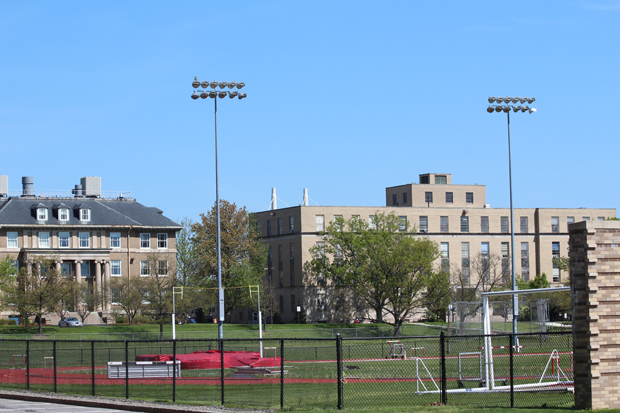
Big Red is perched atop the left-hand pole. 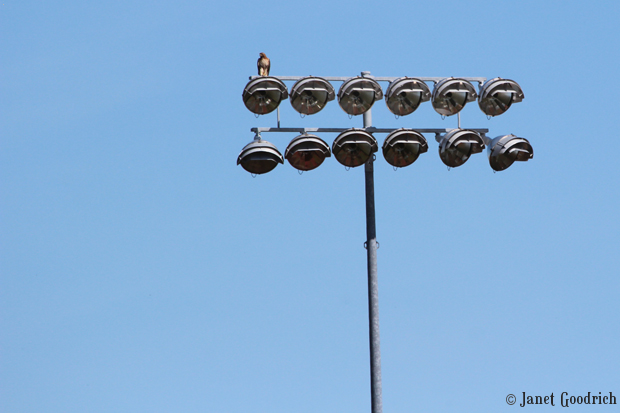 We stayed for about 15 minutes, but that was all the time we had. As we started for the car, I saw Red flapping back toward the nest. I was not in the best position any longer, shooting toward the sun, but I snapped a few shots of the shift-change. Big Red was quite vocal when she returned to the tower, and Ezra didn’t wait long to dive off and head for a nearby light pole.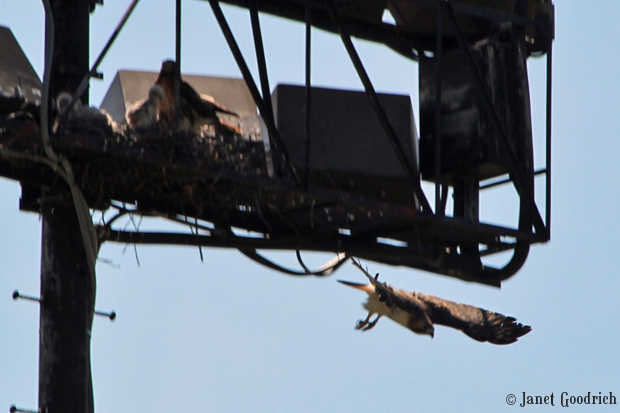
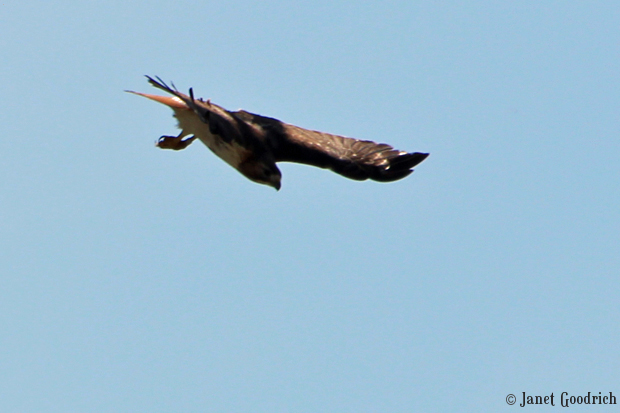
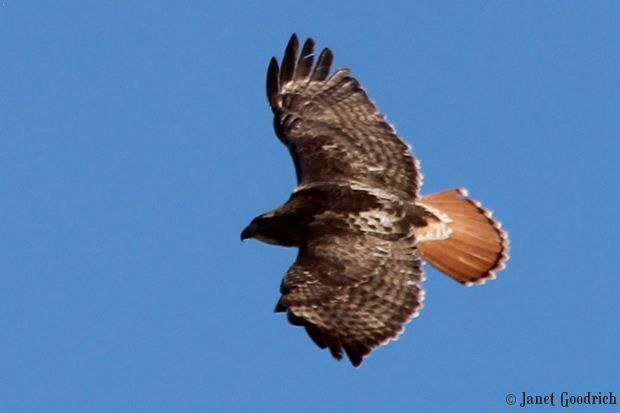

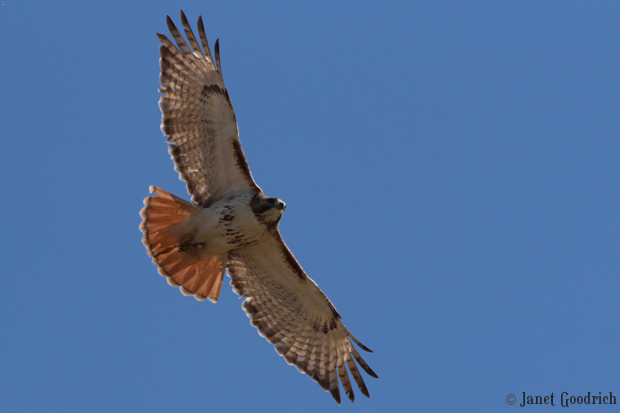
He seemed to consider for a few moments. Then he took off and sailed into the blue. He was aware of us but didn’t appear to be threatened at all.

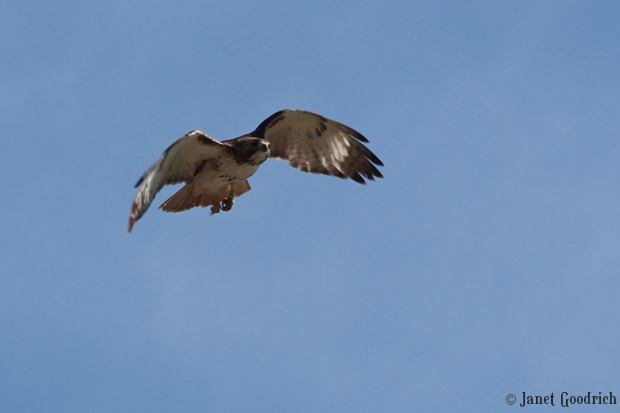
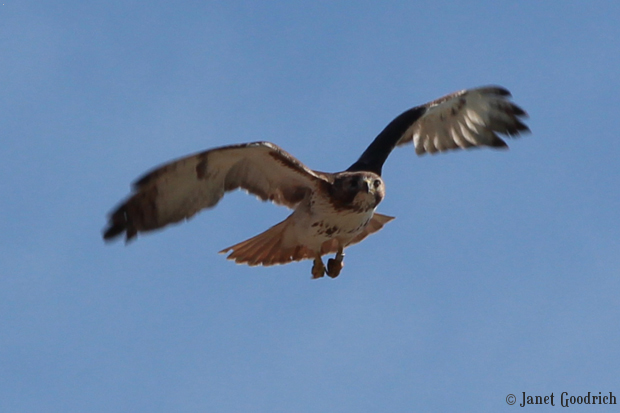
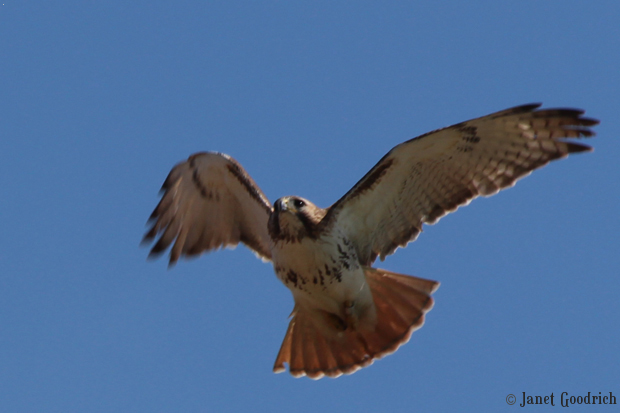
It’s strangely stirring to see a hawk taking flight. Science can answer so many questions, but not all of them. In the end we’re one species observing another, separated by a gulf of differentness, but joined by a kind of respect and wonder in watching the strength and grace of that spiral into the sky.
-
Sample Post
Brand new post…