-
Celebrity Herons
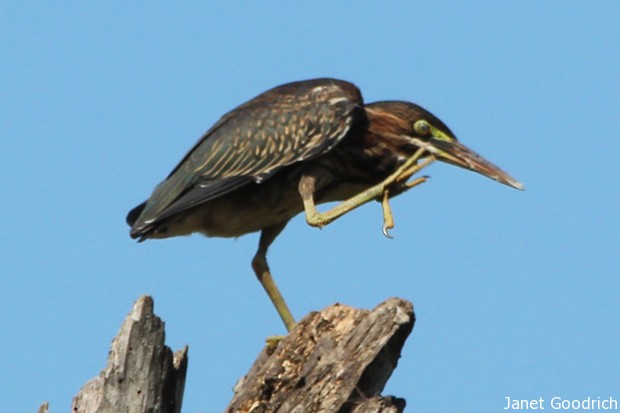
We went to Sapsucker Woods the other day and saw the bowl-full-of teenagers (a.k.a. herons’ nest) chatting and looking around out in the pond.
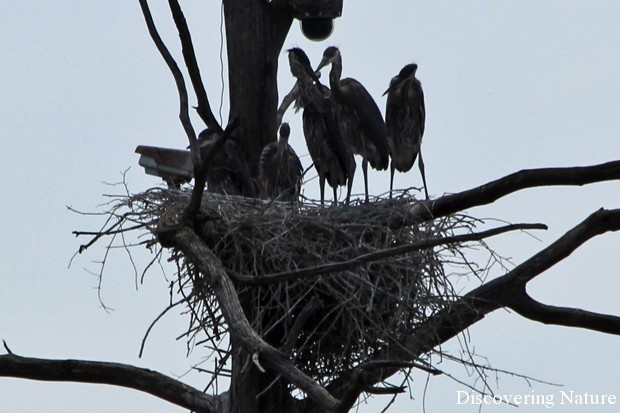
Then we noticed what they were viewing from their balcony seats. Down in the pond, one of the adult herons looked to the right…
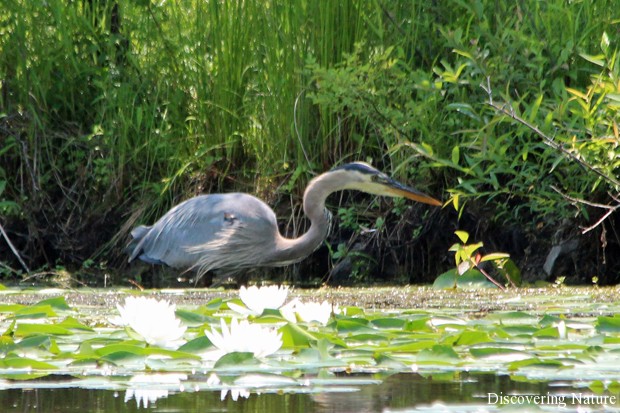
…and looked to the left…
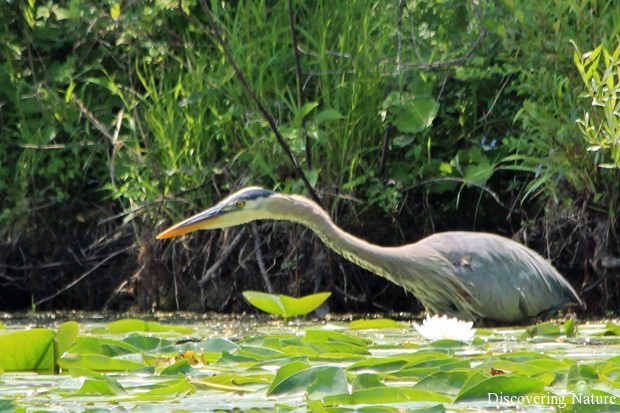
…and looked at us.
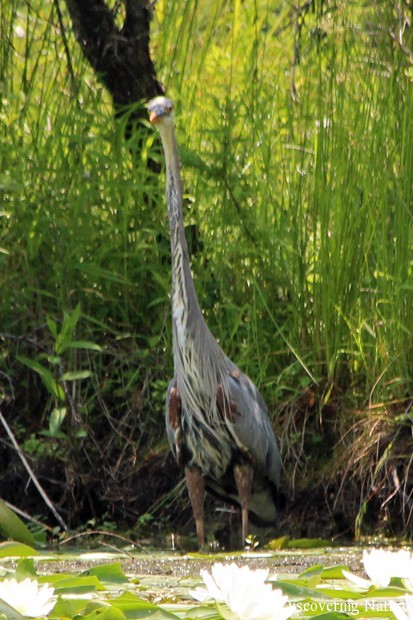
"Oh goody. Another photographer." So very patient. We waited and watched and were eventually reminded that all things come to those who wait.
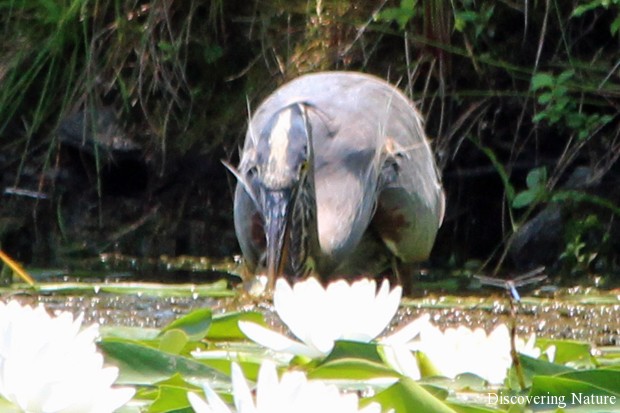
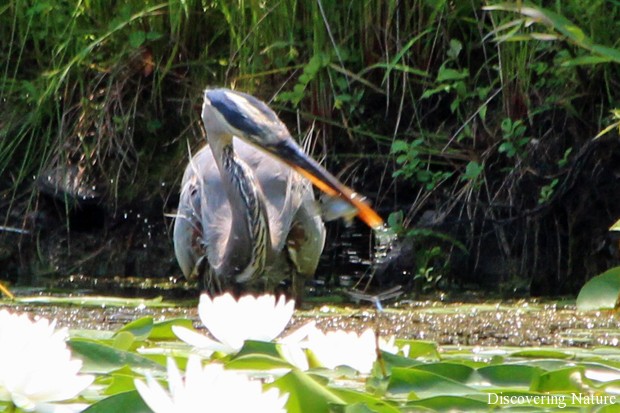
In addition to its children watching from the nest, there is a dragonfly watching the whole show in the right foreground. Someone else was watching, too.
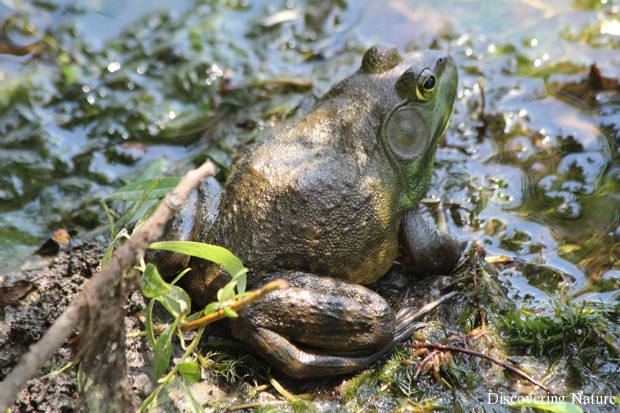
Who was in his turn being observed by others…
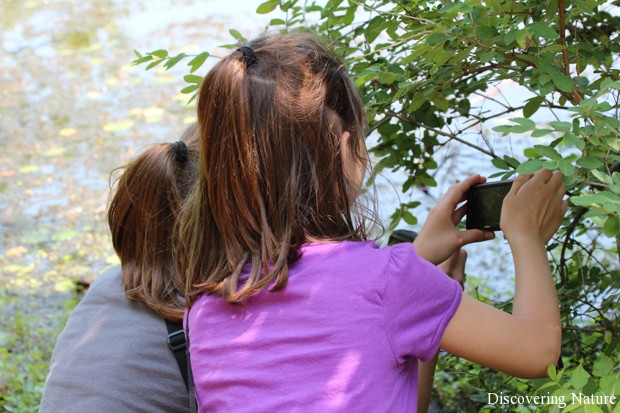
Frog Paparazzi One of the funniest things I saw was a frog literally racing across the lily pads directly in front of the hunting heron. I saw at least two frogs do this. Were they adolescents daring one another to ring the doorbell of their grumpy neighbor? The stakes were pretty high for the frogs! But apparently the heron had an appetite for fish.
While watching the heron, several different dragonflies demanded our attention as well. There were this one,
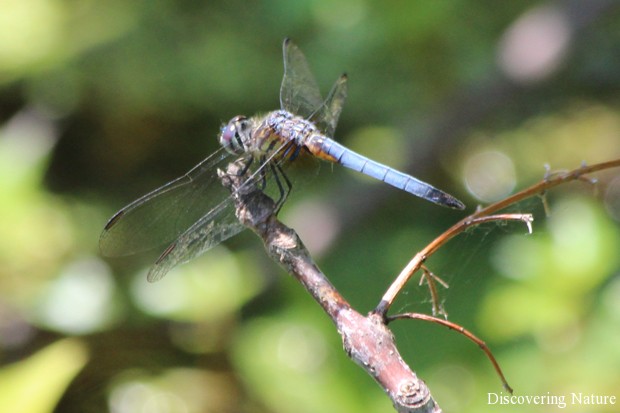
this one,

this one,
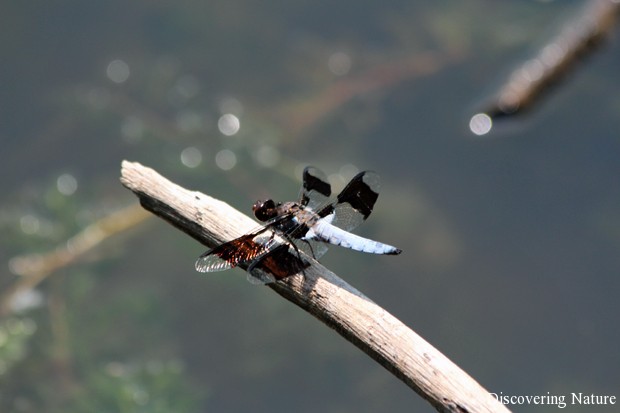
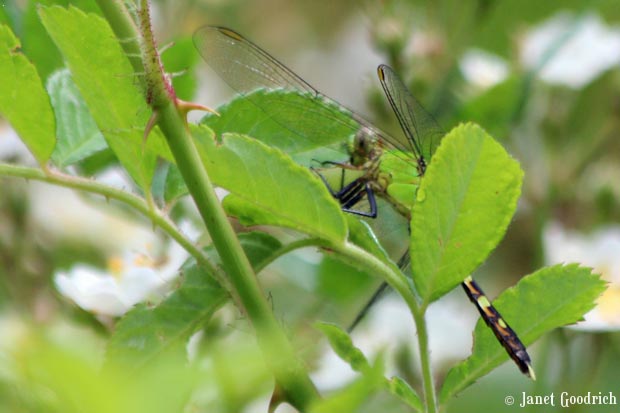
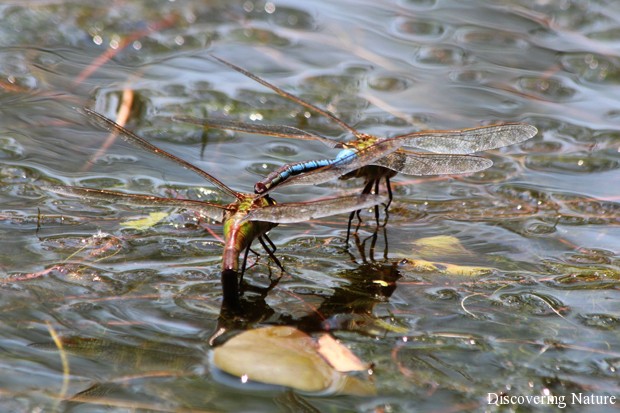
and these two shameless exhibitionists. The female is laying eggs, we guessed.
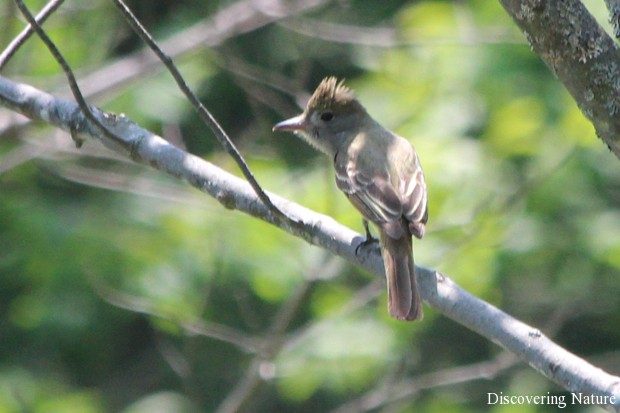
We heard many more birds than we saw. But this is a new one for me, a great crested flycatcher.
The other new sighting for me was a pair of American redstarts. I’ve seen the male before, but not the female.
We were very hot by the time our stroll ended, so we ate the lunch we’d brought and drank gallons of water before heading back home. Older Daughter enjoyed the heron fishing the most, Younger Daughter liked the frogs, and I liked the redstarts. So there was something for everyone and more besides — as usual!
-
Serenity Wood
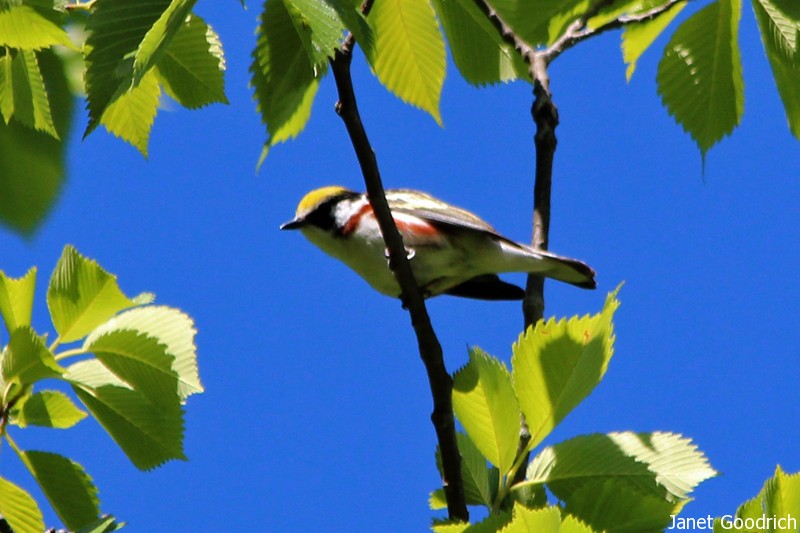
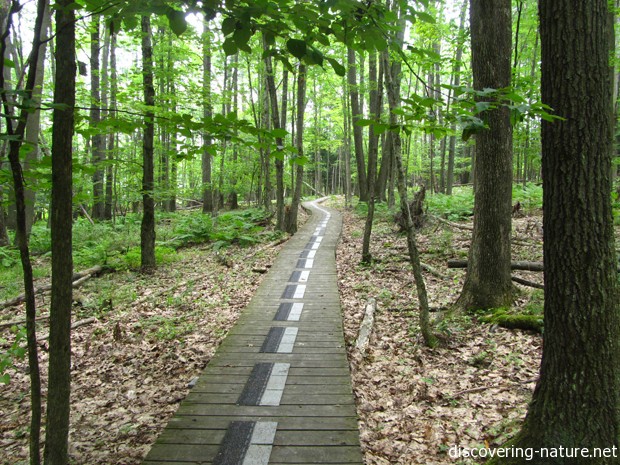
I took a walk today in a favorite place called the Serenity Wood. It was very hot, and I saw many things as I explored woods and meadows: yellow-throats, house wrens, an eastern towhee, a Baltimore oriole. There were deer tracks, coyote tracks, and raccoon tracks in the mud. Robins and sparrows and yellow warblers and chestnut-sided warblers hopped among the leaves. And there were catbirds — always catbirds.

I heard a brown thrasher at one point, and later on I thought this bird, startled up out of the grass beside the trail, was a thrasher. But it was quiet, and it had a shorter tail. I think it was a wood thrush, nesting in the grass. I was delighted to make her acquaintance!
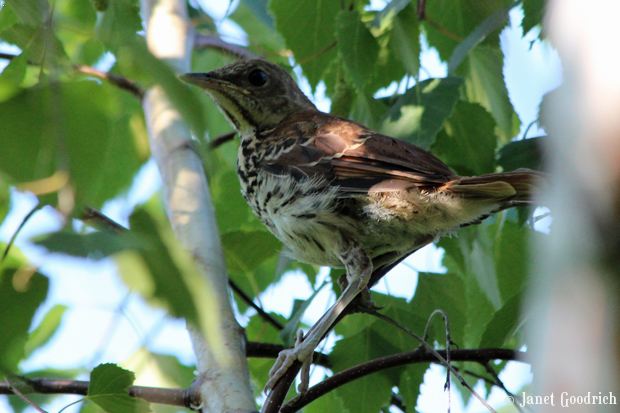
*Edited to add: I’m thinking it may be more likely that this is a hermit thrush, because of the striping on the throat. Very pleased to meet this beautiful songster!
This tiny pearl crescent butterfly was a welcome sight too. Exquisite.

Not everyone is so picturesque, of course. And though the woods were full of noise — squeaking chipmunks, an ovenbird, red-eyed vireos, rustling leaves — some were in a more quiet, meditative mood.

He owes me a smile for not stepping on him as he lay there in the middle of the trail. No gratitude. (It must be confessed: I like toads. As a child I would spend whole afternoons collecting them in coffee cans, then let them all go at the end of the day. I was certain they recognized me as their benefactress.)
I saw the fawn I had the close encounter with last week, too. It might have been a different one, but I prefer to think it’s the same one, developing on schedule. Unbeknownst to me, I was standing right next to it in the trail; it was in the long grass beside me. I didn’t realize it till I gave up on trying to take a picture of the towhee, and took a step. The little fawn thrashed to its feet and disappeared into the brush with a flick of its tail. I was glad… I want it to know enough to run from strange critters like humans.
It was a nice, leisurely walk — perfect outing for a Sunday afternoon.
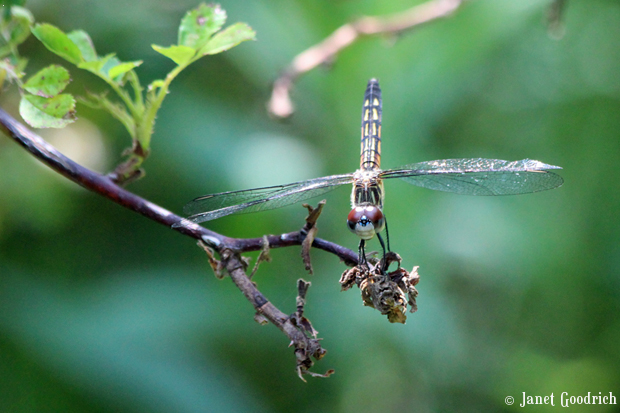
Yellow-striped hunter -
Mighty Mouse
On Tuesday we went to visit the site of a suspected red-bellied woodpecker nest cavity on one of our haunts. I wondered if we might see some nestling activity.
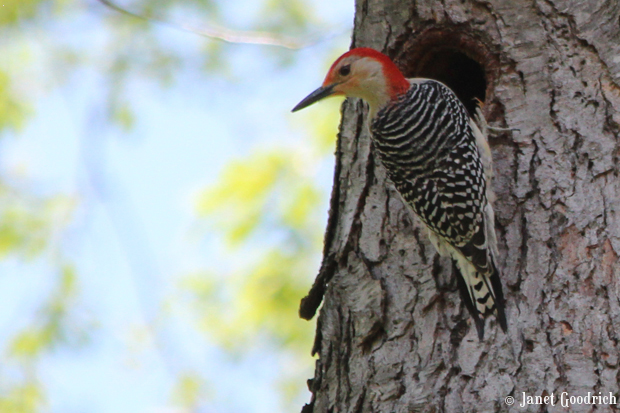
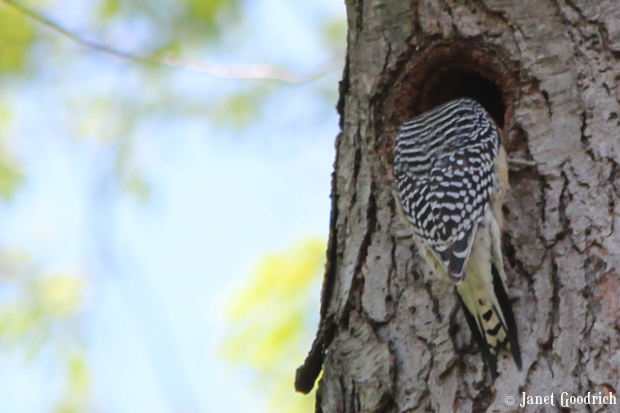
I took these pictures on May 11, and the bird appeared to be feeding young. We hadn’t been able to observe the site again, and I knew that by this time, there was a good chance that any possible woodpecker nestlings had fledged.
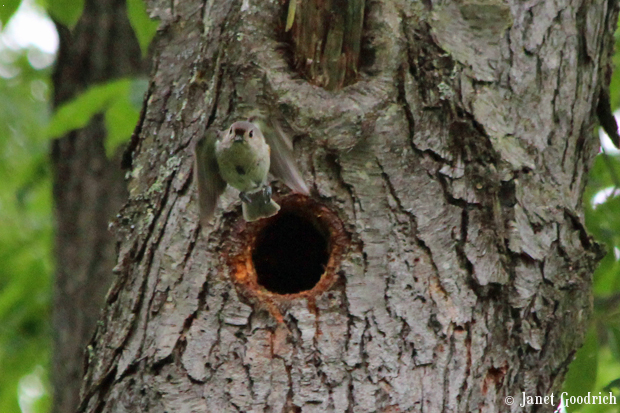
Turned out I was right. We saw nary a woodpecker… but this tufted titmouse came flying briskly out of the woodpecker hole!

I’m not sure if the titmouse is nesting in the woodpecker’s former home, or if it was just foraging for insects in there. We’ll have to check in again soon to see what we can find out.
It’s a brave looking little bird, isn’t it? — Looks like it feels ready for anything.
-
Red’s ledge

I wanted to share a few last photos of our Cornell trip yesterday.
Twice now, when we’ve visited the hawks, Red has spent some time perched on a ledge of the building across the street from the nest. She enjoyed the sun there yesterday before Chick 1 left the nest. Maybe it’s a sauna-type experience for her, surrounded by warm brick.
It’s not necessarily easy to see her there, though — till you step back a bit.
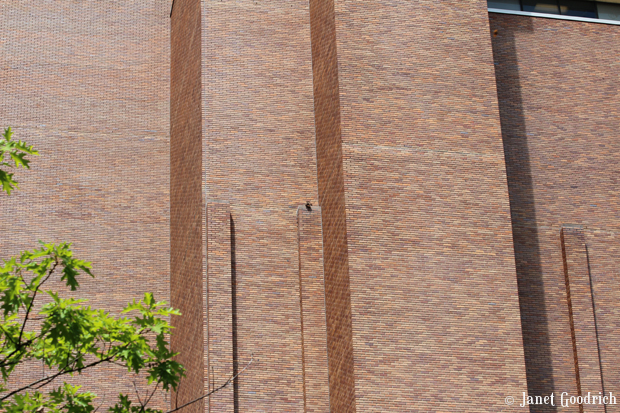
Find that hawk She is such an athlete. I love to see the power when she launches, unfurling all that energy and strength.
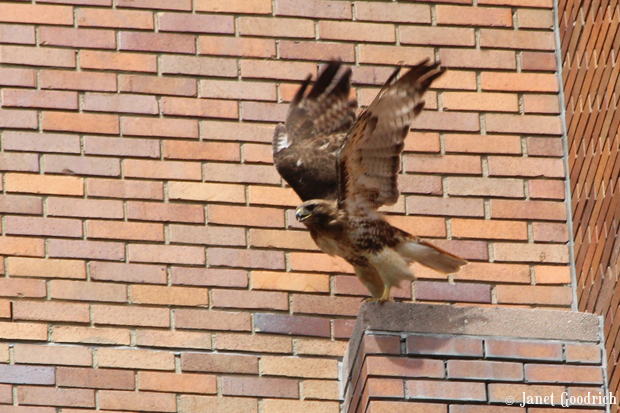
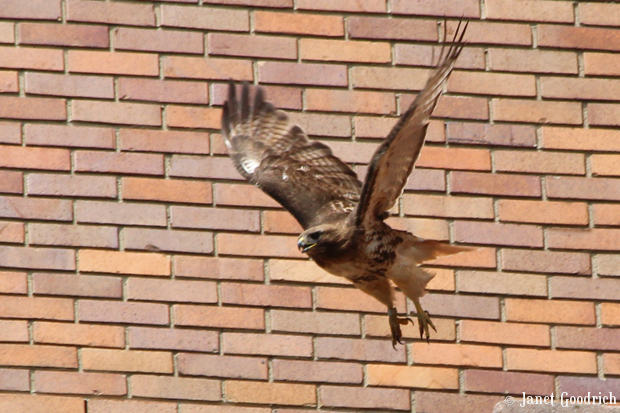
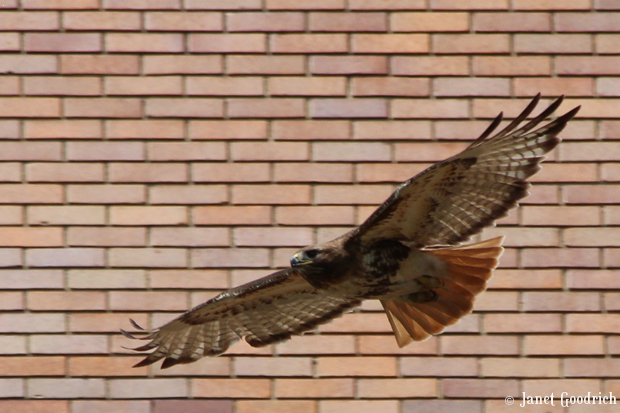
She sets a great example for young birds with much to learn about mastering the air. The hawk chicks watched as they practiced their own feats of daring.

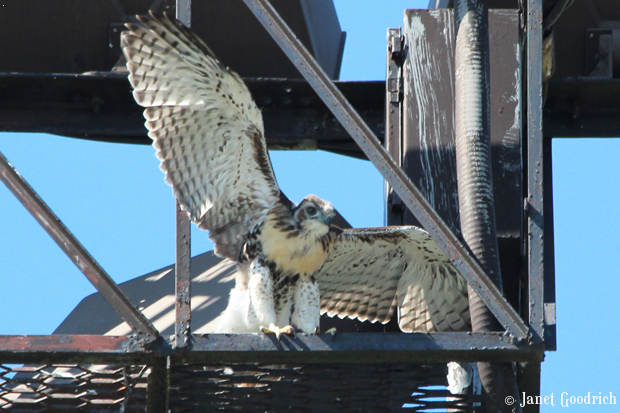
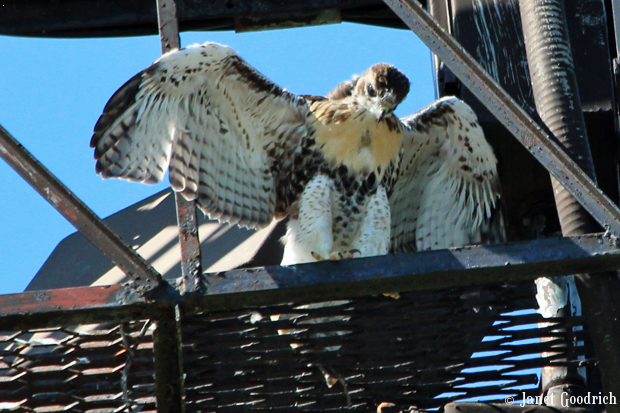
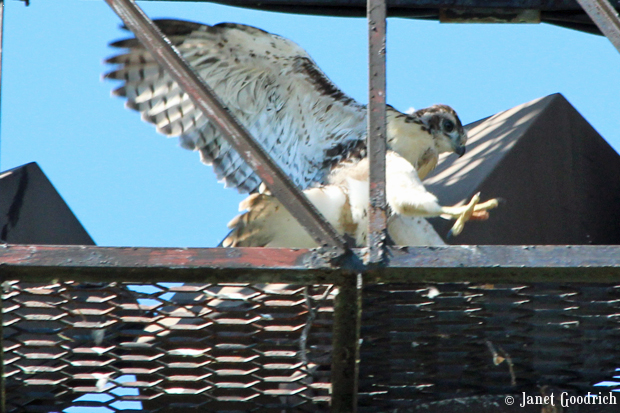
"Let the wild rumpus begin!" While two of the hawklets flapped and considered, the third power-lounged.
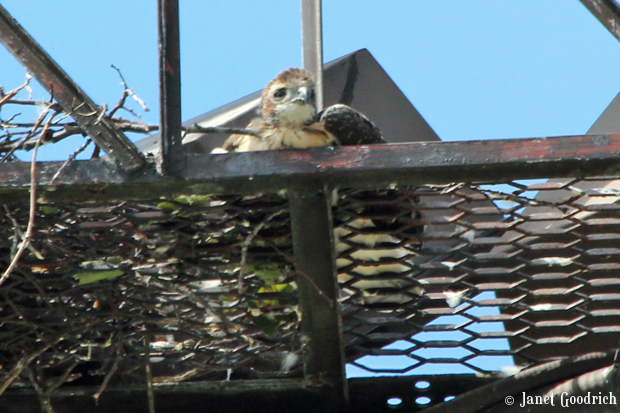

Yesterday as we drove home, I had the bittersweet awareness that we won’t be able to follow these young hawks much longer. I think it was a classic empty-nest feeling. Part of me is relieved that I won’t know all the scrapes they get into. But I’ll always wonder how they fared.
I hope that they find the wits and resourcefulness to rise to every challenge.
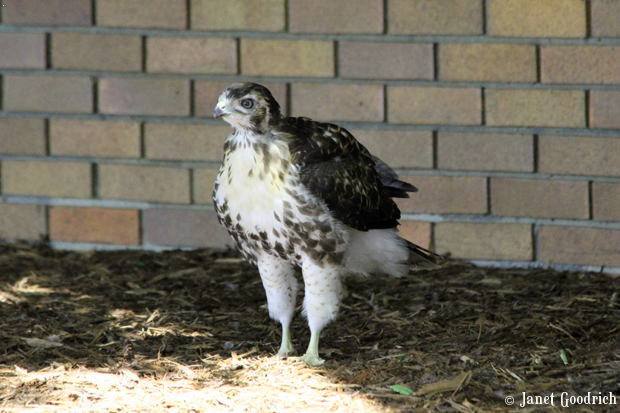
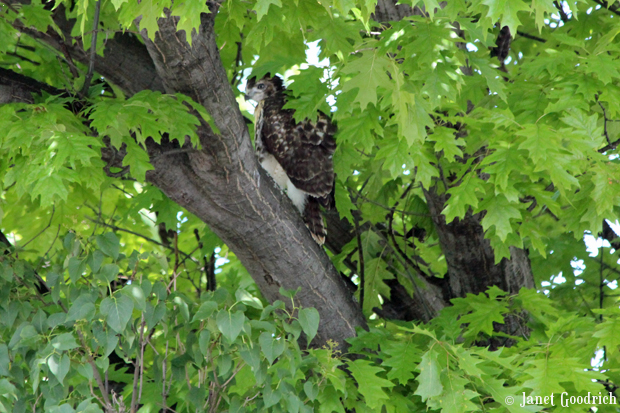
These hawks have parents who show them how it’s done with grace.
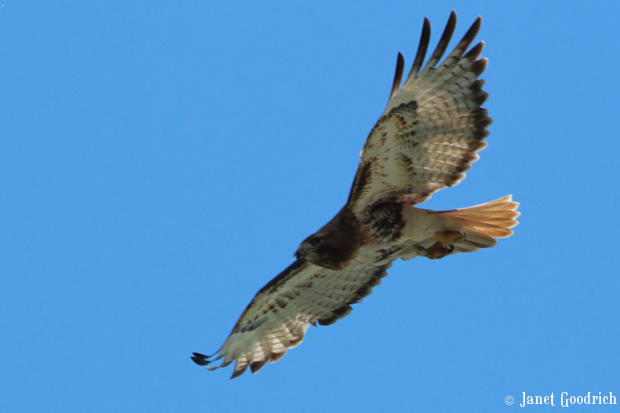
Big Red 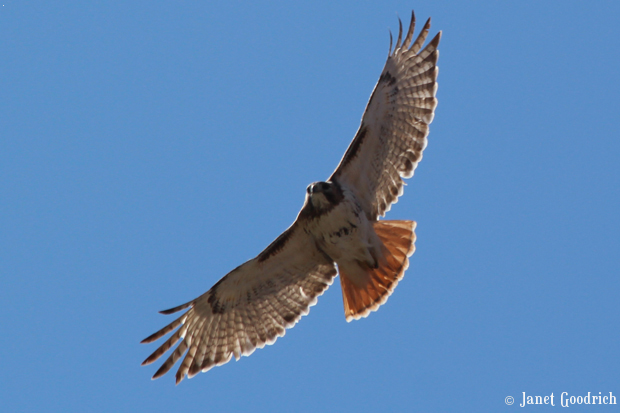
Ezra (photo from April 7) -
Fledge!
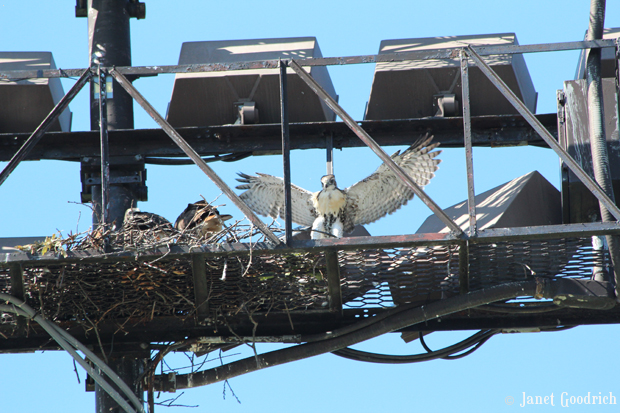
My daughters and I had a feeling today would be the day that one of the Cornell hawks would fledge. So capitalizing on the flexibility of schedule homeschooling gives us, we made the hour’s drive to Ithaca on this glorious sunny morning.
We were watching the cam when the first hawkling made its appearance after a spring snow. We’ve been watching the cam through numerous feeding and flapping sessions. But it was a thrill indeed to be there at the moment of the first fledge!
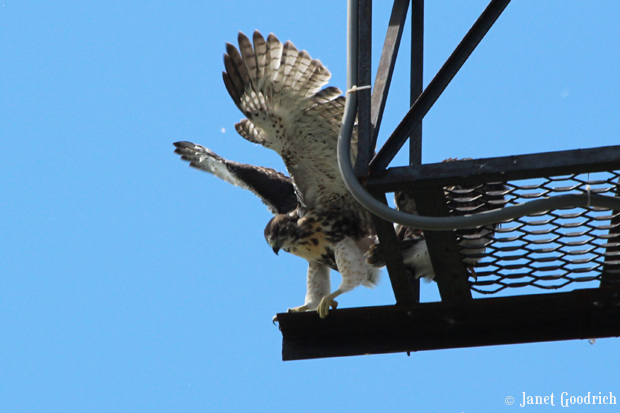
Hawkling on the landing, pumping its wings 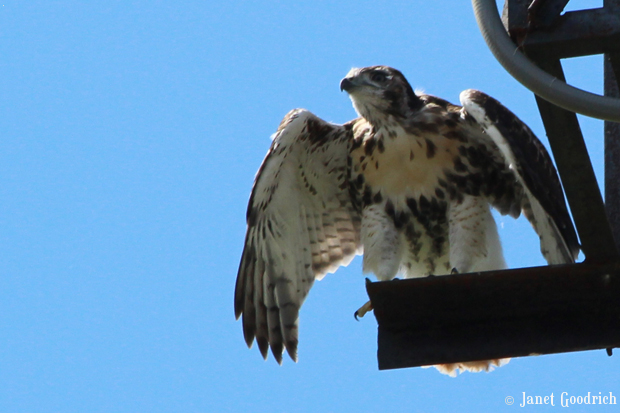
Getting ready to... 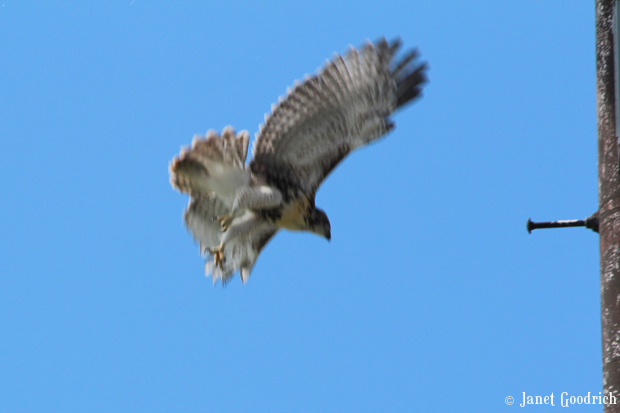
FLY! 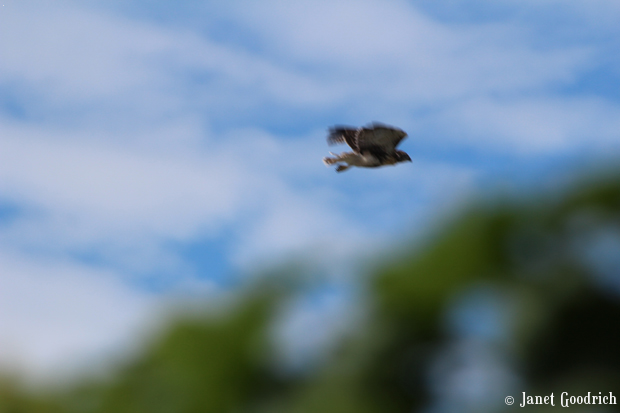
Into the wild blue yonder Where did it go? After an anxious search of nearby trees, a fellow hawk-watcher located the fledgling on the ground at a busy corner of the building across the street.
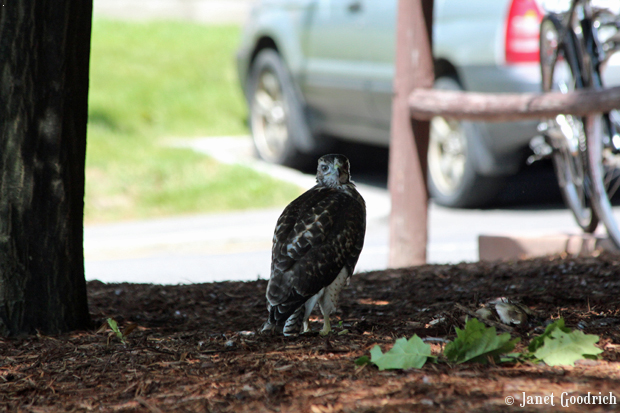
Feeling the ground for the first time 

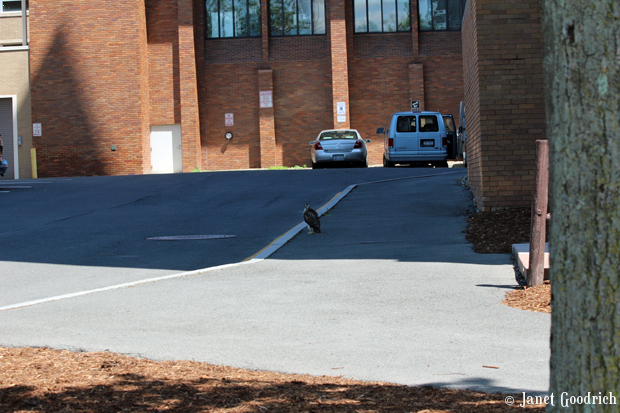
A crowd was congregating, and I was getting nervous. It’s an awfully busy spot for a young hawk. But the crowd served the purpose by alerting drivers to something unusual going on, and any cars that drew near slowed way down.
After perhaps ten minutes on the ground, the young hawk gathered its nerve and flew, screeching, across the street and into a small oak — where it landed upside-down and dangled for a minute. It was a tense moment, but eventually the fledgling righted itself.
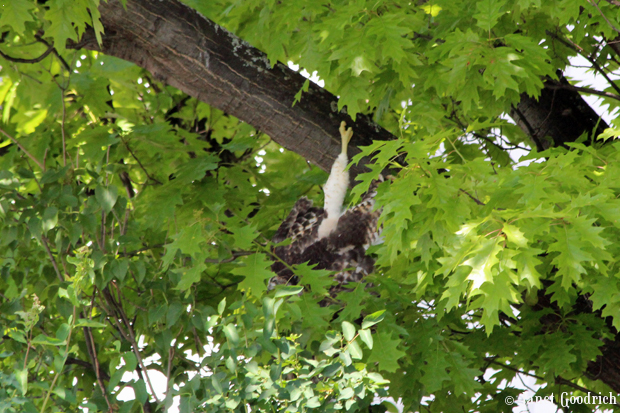
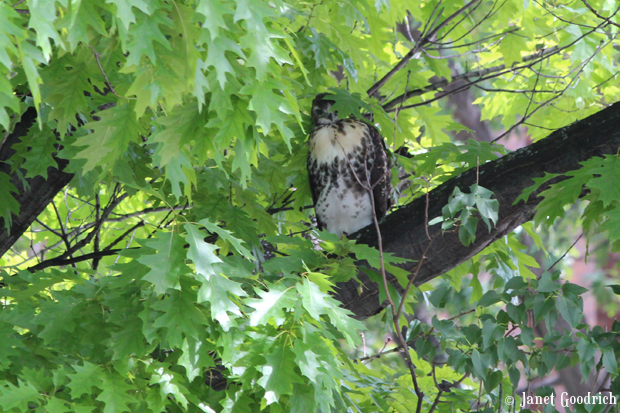
Red had flown over a few times, way up high. She was on a light pole across the fields when the youngster took flight. We left, hoping to give the bird some space to calm down and get reconnected to its parents. Ezra was on a roof nearby, preening, and I’m sure Red wasn’t far away. I got some great flight pics of her; I’ll post them tomorrow, as well as a few more of the chicks in the nest.
We’re grateful to Cornell for this experience! We’re wishing the young hawks well as they move into this next steep learning curve on their way to adulthood.
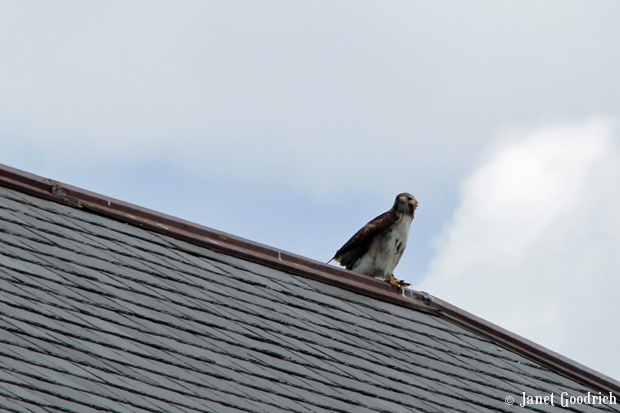
Ezra -
Why nature? Why now?
I have met with but one or two persons in the course of my life who understood the art of Walking, that is, of taking walks, who had a genius, so to speak, for sauntering; which word is beautifully derived “from idle people who roved about the country, in the middle ages, and asked charity, under pretence of going à la sainte terre” — to the holy land, till the children exclaimed, “There goes a sainte-terrer“, a saunterer — a holy-lander. They who never go to the holy land in their walks, as they pretend, are indeed mere idlers and vagabonds, but they who do go there are saunterers in the good sense, such as I mean. Some, however, would derive the word from sans terre, without land or a home, which, therefore, in the good sense, will mean, having no particular home, but equally at home everywhere. For this is the secret of successful sauntering. He who sits still in a house all the time may be the greatest vagrant of all, but the Saunterer, in the good sense, is no more vagrant than the meandering river, which is all the while sedulously seeking the shortest course to the sea. But I prefer the first, which indeed is the most probable derivation. For every walk is a sort of crusade, preached by some Peter the Hermit in us, to go forth and reconquer this holy land from the hands of the Infidels. (Thoreau, “Walking”)
 Why have I turned so intensely to nature study this year?
I go for walks to drink in the beauty of sight and sound. (I’d say smell, but I don’t have much of a sense of smell. I can smell cookies baking, chicken in the oven, skunk. Most other odors are lost on me.)
I go for walks like a drug addict. There is something saving about it that doesn’t get old.
I go for walks because those times seem like the most real experiences of my life. There is nothing of the monotonous hum of technology about it. I confess to a loneliness these days, a loneliness that corresponds to the increasing presence of technology, even in our relationships. Wendell Berry writes in Remembering about a man who has lost a hand to a threshing machine. His point of contact with the world is no longer flesh-and-blood, but mechanized, and the coldness of it creeps toward his heart. It was written in 1988, but it seems prophetic as a picture of modern relationships — to the earth, the each other, to our own souls.
 I wonder sometimes how my children’s experience differs from my own as a child. Once recently, when my computer chimed that I had gotten an email, I remarked absently that there was no email when I was a child. “Really?” both girls asked in unison.
Startled, I looked at them. “Really,” I said. “My mom never checked email when I was growing up. There was no texting either. No cell phones. When Daddy and I got married, Grandma and Grandpa had a cell phone, but you had to pull over and put the antenna on the roof for it to work.”
Wide-eyed fascination from the girls.
“If someone called you, and you weren’t home, they just had to wait and try again later. Then they invented answering machines, and people could leave a message asking you to call them back. If a friend called me, I might not be the one who answered. They would have to say, ‘Hello, this is Christina. Is Janet there?’ And whoever would answer the phone might say, ‘Yes, just a minute,’ or ‘No, she’s not.’ Now people can call each other all the time.”
 I stopped and thought, this is progress?
Thoreau was not the first nature writer, but he is a watershed of sorts, the one after whom so many of his successors have modelled themselves. I’ve been aware of Thoreau for years, yet only now am I recognizing that in many ways he speaks for me. It was Thoreau who said, “I went to the woods because I wished to live deliberately.” I go for similar reasons. It seems more real than the insulated world of scheduled activity and technological efficiency — neither of which offer much real connection. Linked with the escape into the woods is family connection, since my daughters, and my husband when he’s able, often accompany me. It’s good all around.
Sometimes, we come across other people there — other saunterers, as Thoreau would call them: photographers, birders, college students, people old and young. I’ve enjoyed the conversations that have emerged in these places. Mostly we talk about the walk we’re on: “Seen anything?” they’ll ask. Or I will. And we compare notes. Once, as the girls and I watched in delight as a muskrat swam beneath us, a college student came to see what we were looking at. “I’ve never seen that before,” he said in wonder. I’ve gotten photography advice from camera-bearers I’ve encountered on walks, as well as testimony of the wonders of particular trails. Recently I saw a yellow-headed blackbird, a western bird defending territory far off course here in the Northeast, because of a chance encounter with another birder along the trail. Going to the place he had described to see the bird, I met another walker who invited the girls and me to come to their naturalist club’s guided birdsong walks on Saturdays. It was a string of positive encounters.
 But even alone, it is a restorative experience to go for a walk. The natural setting is inexhaustibly interesting. So many sounds. So many movements and colors. None of them depend on me; but if I am quiet and nonthreatening, I can have a place there, witnessing the life and death stories unfolding all around me. It’s humbling to recognize all that is going on there. And it’s a disburdening of the self, an exit from the interior world through the doorway of the observing eye. I don’t really think about myself or my problems; I just look and listen.
Thoreau says something similar in “Walking”:
I am alarmed when it happens that I have walked a mile into the woods bodily, without getting there in spirit. In my afternoon walk I would fain forget all my morning occupations, and my obligations to society. But it sometimes happens that I cannot easily shake off the village. The thought of some work will run in my head, and I am not where my body is; I am out of my senses. In my walks I would fain return to my senses. What business have I in the woods, if I am thinking of something out of the woods?
 I don’t know what neat conclusion I can come to here, except to return to my original question: why such a keen interest in nature these days? Because it’s one of the few places in my life that seem (here comes the word again) real, and we are made for the real. Other settings seem to be mostly blather and abstraction. But nature is spinning out its myriad activities and relationships all the time, and we can see some of it happening if we want to. I can’t really say it better than that.
Maybe finding a better way to say it is one of the reasons I started this blog.
-
Morning magic
This morning I took an early morning walk in the woods. The air was alive with birdsong, and at one point I found myself lured up a trail by the voice of a brown thrasher. This is a bird I’ve just started noticing this year, and its unbroken chatter always makes me smile. It’s the first bird that’s ever tempted me to use the word “loquacious.”
I never did get my eye on the thrasher. But as I neared a bend in the trail, I heard a sudden, panicked snort, followed by thudding and swishing bushes. I’d started a deer.
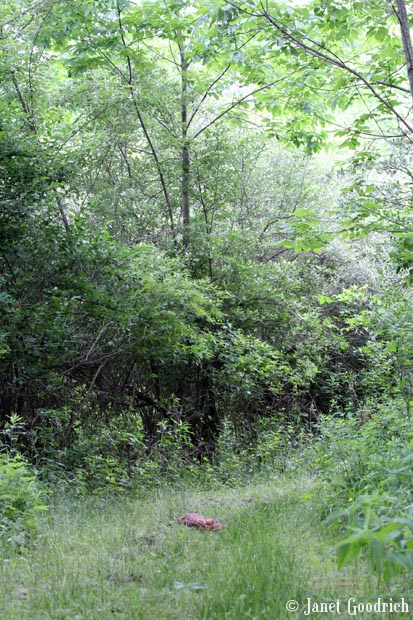
Rounding the bend, I saw something that startled me: something brown and flattened-looking in the trail. A few steps closer, I saw spots. A fawn. It lay at an awkward angle, and I assumed it was dead. Wondering if I’d interrupted a coyote just starting its breakfast, I reached for my Mace (always carried, never used) and considered turning around. But what if it was not dead, only injured? I couldn’t walk away till I made sure.
A little closer, and I saw that it was breathing.
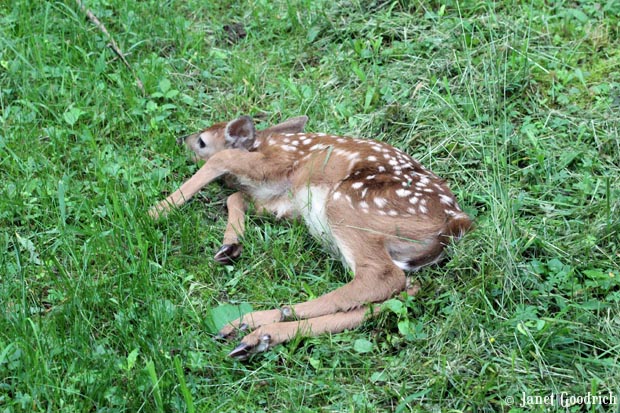
I remembered the stories I’d heard about fawns so conditioned to lie still where their mothers left them that they wouldn’t move out of the path of an oncoming combine. Horrible. Yet if these stories were true, it was no real wonder that the fawn didn’t move when I approached. I walked carefully past it, thinking the gentlest and most encouraging thoughts I could, and resisting the temptation to stroke its head. It remained motionless the whole time.
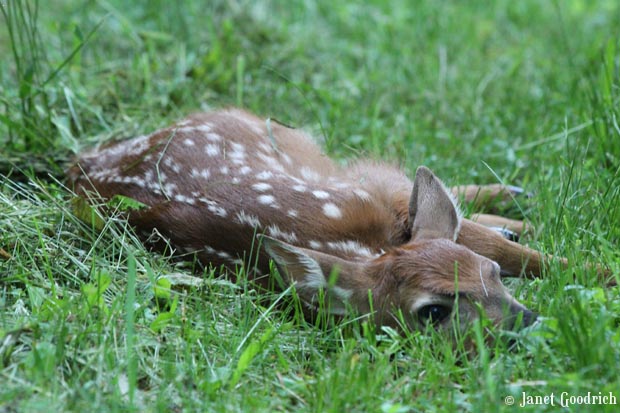
Using a zoom here -- I wasn't sticking my camera right under the little creature's nose. No word seems right to describe the experience.
Later, I read what I could find about white-tailed deer and their fawns (here and here, for starters). I felt reassured that this little fawn was just doing what white-tails do, right down to its awkward position in the grass. I read that the does leave their new fawns in places with low vegetation, and there they lie, heads flattened down as much as possible. The youngest ones remain motionless even when another animal comes close. If there are two or three fawns, the doe will hide them in separate places.
This morning, with only the combine stories in mind to support the notion that the fawn was behaving normally, I walked on down the trail and then waited a minute to see if the doe returned. She had made a wide circle, and through the brush on the other side of the trail from where she’d run away, she came haltingly.
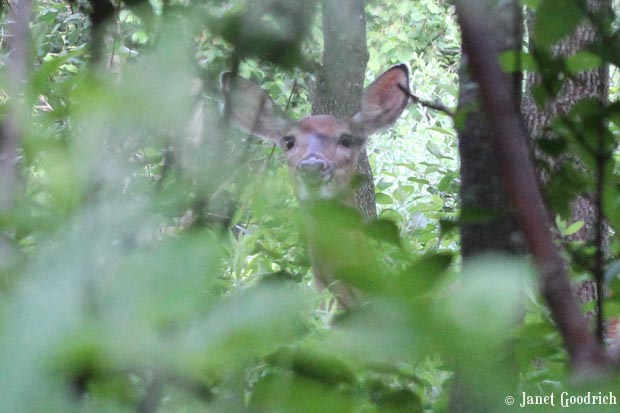
That’s her, flaring her nostrils in another loud snort of alarm at the sight of me. Not wanting to bother this little family unit any further, I headed off.
I couldn’t help but notice the music coming from the surrounding woods. As a lullaby for a young deer, it was superior to any mobile I ever found for my daughters. I recorded a few of the songs, and the sound quality is all right though my video skills are dismal. (I wish I knew how to record sound without video.)
There was the thrasher, who continued endlessly with his one-sided conversation.
Somewhere, a veery sang — a bird I’ve never seen, but whose song I’ve come to recognize. To me, it’s a sound that belongs to secluded places.
And a thrush — I think a hermit thrush, but maybe a wood thrush — sang its lonesome and lovely song. At around the halfway point, the snorts of another startled deer (or two) that had spotted me can be heard.
There were other sights and sounds too, but the fawn was the highlight. One source I looked at said that fawns who survive their first week of life stand a good chance. I’m pulling for you, little one.
-
Flyaway
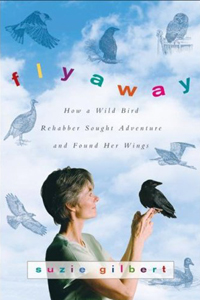 It’s not often that I laugh out loud while reading — laugh till tears trickle down my cheeks and my daughters get out of bed to find out what’s so funny.
It’s only slightly more common that a book moves me deeply enough to call out tears of the other kind. Reading is such an inward act, and the processing happens at such a slow pace, that my emotions seem to absorb and adjust without working their way out to the surface like this. As a Reading Action Figure, I’m normally a silent shape on the couch, eyes on the page, emitting a rustle every now and then when I shift position or turn a page.
A book that makes me both laugh and cry? Rare indeed. But Flyaway: How a Wild Bird Rehabber Sought Adventure and Found Her Wings does. Suzie Gilbert’s writing is lively, honest, and funny enough to prompt me to read sections aloud to my family. “Any new stories?” they would ask when they caught me reading. I could always comply. Her take on the animals she cares for, her insight into their personalities, and her frankness about her own struggles and adventures and passions along the way all make for a fascinating and often comical story.
But there is grief too: birds who don’t survive, exhaustion and difficulty balancing the demands of rehabbing and the rest of life, the perpetual tension of loving creatures enough to nurse them back to health only to release them and perhaps never see them again. Underlying it all is the awareness of the challenges and tragedies birds face, many of them a result of human activity. At times, Gilbert only resolves these tensions in her dreams, beautiful poetic visions of injured creatures flying strong and free. But the majority of the book traces her quest toward workable limits within which to engage in her passion to help wildlife without burning out or shortchanging her family.
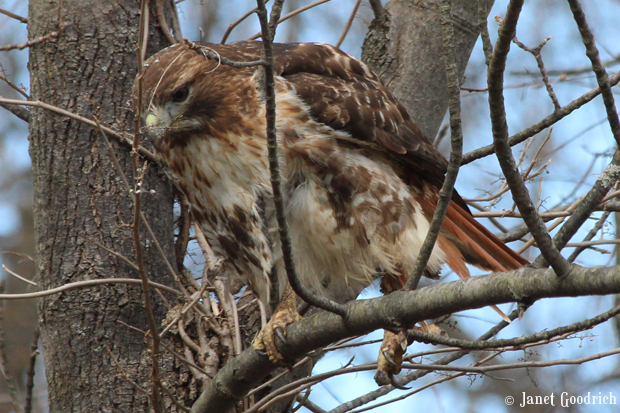
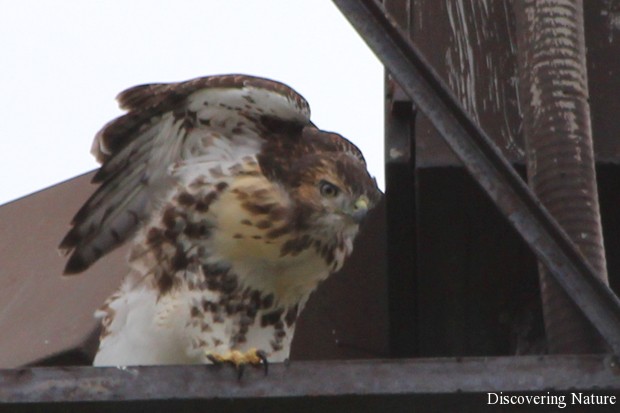
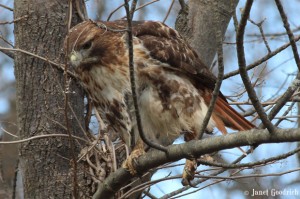 I’ve been interested in the world of bird rehabilitation since seeing this injured hawk at a popular local walking trail back in April. A mature redtail, he could still fly, though he was propping himself up in his perch with a mesh of twigs and when he took off we could see that one leg was dangling. I called a rehabber and was told that until the bird was grounded, he couldn’t pick it up. “But keep looking for it,” he advised. “Keep your eyes open.”
We did. And we saw the hawk twice more, but that was it. What became of it? Did it have a nest somewhere with eggs, or nestlings? It has continued to bother me when I think of the hawk, suffering but unreachable.
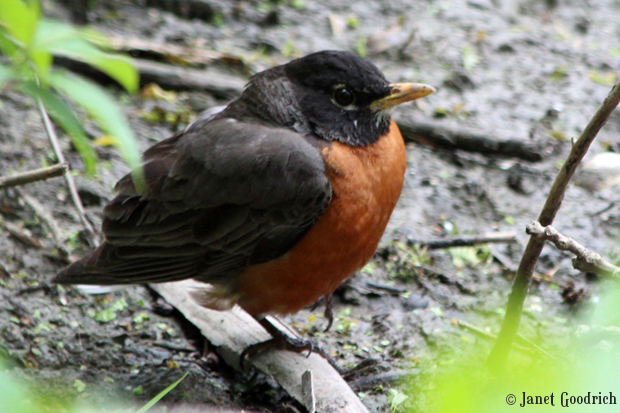
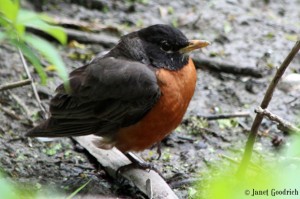 More recently, the girls and I came across a tailless robin and assumed it had lost its tail to a predator. Very likely it was someone’s outdoor cat — a subject Gilbert addresses strongly in Flyaway. I felt I had a kindred spirit as I read, because cats roaming through our yard have always infuriated me. We don’t have a cat, and don’t want one in our yard, prowling for birds and chipmunks. If you are a cat-lover, I support you wholeheartedly in it — as long as you keep your cat on your own property, as I do my dog.
But I digress. Back to the robin, about whom we called the same rehabber. He gave us the number of a woman who cares for injured songbirds and advised us to catch it and put it in a warm dark box will we could get it to her. “Throw some worms in there with it,” he recommended. “Good luck.”
We couldn’t catch it. It mustered enough flight power to motor to a willow branch that had broken and was leaning its base against the trunk and its end plunged into the pond a ways out. There the bird hopped unsteadily up to the trunk and out of reach. It had a robin friend (mate?) nearby with whom it discussed us indignantly, and waited us out.
So far, I’m a failure as a bird rescuer. Before reading this book, I felt sure I’d be a failure as a bird rehabber. I still think I would be. The knowledge required, as well as the plain courage and heart, are incredible. There are so many kinds of birds, and so many kinds of injuries. Suzie Gilbert and her network of wildlife rehabilitators are among the most enlightened generalists out there. I have enormous respect for them. And though the idea of joining that community is daunting, the idea of volunteering time and support seems like a possibility.
Suzie Gilbert’s website is here, and the children’s book Hawk Hill, our first introduction to her writing, is here. Both are worth checking out, as is Flyaway, an eloquent story about the perils and rewards of caring for living things.
-
Phlox Feast
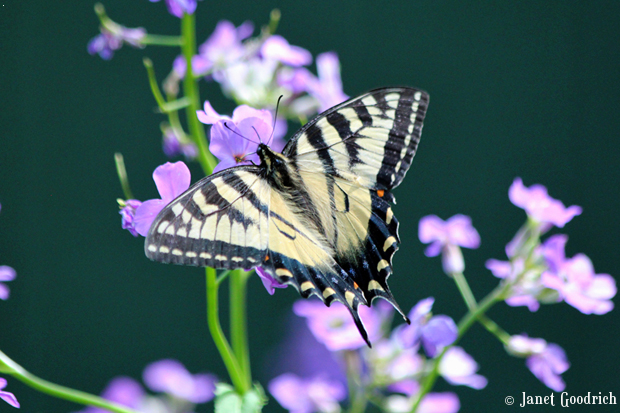
Yesterday at my parents’ house, the Eastern tiger swallowtail butterflies were having a convention. It seemed like every breeze carried in a few of these air-sailors. They were enjoying the phlox growing at the edges of the yard.

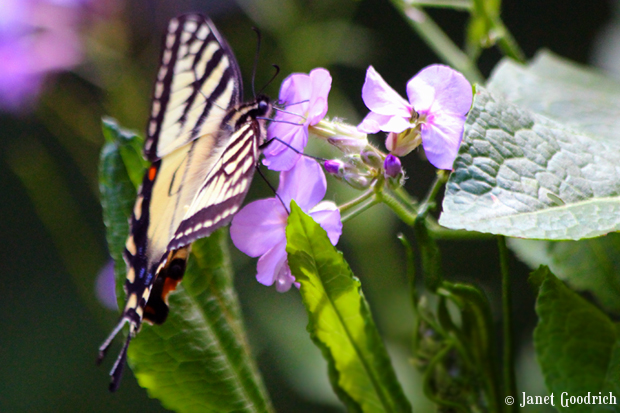
When I walked over to snap a few pictures, I discovered several smaller butterflies floating around like confetti.
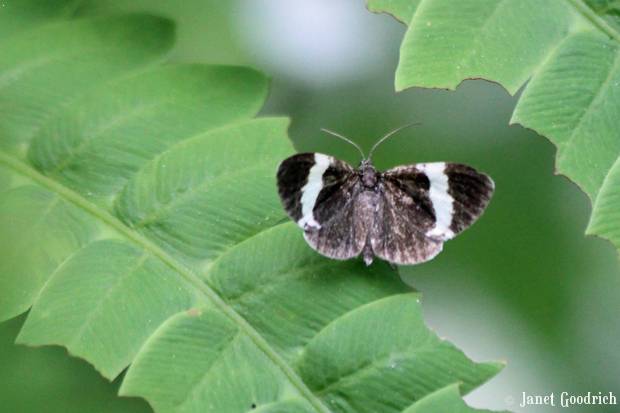
White-striped black moth 
Little wood satyr 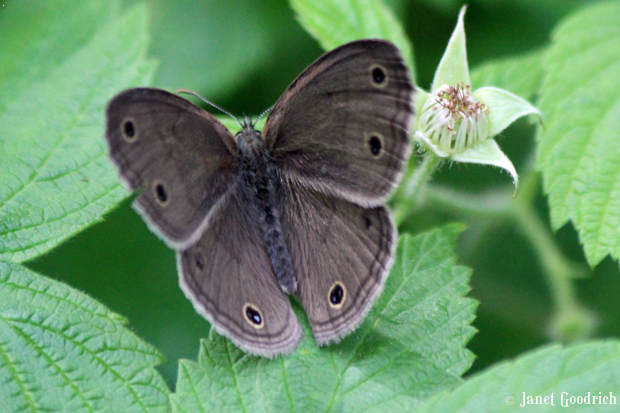
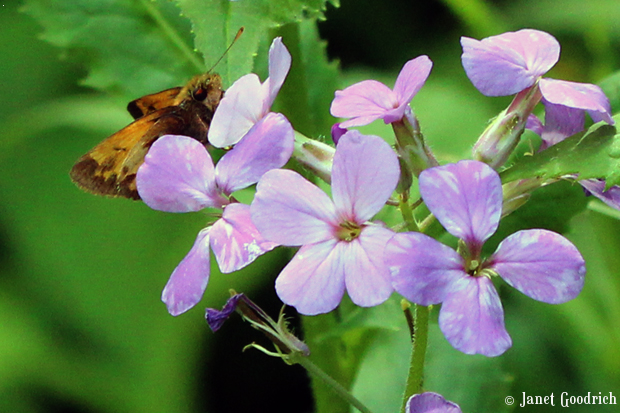
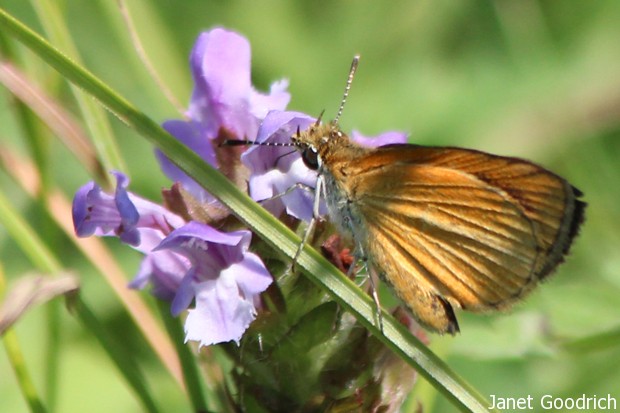
A skipper of some kind... I wish I’d been there a few nights earlier, when Dad had seen a luna moth. Someday.
-
Outdoor Hour Challenge: Pileated Woodpeckers
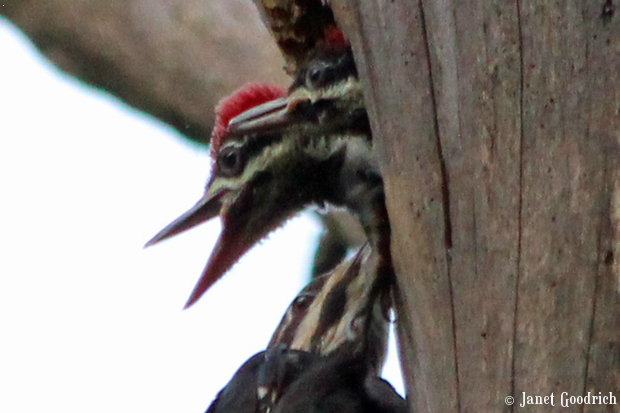
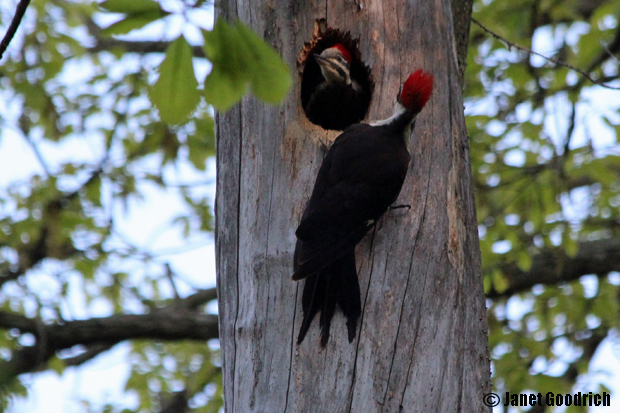
Back in mid-April, my daughters and I stumbled upon a pileated woodpecker nest on one of our walks in the woods. We noticed not one, but two adult birds on a dead tree. The female flew away; the male went inside.
When we went past the spot in subsequent weeks, it seemed like nothing was going on there. But more recently it has become apparent that it was — and is — an active nest after all.

This is the female woodpecker, nearly as large as a crow, preparing to feed. The youngsters are a male (with the red sideburns), and a female (with black sideburns).

The male adult has more red overall — a red crest that reaches all the way down his forehead, and red sideburns.
 I’ve posted some pictures of feeding here, and of a nest exchange here.
The girls and I compiled a list of the most interesting things we’ve learned about pileateds:
- Their tongues coil all the way around their skulls and are long, sharp spears with backward-facing barbs that can be extended and retracted.
- Zygodactylus feet — two toes face forward, two face backward. (A fun new word to pull out from time to time!)
- The nestlings’ solid waste is in small packets that the parent birds carry away. (I witnessed this one morning after a feeding.)
- They are “forest engineers,” excavating cavities that other birds and mammals use for their homes.
- Their call sounds like the wilderness. One of their nicknames among the early settlers was “the laughing woodpecker,” and they do have an wild-sounding laugh — it makes me think of Bertha Rochester in the attic (Jane Eyre).
- A normal clutch is four eggs.
- The parents feed by regurgitating from their crops directly into the eager beaks of their young.
- The male ends up doing the majority of the incubating.
- They have sleeping cavities in trees, and often these holes have escape routes.
- One of their main foods is carpenter ants.
Though my reflex is to think of them as wilderness birds, they have adapted quite well to human “landscape engineering.” I know of three pairs nearby, so I guess this provides some anecdotal evidence. They’re often compared to ivory-billed woodpeckers, which have fared very differently and are now, probably, extinct.
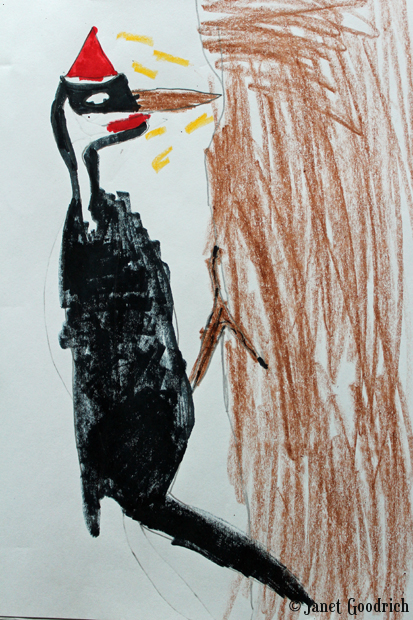
8-year-old's drawing 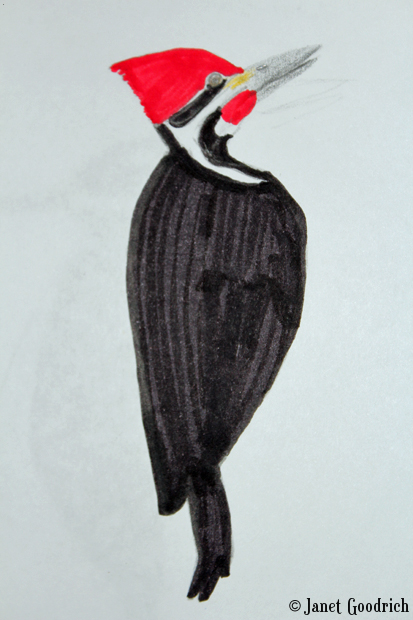
11-year-old's drawing Our favorite resources, in addition to observation, have been this website and several books, of which this one has been the most complete.
I remember hearing a pileated woodpecker while riding my bike a year ago, and working hard to get my first picture of one. It was far away and a little blurry, but I was completely thrilled. I never would have guessed the sights we had in store for us this year. If the trees had been fully leafed-out, we probably wouldn’t have seen this pair that day in April. And though the young make quite a racket begging for food when their parents are near, we might chalk the strange sound up to something else if we didn’t know the source. It’s been a good reminder for us to keep an open mind and alert senses in the woods.
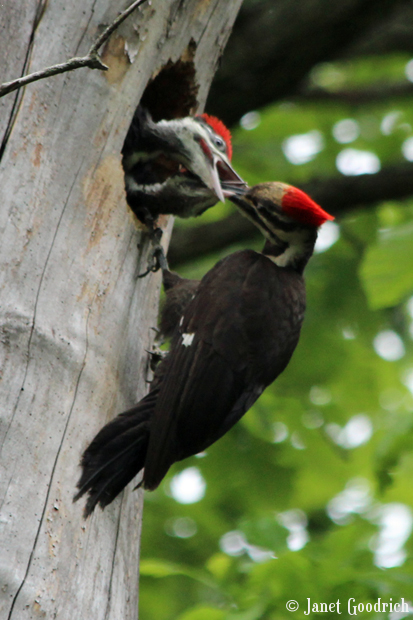
Feeding can be a hazardous occupation... I’m submitting this post to the Outdoor Hour Challenge, a great round-up of nature-study postings each month.